Not one person in my family showed up while my six-year-old son underwent nine hours of heart surgery. Three days later, Mom texted: “I need $10,000 for your sister’s wedding dress.” I sent her $1 with just one message. The next morning, my bank manager called: “Your parents are here. We need to talk.”
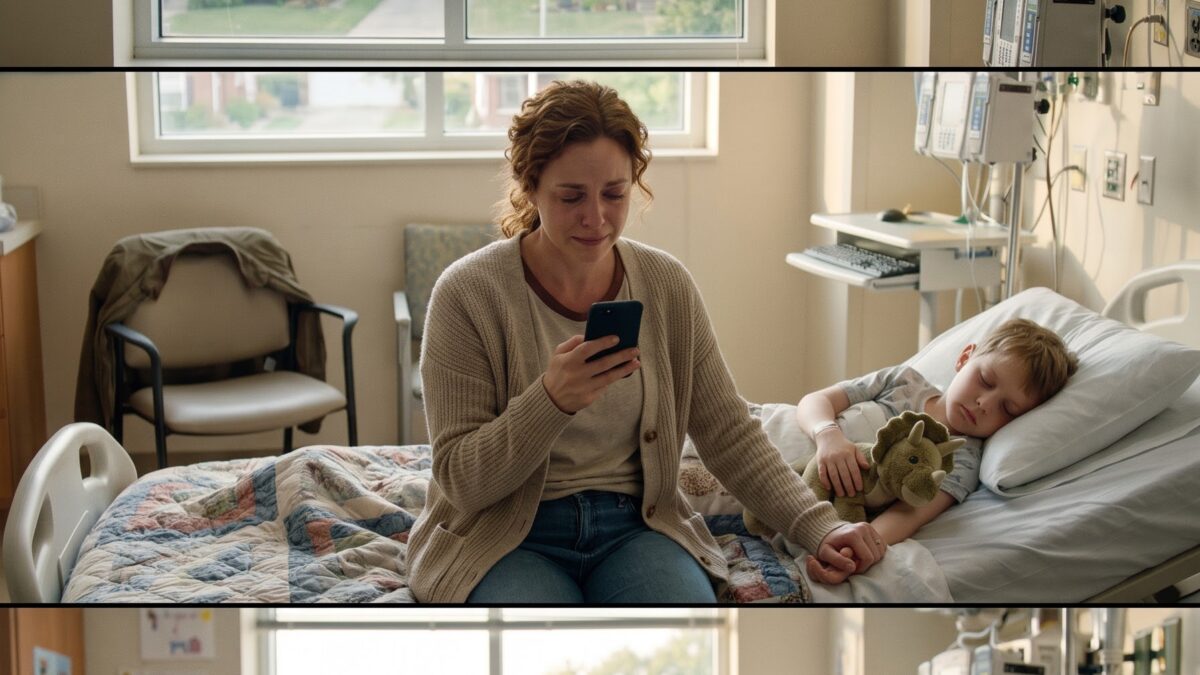
Three days after my six-year-old son came out of heart surgery, my mother texted me from a bridal boutique and asked for $10,000.
I was asleep in the chair beside Ethan’s hospital bed when my phone vibrated against my leg. His breakfast tray was still on the counter. He had managed half a piece of toast before deciding that chewing was too much work.
Under his arm lay Captain, the stuffed triceratops his father had bought him at the Columbus Zoo. One horn had been repaired with blue thread. Ethan refused to let me replace it with a matching color.
My mother’s message began pleasantly enough.
Glad Ethan is better.
Then came the reason she had written.
Chloe’s dress has to be paid for today or they release the sample. I need you to send $10,000 before four.
I read it twice, wondering whether exhaustion had made me miss a sentence. There was nothing about visiting. Nothing about bringing clean clothes or sitting with Ethan while I took a shower.
Three days earlier, I had spent nine hours alone in a surgical waiting area, looking up whenever the doors opened.
My parents had said they would come. My sister had told me to let her know what I needed.
I had.
I needed them there.
Now my mother needed a dress.
I opened my banking app and selected the contact I had labeled Mom—Emergency years earlier. I sent one dollar.
In the memo, I wrote: Buy a veil.
It was petty. I knew that while I typed it. I sent it anyway.
Then I called the credit card company and began removing the people I had spent years allowing to spend my money.
I thought the difficult part would be enduring their calls.
The next morning, the manager of our bank branch called me instead.
“Renee, can you speak privately?”
Ethan was watching a cartoon with the sound low. I stepped a few feet away from his bed.
“Yes.”
“Your parents and Chloe are here. Your mother has brought a financial power of attorney.”
For a moment, I couldn’t remember how to answer.
“She’s asking us to transfer thirty-eight thousand dollars from your savings to an account in her name.”
I looked at Ethan, who was concentrating on getting Captain to sit upright against his pillow.
My mother hadn’t come to the hospital when I asked.
She had gone to the bank when I said no.
My name is Renee Collins. I was forty-one that spring, living outside Columbus, Ohio, in the house my husband and I had bought before Ethan was born.
I worked in operations for a software company. Most of my days involved contracts, budgets, and getting people to agree on what they had actually promised.
At work, I was good at saying, “That isn’t included.”
At home, I had spent years paying for things that weren’t included either.
My sister, Chloe, was five years younger. Growing up, she could make everybody laugh without trying. She climbed into our father’s lap well past the age when I would have considered it. She remembered birthdays, gave enthusiastic hugs, and cried openly when something hurt.
I liked those things about her.
The trouble was that our family gradually organized itself around preventing her disappointment.
When Chloe forgot her lunch, Mom drove it to school. When I forgot mine, Dad told me I would remember tomorrow.
When she struggled with homework, somebody sat beside her. When I brought home good grades, they barely looked up.
“That’s our Renee,” Dad would say.
I learned to hear affection in it. I also learned not to bring them problems that required much attention.
My mother, Diane, called me her miracle worker.
My father, Paul, called me the steady one.
By the time I was old enough to understand what those names cost, I had already made them part of how I saw myself.
At twenty-eight, I had saved a little over $60,000 toward a condo. I had worked since college, lived with roommates longer than I wanted, and put most of a promotion bonus into savings.
Then Dad’s printing business lost its largest customer.
He had borrowed against the house to keep the company running. When the payments fell behind, my parents tried selling equipment and negotiating with the lender. None of it closed the gap.
Mom called me one evening while I was eating dinner over the kitchen sink.
“I don’t know what we’re going to do.”
Dad got on the phone afterward.
“We’ll figure something out,” he said, in the voice he used when he didn’t know how.
I offered the money before either of them asked directly.
It went toward overdue payments and the amount their lender required for a restructuring arrangement. The house stayed theirs. My condo became a folder of listings I stopped opening.
At Christmas, Dad raised his glass.
“To Renee. We wouldn’t be sitting here without her.”
Everybody applauded.
I was proud. I want to be honest about that. I wasn’t sitting there secretly furious while pretending to smile.
I felt useful. I felt loved.
That made the next request easier.
When Mom needed a procedure several years later, I arranged appointments, paid expenses her insurance didn’t cover, and hired help for the first week afterward.
Chloe said hospitals made her anxious.
I said I understood.
When Dad had a slow month, I sent enough to cover a bill. When Chloe fell behind on rent, I helped her catch up. Sometimes they thanked me warmly. Sometimes the next request arrived before the first transfer had cleared.
I complained occasionally.
Mom would say, “Nobody’s forcing you.”
Technically, she was right.
That was part of what made it so difficult to explain.
I met Mark when I was thirty.
His engineering firm was working on a renovation at our company’s office, and we kept ending up in the same conference room. He wore shirts that always seemed freshly ironed until he pushed up his sleeves and went looking for whatever had gone wrong.
On our third date, Mom called twice.
Chloe’s landlord had raised the rent. She wanted to move but didn’t have a deposit for another apartment.
I stepped outside the restaurant both times.
When I came back, Mark had left the last piece of bread on my plate.
“Everyone okay?”
“Yes. Family stuff.”
“An emergency?”
“Not exactly.”
He glanced toward my phone.
“Then why are you checking your bank balance?”
I put the phone facedown.
“I wasn’t being very subtle, was I?”
“No.”
He didn’t lecture me. He asked whether I could afford what they wanted and whether I actually wanted to give it.
Those were separate questions. Until then, I hadn’t treated them that way.
We married two years later.
Mark never told me to stop loving my family. He liked Dad’s terrible jokes and let Mom send us home with leftovers in containers she expected back. He helped Chloe carry boxes when she moved.
But when she wanted us to pay half the cost of a birthday trip she couldn’t afford, he said we weren’t doing that.
Mom called him privately afterward.
“Could you talk to Renee? She listens to you.”
“She makes her own decisions,” he told her.
Mom complained to me that he was inflexible.
That evening, I watched him unload the dishwasher and found his inflexibility rather attractive.
Ethan was born when I was thirty-five.
A murmur was detected before we left the hospital. Further testing showed a defect in his heart that would need regular monitoring.
His cardiologist thought there was a reasonable chance we could avoid surgery. At first, the defect wasn’t placing enough strain on his heart to justify an operation, and there was still hope it might become less significant as he grew.
So we went to appointments. We learned what symptoms to watch for. We tried not to make every cough into a crisis.
Ethan became a cautious, funny little boy who asked whether dinosaurs had belly buttons and refused peas unless they were hidden in fried rice.
When he was two, Mark bought him Captain at the zoo.
For weeks, the dinosaur came everywhere with us. Mark gave it a deep voice and made it ask Ethan to brush his teeth.
“Captain doesn’t have teeth,” Ethan protested.
“Then Captain is depending on you.”
Two years later, Mark died in a highway accident.
I remember the officer taking off his hat. I remember asking a question he had already answered because I needed the answer to change.
Afterward, there were calls, documents, casseroles, and a four-year-old who kept asking when Daddy would be home.
My family came.
Mom stayed five nights. Dad handled food and answered the door when I couldn’t bear another visitor. Chloe slept on the sofa and held Ethan during one of his worst nights.
I haven’t erased that because of what happened later.
They helped me then. They loved Mark. Their grief was real.
But before the first month was over, the familiar requests returned.
Property taxes. A temporary business shortfall. Chloe’s rent.
I paid because arguing required something I didn’t have.
Mark’s life insurance and savings gave Ethan and me a measure of security. His retirement account remained separate from the money I used for everyday expenses.
I still needed to work. I still needed to plan.
The insurance wasn’t a windfall to celebrate. It was supposed to help replace years of income and give our son a stable home.
My parents knew there had been a policy. I never gave them the balance.
During that first year, my estate attorney helped me revise my documents.
We discussed what would happen if I became unable to manage my finances. I named my parents as financial agents, acting together, under a durable power of attorney that would take effect only after the incapacity determination required by the document.
It allowed them to pay my obligations. It did not authorize gifts from my accounts.
I also nominated them in my will to care for Ethan if I died, subject to the court’s decision.
At the time, they were nearby. They had come when Mark died. Choosing them felt obvious.
My attorney suggested reviewing everything as circumstances changed.
I put the papers in a drawer.
About eighteen months after Mark died, Chloe wrecked her car while looking at her phone.
She wasn’t seriously hurt. The car was.
She sold handmade home goods at weekend markets and said she couldn’t keep working without transportation. Her credit wasn’t good enough for the replacement she wanted.
I suggested a less expensive car.
Mom said the cheaper ones weren’t reliable.
I suggested Chloe save for a larger down payment.
Dad said that would leave her unable to work.
Eventually, I co-signed a used-car loan.
Within a few months, Chloe missed a payment. I covered it to protect my credit. Then I covered another.
By the time Ethan needed surgery, I was making most of the payments on a car I had never driven.
That winter, he began getting tired in ways I couldn’t dismiss.
He stopped racing other children across the playground. At soccer, he sat down before the other kids did. One afternoon, he came inside after playing in the yard and leaned against the refrigerator.
“My chest feels tired.”
I called cardiology.
Tests showed that the defect was still significant and his heart was now doing more work than the doctors wanted. The recommendation changed from watching it to repairing it.
The cardiologist explained the plan carefully. He answered my questions without pretending an operation was nothing to worry about.
Ethan drew a dinosaur on the paper covering the examination table.
On the way to the parking garage, he asked whether the hospital had chocolate milk.
I told him I would find out.
Then I buckled him into the car, sat behind the wheel, and cried.
“Mom?”
“I’m okay.”
“You don’t look okay.”
I wiped my face with a fast-food napkin.
“I’m scared because I love you. The doctors have a plan.”
He thought about that.
“Can Captain come?”
“Absolutely.”
That evening, I called my mother.
She answered from a florist. Chloe was beside her discussing arrangements for her September wedding, four months away.
“I need to tell you something,” I said.
I explained what the doctor had told us.
“Oh, honey. Children do so well these days.”
“I know. But he needs heart surgery.”
There was a pause. In the background, Chloe asked someone about ivory roses.
“Maybe don’t tell your sister everything tonight,” Mom said. “She’s already overwhelmed.”
I stared at the school calendar on my refrigerator.
“Mom.”
“I’m just saying we should all stay calm.”
“My son is having surgery. I’m telling you because I need you.”
Her voice softened.
“Of course you do. Call me when you have the date.”
When I did, she said she would be there.
Dad said the same.
Chloe texted the next morning.
Mom told me. I’m so sorry. Love you both. Tell me what you need.
I answered: Please come to the hospital.
She sent a heart.
Chloe’s fiancé, Tyler Brooks, was practical in a way our family didn’t always appreciate.
He liked a good meal, kept an older pickup running, and seemed perfectly comfortable admitting he couldn’t afford something.
He and Chloe had agreed on a wedding budget.
Mom treated that budget as a starting position.
She wanted a hotel ballroom, more flowers, more guests, and a dress that would impress relatives whose opinions she claimed not to care about.
Tyler once said, “We want a wedding, Diane. We’re not opening a hotel.”
Dad laughed.
Mom didn’t.
The dress became an issue during the week before Ethan’s operation.
A boutique had an elaborate designer sample Chloe loved. Even discounted, with alterations and the related costs, it was close to $10,000.
The shop had agreed to hold it briefly.
Mom began mentioning it to me as though repetition might turn it into my responsibility.
“You should see how she looks in it.”
“I’m sure she looks lovely.”
“She’ll only get married once.”
“I hope so.”
“You helped with the engagement dinner.”
“I offered to pay for that dinner. I didn’t offer to pay for the wedding.”
Mom went quiet.
Then she said, “You don’t have to be sharp with me.”
I was standing at my kitchen counter, sorting hospital papers while Ethan watched a dinosaur documentary.
“I can’t discuss dresses right now.”
“I’m trying to give you something happy to think about.”
“Then ask me about Ethan.”
She did, after a silence long enough to hurt.
We arrived at Nationwide Children’s before sunrise on the morning of the operation.
Ethan wore dinosaur pajamas under his jacket. Captain rode in the tote bag with his face sticking out.
Before the team took him back, Ethan asked whether I would stay.
“I’ll be here the whole time.”
“Even if it takes until dinner?”
“Even then.”
I kissed his forehead. A nurse helped him hold Captain while they got ready to move him.
Then I went to the waiting area.
I sent a message to the family group.
They’re taking Ethan back now. I’m in the surgical waiting area. Please come when you can.
Mom replied, Keep us updated, honey.
Dad wrote, Tough kid. He’ll pull through.
Chloe sent another heart.
Tyler said he was thinking of us.
I set my bag on the empty chair beside me, then moved it to the floor in case someone arrived.
An older couple sat across from me with their daughter. A man paced near the windows until his sister brought him coffee. Another family took turns leaving and returning, always with somebody left behind.
I checked my phone.
At first, I supplied reasons.
Traffic. Work. Mom needed to get Dad. Chloe might be coming with Tyler.
The nurse gave me updates. There had been a delay before the repair began. Later, she told me the operation was progressing and they would contact me when the surgeon was ready to speak.
The total wait would stretch to nine hours, including preparation, surgery, and the time before I could see him afterward.
By lunchtime, the chair beside me was still empty.
I texted Mom.
Are you coming?
She answered twenty minutes later.
Your father has something to finish. We’re praying.
I called.
It went to voicemail.
A photograph appeared in the group chat shortly afterward: champagne-colored fabric held against Chloe’s arm.
Does this look too yellow?
She deleted it almost immediately.
Sorry. Wrong chat.
I stared at the place where the photograph had been.
Then I typed, Ethan is still in surgery.
Nobody answered for a while.
My friend Nina had offered to come, but she was out of town helping her own mother after a fall. I had told her my parents and sister would be with me.
She called during the afternoon anyway.
“Who’s sitting with you?”
I looked at the empty chair.
“No one yet.”
“Renee.”
“I’m okay.”
“No, you’re getting through it. Those aren’t the same.”
She stayed on the phone until another hospital update came.
When the surgeon finally spoke to me, he said the repair had gone well and explained what they would watch during recovery.
I asked him to repeat part of it.
He did.
Afterward, I sat down because my knees had begun shaking.
I sent the family a brief update.
Mom replied with praying hands.
Dad sent a thumbs-up.
Chloe wrote, Thank goodness.
I wanted to throw the phone into my bag and never hear it again.
Instead, I kept it charged in case the hospital needed me.
Ethan spent the first part of his recovery in intensive care.
There were tubes and monitors, staff moving in and out, and stretches when the only useful thing I could do was sit close enough for him to hear me.
When he was more awake, he asked for Captain.
A nurse helped me position the dinosaur where it wouldn’t interfere with anything.
He touched the repaired horn.
“Did you stay?”
“I stayed.”
Later, after he moved to a regular room, he began noticing who wasn’t there.
“Is Grandma coming?”
“I don’t know yet.”
“Did you tell her?”
“Yes.”
He looked toward the door.
I called Mom again that afternoon.
“He’s asking about you.”
“Oh, sweetheart. I didn’t want to crowd you.”
“You wouldn’t be crowding us.”
“Well, let’s see how tomorrow goes.”
Tomorrow became another day when she didn’t come.
My neighbor Bethany brought coffee, clean socks, and the phone charger I had left plugged in beside my bed at home.
She had texted first to ask what I needed.
When she handed me the bag, I nearly cried.
“It’s just socks,” she said.
“I know.”
She sat with me for half an hour while Ethan slept.
Nobody mentioned money.
Tyler contacted me privately that evening.
I offered to drive Chloe over yesterday. Diane said you didn’t want visitors yet. Is that true?
I called him.
“No,” I said. “It isn’t.”
He was quiet.
“I’m sorry. I should have checked with you.”
“Yes.”
“Does Chloe know?”
“She knows I asked her to come before the surgery.”
He exhaled.
“I’ll talk to her.”
I wasn’t ready to sort out whether Mom had lied to protect them, control them, or avoid admitting that she didn’t want to be there.
My son needed help drinking water. His medication schedule mattered. His comfort mattered.
My family’s explanation could wait.
Then Mom sent the message about the dress.
After sending the dollar, I put the phone on the windowsill.
I waited for guilt.
What came first was a desire to do something useful.
I called the issuer of the credit card I had given my parents for emergencies and removed Mom as an authorized user. Dad hadn’t had a separate card, though I knew he sometimes used hers.
Then I removed Chloe from another personal card.
I had let her use it during a rough stretch after her breakup. The rough stretch had ended. The card hadn’t come back.
I canceled future recurring transfers I had set up myself and reviewed the payments scheduled from my account.
Nobody else owned that money. I wasn’t taking anything from their accounts.
I was ending permissions and support I had provided.
Finally, I sent one message.
I am not paying for the dress or the wedding. I am reviewing the other expenses I have been covering. Please do not call me today unless it is about Ethan.
Mom called almost immediately.
I silenced the phone.
Dad called.
Chloe called twice.
I changed the settings so those calls wouldn’t ring while Ethan rested.
Tyler texted.
I’ve seen your message. Take care of Ethan. We’ll deal with the wedding ourselves.
That evening, Mom sent a long message about how humiliating the dollar had been.
She was right about that part.
It had been meant to sting.
But the message went on to accuse me of ruining Chloe’s happiest time and treating my family like strangers.
There was no mention of the waiting room.
Dad wrote, Your mother is very upset. Please don’t make this bigger.
I didn’t answer.
Chloe’s message came later.
I don’t care about the dress right now. Can we talk?
I almost replied.
Then Ethan woke hurting, and I put the phone down.
Frank Delaney, the bank manager, knew our family by sight.
He hadn’t personally managed every account we held, and he wasn’t calling as a friend doing me a favor. A request involving my savings had been brought to his attention, and the bank needed to verify what was happening.
After identifying me through the bank’s usual security questions, he explained that my mother had presented the old power of attorney.
“She says you’re overwhelmed by your son’s surgery and aren’t making sound financial decisions.”
“Because I stopped paying for things?”
“That appears to be part of what she’s saying.”
“What has been transferred?”
“Nothing. The document requires an incapacity determination before their authority begins. They haven’t provided that. There are also concerns about the proposed transfer and the authority granted.”
I leaned against the wall.
“How much?”
“Thirty-eight thousand dollars.”
“To my mother?”
“To an account in her name. She describes it as money for wedding obligations and household expenses you had agreed to cover.”
“I haven’t agreed to that.”
“Thank you. We’re documenting your response.”
“Please don’t give them my balances.”
“We have not disclosed them.”
“Is Chloe trying to use the document too?”
“She isn’t named as an agent. Your parents are. Your sister accompanied them.”
“Did my father say anything?”
“He referred to the money as family support funds.”
I looked down at the hospital bracelet still around my wrist.
Family support funds.
That was what my savings had become in their minds.
“Frank, I want to revoke that document.”
“You should speak with your attorney. I can connect you with the bank’s process for recording the notice and providing the written revocation.”
After we finished, I called the attorney who had drafted it.
She returned the call before lunch.
I told her what had happened.
“Your mother cannot activate this document simply by saying you’re exhausted,” she said. “And it doesn’t authorize them to give your money away.”
“But they tried.”
“Yes.”
I appreciated that she didn’t rush to soften it.
She reviewed the document, contacted the bank with my authorization, and explained the next steps.
I sent written notice that I was revoking my parents’ authority. Later that day, I signed the formal revocation she prepared, with a notary arranged through the hospital.
Copies went to my parents and the relevant financial institutions. My attorney asked for confirmation that the bank had recorded the revocation.
She also told me we should revisit my will and other documents once Ethan was home.
“Today we stop this,” she said. “The rest deserves a proper conversation.”
For the first time that week, an adult was helping me solve a problem without creating another one.
My parents came to the hospital the following afternoon.
They texted from downstairs, asking which floor Ethan was on.
I met them near the elevators.
For a few seconds, we stood beside a cart stacked with clean linens.
Mom held her purse against her chest.
“You’ve upset everyone.”
“You tried to transfer thirty-eight thousand dollars.”
“We were trying to get things settled.”
“From my savings. After I said no.”
Dad glanced toward the nurses’ station.
“Let’s keep our voices down.”
“My voice is down.”
Mom looked at him, then back at me.
“You’re exhausted. You sent me a dollar with a cruel little message.”
“Yes. That was cruel. I shouldn’t have sent the note.”
She seemed relieved, as though I had found my way back to the part she understood.
I continued.
“That doesn’t give you permission to take money.”
“We didn’t take anything.”
“The bank stopped you.”
Dad rubbed the back of his neck.
“Your mother thought the document would let us handle bills while you were occupied.”
“Whose bills?”
He didn’t answer quickly enough.
“The dress,” I said. “The wedding. Your household expenses.”
Mom began crying.
“You’ve helped with those things before.”
“I have. That isn’t an agreement to keep doing it.”
She reached toward my arm. I stepped back.
“Why didn’t you come when Ethan was in surgery?”
“I couldn’t have sat here all day. I would have been frantic.”
“I was frantic.”
“You’re his mother.”
“You’re mine.”
She looked away.
Dad said, “We knew he was in good hands.”
“That’s why I could sit in the waiting room instead of trying to operate on him myself. It didn’t make me less afraid.”
Mom took a tissue from her purse.
“I told Chloe you needed quiet.”
“I asked her to come.”
“You needed rest.”
“Then someone could have sat with him while I rested.”
For a moment, the only sound between us was the linen cart rolling past.
I turned to Dad.
“Did you know she was taking the power of attorney to the bank?”
“Yes.”
“Did you know she wanted money moved?”
“She said it was for things you normally helped with.”
“That wasn’t what I asked.”
He looked at me.
“Yes.”
I had hoped he would say something else.
Mom wiped under one eye.
“Are you really ending everything over a wedding dress?”
“I’m ending the financial support because you tried to get around my refusal. And I need space because none of you came when I asked.”
“We’re here now.”
I glanced toward Ethan’s hallway.
“Yes. After the bank called.”
Neither of them asked to sit with him before leaving.
I didn’t offer.
Ethan went home after a week in the hospital.
Before discharge, a social worker helped me review who could assist us, how I would get him to follow-up appointments, and what support I had if I became too tired to manage safely.
I named Bethany and Nina.
When she showed me the emergency contacts already on file, my parents were listed first.
“I need to change those,” I said.
She gave me the appropriate form.
Ethan was awake, watching a cartoon.
“Are you crossing out Grandma?”
“I’m changing who the hospital should call if they can’t reach me.”
“Why?”
I almost said Grandma was busy.
It was the easiest answer, and I was tired enough to want an easy answer.
Then I remembered what it would mean to him.
“Because Nina and Bethany have agreed they can help when we need them.”
He kept watching the television.
After a while, he said, “Grandma didn’t come.”
“No.”
“Grandpa didn’t either.”
“No.”
“Did I do something?”
I moved my chair closer.
“No, sweetheart. You didn’t do anything.”
He picked at Captain’s blue stitches.
“Were they mad?”
“Not at you.”
“Then why?”
I couldn’t give him a complete answer. I didn’t have one.
“They should have come,” I said. “They made a bad choice. You were allowed to want them here.”
“Are you mad?”
“Yes.”
He considered that.
“Me too.”
I put my hand beside his on the blanket.
“That’s okay.”
He didn’t need the bank story. He didn’t need to know about insurance or thirty-eight thousand dollars.
He needed to know that their absence wasn’t his fault.
Chloe called that evening from the hospital parking lot.
“Can I come up?”
“Are you with Mom?”
“No. Tyler drove me.”
I asked Ethan whether he wanted to see her.
He shrugged, then said yes.
She came in without balloons or a bag from the gift shop. Tyler waited downstairs.
Chloe stopped beside the bed.
“Hey, dinosaur man.”
“You missed my surgery.”
Her mouth trembled.
“I did.”
“Why?”
She pulled a chair closer, but didn’t sit until he nodded.
“I was scared. Grandma told me you needed quiet, and I let that be my excuse. I should have called your mom.”
“Mom was scared too.”
“I know.”
He looked at her carefully.
“Did you bring Captain anything?”
“No. I didn’t know dinosaurs needed presents.”
“They like crackers.”
“I’ll remember.”
He handed her the unopened packet from his tray.
She opened it and placed it within his reach.
That small task gave her something to do with her hands.
After he fell asleep, we sat near the window.
“I told the boutique to release the dress,” she said.
“Okay.”
“Mom’s furious.”
“That’s between you and Mom.”
Chloe nodded.
Then she said, “I’m sorry about the hospital. And the bank.”
“What did you know before you went?”
“Mom said you were canceling everything because you hadn’t slept. She said we needed to speak to Frank about the expenses you were already covering.”
“And you thought that was reasonable?”
“I thought we were going to ask what the canceled cards meant. I knew she was bringing papers. I didn’t ask what papers.”
“You knew I had said no.”
“Yes.”
I waited.
“When she asked for thirty-eight thousand dollars, I told her she couldn’t do that. Frank asked me to step out because I wasn’t named in the document.”
“Then why didn’t you call me?”
She looked at her knees.
“Because I knew how bad it sounded.”
Her answer was more believable than the excuses I had heard all week.
It didn’t make me feel better.
“Tyler asked me tonight whether I was upset about losing the dress or about what we’d done to you,” she said. “I didn’t know how to answer without sounding awful.”
“What’s the answer?”
“Both. At first.”
I nodded.
She began crying again, quietly enough not to wake Ethan.
“I wanted that dress. I liked the idea of everybody seeing me in it. And I kept telling myself you had enough.”
“You don’t know what I have.”
“I know.”
“You don’t know what Ethan’s care will cost over the years. You don’t know what I’m trying to save for him.”
“I know.”
“And you could have called me about the hospital.”
“Yes.”
“I’m not ready to forgive you.”
She wiped her face with her sleeve.
“Okay.”
We sat for a minute.
Then I said, “We also need to deal with the car.”
She gave a wet, startled laugh.
“That was a pretty hard turn.”
“The payment comes out next week.”
“I’ve been looking at the numbers with Tyler.”
“I can’t just stop paying if you don’t. My name is on that loan.”
“I’ll apply to refinance it in my name. If I can’t qualify, I’ll sell it and cover the difference.”
“How?”
“Inventory. Savings. Less wedding.”
I watched her.
“I need dates and a plan. Not another promise that you’ll get around to it.”
She nodded.
Before leaving, she wrote down the balance, the next payment date, and what she would do that week.
It was the first conversation about her car that didn’t end with me paying for her relief.
Bethany drove us home.
Nina had returned by then and was waiting at my house with soup, groceries, and clean sheets on Ethan’s bed.
She had known Mark. She knew which cupboard held the mugs without asking.
Ethan wanted to walk in by himself. We let him take it slowly.
Once he was settled, Nina stood with me in the kitchen.
“Have you eaten?”
“I had crackers.”
“That’s a no.”
She put soup in a bowl.
I began telling her about the bank. Halfway through, I stopped because I could hear how strange it sounded.
“My own parents,” I said.
Nina handed me a spoon.
“I know.”
“They think I’m doing this because I’m tired.”
“You are tired. You can still know what you want.”
The following weeks were occupied by real work.
Medication. Follow-up appointments. Helping Ethan move carefully. Keeping track of what the discharge instructions said about activity, school, and when to call.
He improved, but not all at once.
One morning he wanted to build a fort. By lunchtime he was asleep.
Another day, he cried because he couldn’t keep up with a friend who had come to visit.
I didn’t tell him to be grateful the operation was over.
I sat beside him until he was ready to try something quieter.
My attorney helped me revise my documents over several appointments.
Nina agreed to serve as my new financial agent under a replacement power of attorney. She and her husband also agreed to be nominated to care for Ethan if I died.
The lawyer made clear that a nomination wasn’t a guarantee; a court would still consider Ethan’s interests.
Bethany became an emergency pickup contact and part of our practical backup plan.
I didn’t hand anybody unlimited authority because I was grateful they had brought soup.
We talked through responsibilities. We reviewed what they could realistically do.
I asked questions I should have asked before.
My mother didn’t accept the changes quietly.
Relatives called.
One aunt said, “Diane tells me you cut them off while Ethan was in the hospital.”
“I stopped paying expenses that weren’t mine.”
“She says you have plenty.”
I almost began explaining my accounts.
I could list what I had spent. I could show that I was careful, that I wasn’t selfish, that the insurance wasn’t some endless pile of spare money.
Then I realized I was about to give another person access to information she didn’t need.
“My balance isn’t the issue,” I said.
“What is?”
“I said no. They took an old power of attorney to the bank and tried to move money anyway.”
My aunt stopped talking.
“Diane didn’t tell me that.”
“I know.”
“Did the bank let them?”
“No.”
“Do you want me to speak to her?”
“No. Please don’t carry messages between us.”
She agreed.
A cousin wasn’t so willing to listen. He wrote that I was punishing the entire family over one missed hospital visit.
I drafted a long reply.
Then I deleted it.
He hadn’t sat in the waiting room. He hadn’t answered Ethan’s questions. He didn’t need to approve my decision before I could keep it.
That evening, I put the phone in a drawer and helped my son finish a puzzle.
Dad asked to visit two weeks after Ethan came home.
I agreed to an hour.
He arrived alone with a board game Ethan already knew how to play.
He didn’t bring a speech.
They played at the kitchen table until Ethan became tired. After I settled him on the sofa, Dad stayed seated.
“I should have come to the hospital,” he said.
“Yes.”
“I let your mother tell me you didn’t need us.”
“You had my messages.”
“I did.”
He looked older than he had a month earlier.
That didn’t make him less responsible.
“Why did you go to the bank?” I asked.
“Because I thought you were cutting everything off in anger.”
“I was angry.”
“I know.”
“Did you think that meant I couldn’t decide?”
He rubbed his thumb along the edge of a game card.
“I thought we could keep the bills paid and talk later.”
“Your bills.”
He nodded.
“Your mother called it protecting the family. I didn’t stop to ask who was protecting you.”
I looked toward the living room. Ethan had fallen asleep with a blanket halfway off his legs.
“For years, when something went wrong, we called you,” Dad said. “After a while, I stopped thinking about what happened on your end.”
“You stopped asking.”
“Yes.”
“Did you know she wanted to transfer the money into her account?”
“Yes.”
I appreciated that he didn’t retreat from the answer this time.
“I don’t want you to blame everything on Mom,” I said.
“I’m not.”
“You went.”
“I went.”
We sat quietly.
Then he asked whether he could come another afternoon and help Ethan with the game again.
“Ask me next week.”
“All right.”
He left without asking about a payment.
Later that summer, he canceled his golf membership and stopped buying equipment for the printing business on credit. He picked up part-time bookkeeping work for a friend.
I learned some of that from him months later. He wasn’t presenting receipts as an application for forgiveness.
He was paying bills he had expected me to cover.
It mattered.
Chloe’s car took almost two months to resolve.
The first lender turned her down.
She called to tell me, and I could hear the old expectation waiting in the silence.
“I’m applying somewhere else,” she said before I filled it.
“Okay.”
She sold inventory, added to her down payment, and accepted a higher interest rate than she wanted. Tyler helped her make a budget, but he didn’t become the new person responsible for rescuing every shortfall.
When the original loan was paid off, I confirmed it with the lender myself.
Only then did I remove the payment from my budget.
Other obligations took longer.
I had already paid part of my parents’ homeowners insurance for the current term. I wasn’t getting that money back. Dad would have to cover the next renewal.
A medical expense I had charged to my own card still had to be paid. Ending support didn’t remove my name from contracts or erase purchases I had made.
I kept the promises that were legally mine.
I stopped making new ones because somebody else was upset.
With a therapist’s help, I adopted one practical rule: I wouldn’t make a financial decision during the same call in which someone requested money.
I could sleep on it. Check the details. Decide without somebody crying in my ear.
Mom hated the delay.
“What is there to think about?”
“Whether I want to do it.”
“You never used to make us wait.”
“I know.”
The first time I ended a call while she was still arguing, my hands shook so much that I put the phone down carefully.
Nothing happened.
No disaster followed.
I made dinner.
Chloe and Tyler reduced the wedding.
They moved it from a hotel ballroom to a restored community hall that had an opening on the same September weekend. They lost part of a deposit, but the total cost still came down.
The guest list shrank. The flowers became simpler. Chloe bought a dress she could pay for herself.
Mom complained until Chloe said, “If you want the bigger wedding, you’ll have to pay the difference.”
Mom couldn’t.
That ended one argument, though not all of them.
I wasn’t certain I would attend.
Chloe called me directly.
“I want you and Ethan there. I’m not asking for money.”
“Not for something you forgot?”
“No.”
“Not for a last-minute problem?”
“No.”
I heard Tyler say something in the background.
Chloe sighed.
“He says I should put that in writing.”
“For once, I agree with him.”
She laughed, then became serious.
“I know things aren’t fixed. I still want my sister there.”
I went.
By September, Ethan’s recovery had progressed well enough that his care team was comfortable with him attending and taking part in a simple, low-effort role.
He wore a navy suit and carried the rings down a short aisle. Halfway through the ceremony, he leaned against my arm and whispered that his shoes were annoying.
The hall looked warm and lived-in. There were string lights overhead, ordinary chairs, and relatives carrying dishes from the kitchen.
Chloe looked beautiful.
I didn’t spend the evening calculating what the room would have cost me.
Mom avoided me for the first hour. Dad helped Ethan find a quieter place when the music began.
Later, Chloe asked whether we could talk.
“There’s something you should know.”
I set my glass down.
“About the bank?”
“About Mark.”
I felt my body become still.
“Mom told me his insurance was supposed to help the family.”
“What?”
“After he died. She said he believed in taking care of everybody, and you were managing the money because you were better at it.”
I watched her face.
“Did she say he told her that?”
“No. She said he would have wanted it.”
“Those are different things.”
“I know that now.”
I looked across the room.
Mom was speaking to an aunt near the dessert table.
“How long have you believed this?”
“I didn’t think it was a legal arrangement. I knew the money was in your name. I just thought helping us was part of what you were doing with it.”
“Because Mom said so.”
“And because you kept paying.”
That hurt in a way I hadn’t expected.
Mark had disliked the pressure they put on me.
Now his name had been used to make the pressure sound generous.
“Did you think the dress was something he would have wanted to pay for?”
Chloe swallowed.
“I told myself you were protected, and helping me wouldn’t hurt you.”
“You didn’t ask whether it would.”
“No.”
“Did Dad hear the same story?”
“I don’t know.”
I took a breath.
“Thank you for telling me.”
“I should have asked you much earlier.”
“Yes.”
I stayed long enough for Ethan to eat cake.
Then we went home.
I called Mom the next day.
“Did you tell Chloe that Mark’s life insurance was meant to support the family?”
There was a pause.
“I said Mark cared about us.”
“That wasn’t my question.”
“He did care about us.”
“Did he ever tell you I should use his insurance for your expenses?”
“No, but—”
“Did he tell you to expect money for Chloe’s wedding?”
“Of course not. We didn’t know about this wedding then.”
“Then why did you let her believe it?”
Mom’s voice grew sharper.
“You had help. Your father and I were struggling.”
“I was raising a child without his father.”
“You were financially protected.”
“I was trying to make that protection last.”
She began explaining the house, the business, the bills.
I let her finish.
Then I said, “Mark didn’t appoint me to keep everybody comfortable after he died.”
“He wouldn’t have wanted us to lose the house.”
“I helped save your house before I even met him.”
“And he knew you were generous.”
“He also knew you kept asking.”
She stopped.
I could hear a television in the background.
“You took something he left to help Ethan and me, and you made it sound like I was holding money for everybody.”
“I never said you were holding it for us.”
“Chloe believed you were.”
“I can’t control every conclusion Chloe reaches.”
“You could have corrected it.”
Mom began crying.
“I was scared.”
“So was I.”
“I didn’t mean to hurt you.”
“I believe you didn’t sit down and plan to hurt me. You still did.”
She asked what I wanted her to say.
That question exhausted me.
“I don’t want to give you the right words. I need you to understand what happened.”
“Renee—”
“I’m going to go.”
“You’re punishing me.”
“I’m taking some space. Please don’t send Dad to speak for you.”
I ended the call.
For almost three months, we barely communicated.
Thanksgiving came during that silence.
Mom invited us and added, No money talk. I promise.
I couldn’t tell whether she understood why I wasn’t ready.
I declined.
Nina invited Ethan and me to spend the day with her family.
I offered to buy the turkey.
She told me to bring the cranberry sauce I liked.
At her house, nobody handed me a problem to solve.
Her husband showed Ethan how to set the timer for the rolls. Their daughter let him choose a movie after dinner.
He ate too much pie and fell asleep on the sofa with Captain tucked under his chin.
I sat beside him while people argued cheerfully about whether the leftovers should be divided before dessert.
For a little while, I felt guilty.
Then Nina handed me a container of stuffing and asked whether I wanted more.
That was all she wanted from me.
Mom’s letter arrived in December.
It wasn’t long.
She wrote that she had mistaken my ability to manage things for proof that I didn’t need help.
She admitted telling Dad and Chloe that I didn’t want visitors because she was afraid of seeing Ethan in the hospital and didn’t want to explain that fear.
She wrote that she had used Mark’s financial planning to reassure herself there would always be enough for everybody.
Near the end, she said she had treated my refusal as something to get past instead of an answer.
I read that paragraph several times.
There was an apology.
There was no request for money. No instruction to call. No paragraph about how much she had suffered.
I put the letter in a drawer.
For once, I didn’t respond immediately because somebody else might be waiting.
A week later, I sent a short message.
I received your letter. Thank you for taking responsibility. I still need time.
She answered, I understand.
I waited for the next message.
None came.
That helped more than another apology would have.
Over the winter, contact remained limited.
Dad visited occasionally, after asking. Chloe called to talk about her market business without turning each conversation into an application for help.
Mom sent a card for Ethan’s birthday.
It contained a modest bookstore gift card and a note about a dinosaur book she thought he might like.
She didn’t arrive uninvited.
When Ethan’s school announced a spring music program, she asked whether she could attend.
I talked to him while we were putting away groceries.
“Grandma would like to hear you sing.”
He pushed a box of cereal across the counter.
“Do I have to talk to her?”
“No.”
“Will she be sad if I don’t?”
“She might be. That’s for me and Grandma to handle.”
He thought for a moment.
“I don’t want her there this time.”
“Okay.”
I told Mom he wasn’t ready.
Her reply took a while.
Then she wrote, Tell him I hope it goes well.
At the program, Nina and Bethany sat beside me.
Ethan sang too loudly, forgot part of a verse, and bowed when the other children stayed still.
Afterward, he scanned the crowd.
“Grandma didn’t come?”
“No. I told her you didn’t want her to come this time.”
He nodded.
Then he asked whether we could get ice cream.
I hadn’t needed to persuade him to be affectionate so an adult could feel better.
Mom hadn’t tried to get around his answer.
It was a small evening. It mattered.
Our first lunch with Mom happened later that spring.
I chose a place near home and told her we could stay about forty-five minutes.
She arrived on time.
There were no expensive gifts. No tears in the doorway. No attempt to hug Ethan before he was ready.
She asked about school.
He told her his class was learning about weather, which he considered less interesting than dinosaurs.
Mom listened.
Halfway through his sandwich, he said, “You didn’t come when I had surgery.”
She put down her water glass.
“No. I should have.”
“Were you scared?”
“Yes.”
“Mom was too.”
“I know.”
He looked at me, then back at her.
“If I have another one, will you come?”
“If you want me there, I will.”
He returned to his sandwich.
There was no hug afterward.
Mom didn’t ask for one.
When our time was up, she stood and thanked us for meeting her.
Ethan waved from beside me.
She waved back.
I went home without feeling as though I had spent the lunch managing three people’s emotions.
The changes were uneven.
Dad forgot to ask before giving Ethan advice about an activity, and I reminded him that we were following the cardiologist’s instructions.
He apologized and stopped.
Chloe had a poor sales month and called me sounding frightened.
I braced myself.
“I’m closing one of the booths,” she said.
“Have you checked the cancellation terms?”
“Yes.”
“Okay.”
“I hate it.”
“I’m sorry.”
“I wanted you to tell me I could somehow keep everything.”
“Can you?”
“No.”
We sat on the phone for a moment.
Then she asked whether I could look at a supplier email and tell her if it was clear.
I did.
Helping her with an email felt different from paying to prevent her from making a difficult decision.
Mom tested a boundary once by asking whether I might cover a family dinner because it would mean so much to Dad.
I said I wasn’t doing that.
She started to explain, then stopped.
“All right.”
The dinner became a potluck.
Nobody went hungry.
I had work to do too.
For years, I had told myself I hated being indispensable.
I did hate the pressure. I hated the assumption that I would make everything easier.
But there was a part of me that felt safer when everybody needed me.
After Mark died, a request gave me a task I knew how to complete. I could pay a bill. I could check a balance. I could make somebody’s immediate fear go away.
I couldn’t explain death to Ethan in a way that made him stop missing his father.
I couldn’t make my own bed feel less empty.
My therapist asked what frightened me about saying no.
I answered quickly.
“The argument.”
She waited.
Finally, I said, “What if they stop calling?”
Some people did.
A cousin who had borrowed money twice stopped checking in. An aunt became distant after I declined another loan.
I noticed. It hurt.
But Dad called to ask how Ethan’s appointment had gone.
Chloe called because she had seen a ridiculous lamp at an estate sale and thought Mark would have hated it.
We laughed about how he would have tried to repair its crooked shade.
Mom’s calls were less frequent, but sometimes she asked about my work and actually stayed on the subject.
I didn’t know how to measure those changes at first.
There was no statement showing the balance.
I had to notice whether a conversation left me feeling heard.
A year after the operation, Ethan had a follow-up at the same hospital.
By then, his stamina had improved. He had returned to school and ordinary play under the guidance of his care team, though we still discussed sports and limits at his appointments.
He carried Captain into the building.
“For luck,” he told me. “Not because I’m little.”
“Of course.”
Chloe had asked a week earlier whether she could come.
I said yes.
Dad confirmed the time directly with me instead of relying on Mom.
Mom asked too. Ethan said he wanted Aunt Chloe and Grandpa for this visit.
I told her.
“All right,” she said. “Let me know how it goes if you have time.”
She didn’t ask why he had chosen them.
She didn’t tell Dad he should stay home with her.
That morning, Chloe arrived carrying two coffees and a small carton of milk.
“I checked,” she told Ethan. “No coffee for you.”
“I know.”
Dad came a few minutes later and sat beside him.
We were in an outpatient waiting area that shared the same familiar hospital corridors, signs, and elevator route I remembered from the surgery.
My shoulders had tightened as soon as we entered.
Then Chloe handed me the coffee.
Dad asked Ethan about a book he was reading.
I looked at the chairs around us.
Nobody was waiting for me to solve anything.
The cardiologist said the repair looked good. Ethan would continue to need follow-up, but the findings were reassuring.
Ethan asked about joining soccer again.
We discussed what was appropriate for him and what signs would mean he should stop and tell an adult.
He listened more carefully than he usually listened to me.
On the way out, we passed the corridor leading toward the surgical waiting area.
Ethan slowed.
“This is where I had my surgery.”
“Yes.”
He looked at Chloe.
“You didn’t come that time.”
“I know.”
Then he looked at Dad.
“Neither did you.”
Dad nodded.
“I should have.”
Ethan adjusted Captain under his arm.
“You came today.”
“We did,” Chloe said.
He considered that, then pressed the elevator button.
No one tried to turn it into a speech.
We went downstairs.
In the years that followed, I revised my estate plan again.
Nina remained the first person I had nominated to care for Ethan. Chloe became an alternate only after sustained reliability and a serious conversation about what she could take on.
My parents were not restored as financial agents.
When Mom asked about that, I answered plainly.
“I’m comfortable rebuilding some parts of our relationship. I’m keeping my finances separate.”
It hurt her.
She accepted it.
Chloe eventually had a baby of her own.
One night she called crying because the baby wouldn’t sleep and she was convinced she was doing everything wrong.
My first instinct was to wait for the request.
There wasn’t one.
“I just need to talk to my sister,” she said.
I sat on the kitchen floor with the phone against my ear until she could breathe more easily.
Later, after we hung up, I stayed there a few minutes.
That was what I had wanted from her all along.
Not repayment. Not proof that she could be as strong as I had tried to be.
A call that didn’t end with me opening my bank account.
I still remember the lunch after that one-year hospital appointment.
Chloe offered to buy it.
Ethan wanted fries. Dad made a mild objection that nobody took very seriously.
We found a booth near the window. Captain occupied the space beside Ethan until a plate arrived and the dinosaur had to move.
Chloe asked about my work.
Dad told us about a bookkeeping error he had found and corrected before it became a problem.
Nobody asked what I earned.
Nobody mentioned an overdue bill.
When the check came, I reached for it automatically.
Chloe put her hand on the little black folder first.
“I said I was buying.”
“I know.”
She waited.
I took my hand away.
Across the table, Ethan was making a fry disappear into Captain’s mouth. Dad pretended not to see him slip a second one underneath the napkin.
Chloe paid with her own card.
I thanked her.
Then I gathered my bag, helped Ethan with his jacket, and walked out with my family.