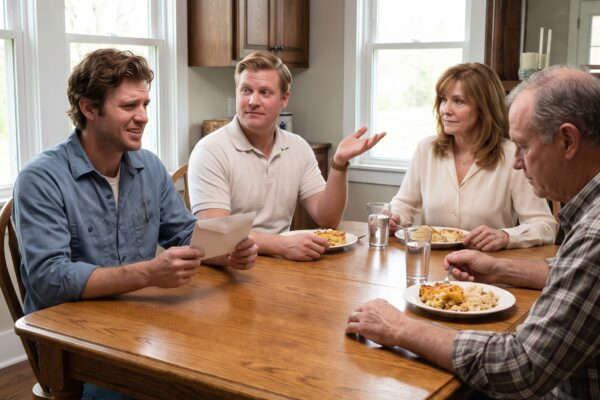
After 30 years as a nurse, I bought a small house by the sea, hoping for a peaceful life. That first weekend, my son called: “We’re having our wedding there. Eighty guests. I’ve already booked you a room. You’ll stay at a hotel.” His fiancée added, “And we’re keeping it as our summer house.” I hung up. They thought I’d give in once the guests were there. But at 67, I knew I wasn’t going to let them make my decisions for me anymore.
My son told me I would be staying at a hotel while he held his wedding at the little house I had just bought for my retirement.
Then his fiancée took the phone.
“And we’re keeping it as our summer house, Bobby. You’ll barely notice us.”
I was standing in my new kitchen with a dish towel over my shoulder. There were still moving boxes against the refrigerator. I had owned the place for two days.
“No,” I said.
Eleven weeks later, they arrived with a wedding party, a shuttle bus, and eighty invited guests.
By then, there were two green trucks in my driveway, fresh protective fencing on the beach, and a white rose arch lying on its side in my grass.
My son looked at all of it, then at me.
“Mom. What did you do?”
For once, the answer was considerably less than he had done.
My name is Bobby Smallwood. I was sixty-seven that spring, and I had just finished thirty years of night shifts as an ICU nurse in Worcester, Massachusetts.
My last shift at St. Brendan’s Medical Center ended at seven on Friday morning, March 27, 2026. Somebody brought a sheet cake with blue icing. The day nurses gathered near the desk and clapped while I tried to decide what to do with my hands.
I took home my locker shoes, three pens that weren’t mine, and the chipped coffee mug I had been using since 2004.
A younger nurse asked what I would miss most.
I almost said the people.
Then a monitor started alarming down the hall, and three of us turned toward it before remembering whose shift it was.
“I’ll let you know,” I told her.
I had spent most of my adult life sleeping while other people were awake. I knew which grocery store opened early, which diner would sell you meatloaf at eight in the morning, and how to wrap Christmas presents quietly enough not to wake a child.
What I wanted in retirement was ordinary.
A kitchen I could sit in during daylight. A bedroom without blackout curtains. Somewhere I could hear something besides traffic when I opened a window.
I sold my condo for $268,000. After the closing expenses, I added savings I had built over many years and paid $398,000 for a gray-shingled cottage on the southern Maine coast.
The address was 14 Gannet Lane, in a little place called Marrow Point.
Two bedrooms. One bathroom. A narrow porch facing the Atlantic. The furnace was old, the kitchen cabinets had been painted several times, and the bathroom door needed a firm lift before the latch would catch.
The inspection had found enough small repairs to keep me occupied without frightening me.
I closed on Thursday, April 9.
The cottage was mine alone. There was no mortgage, no family partnership, no promise that anybody else would use it.
I still had retirement income, an emergency reserve, and enough sense to know that a furnace eventually stops being charming.
Evan drove up from Framingham the next day to help me move.
He carried boxes, assembled my bed, and ate two sandwiches standing at the counter. He was thirty-six, broad through the shoulders like his father, with the same little crease between his eyebrows he had worn while doing math homework.
For most of that afternoon, he was good company.
He put my chipped mug in the cabinet nearest the coffeemaker without asking where I wanted it. That touched me more than the heavy lifting.
Before he left, I gave him a spare key.
“For emergencies,” I said.
He slid it onto his key ring.
“Of course.”
On Saturday, I woke shortly after five, because thirty years of habit does not disappear with a retirement cake.
I made coffee and carried it onto the porch.
The tide was going out. Small pale birds hurried along the wet sand, stopping so abruptly they looked as though somebody had pressed a button.
There were four houses on our lane. At that hour, none showed a light.
I sat with my feet on the porch rail and drank my coffee while it was hot.
At 9:12, Evan called.
“Mom, we have amazing news.”
I smiled before he finished.
“We’re having our wedding there.”
I lowered my feet.
“Where?”
“At the cottage. June twenty-seventh. Eighty guests.”
I looked through the open doorway at my living room. The sofa nearly filled one wall. The bathroom was visible from the kitchen.
“Evan, this house has one bathroom.”
“We’ll rent a restroom trailer. Sienna has people.”
“You’re talking about a wedding here?”
“The ceremony on the beach. Reception on the lawn. It’ll be beautiful.”
“You haven’t asked me.”
He paused, but only long enough to change tactics.
“You’ll stay at a hotel. Just for the weekend. We’ll need the bedrooms for getting ready.”
“No.”
There was a rustle against the microphone.
Then Sienna was speaking.
“Bobby, hi. I think you’re picturing something much bigger than it is.”
Sienna Price was thirty-one and ran a small event-planning business called Salt and Linen Events. She had an eye for beautiful tables and a habit of describing other people’s possessions as possibilities.
“I’m picturing eighty people at my house,” I said.
“It’s two bedrooms. You don’t need both.”
“One is where I sleep. The other is for guests I invite.”
She gave a short laugh.
“And we’re keeping it as our summer house. You’ll barely notice us.”
I stood up.
“No, Sienna. You are not.”
“Let’s not make decisions before we’ve—”
“I’ve made mine.”
I ended the call.
Then I stood at the kitchen counter, holding my phone, listening to the refrigerator hum.
I had expected a conversation about flowers, perhaps an opinion about a dress. I had not expected to be told where I would sleep in my own home.
An hour later, a reservation confirmation arrived in my email.
Sandpiper Motor Inn. June 26 through June 28. Two nights. Room 12. Total prepaid: $318.
Evan had put down his card and listed me as the arriving guest.
There was no message asking whether the dates suited me.
I called the inn.
The woman at the desk sounded busy and kind.
“I didn’t make this reservation,” I told her. “My son did. Please note that I haven’t agreed to stay.”
She checked the booking.
“All right. We won’t assume you’re coming.”
I thanked her and wrote her name on the confirmation.
Joan Arsenault.
Then I called Evan back.
He didn’t answer.
I left a message.
“I’m not staying at the Sandpiper. I’m not hosting the wedding. Please call me before you make another arrangement involving my property.”
I sent the same thing by text.
He read it.
He did not reply.
To understand why he thought I would change my mind, you need to know how things had worked between us.
His father, Doug, left in 1995, when Evan was five.
I had started nursing school two years earlier, when our marriage was already becoming something we moved around carefully. After Doug left, I finished with a babysitter, borrowed notes, and a kitchen calendar covered in crossed-out work shifts.
I received my license in March 1996.
Night work paid a little more and fit the childcare I could arrange. Weekends and holidays were easier to pick up. Once I had ICU experience, there was almost always another shift available.
Doug sent support checks for a while.
The last came in 1998.
I pursued what I could through the proper channels, but an order on paper did not buy groceries when the money failed to arrive.
So I worked.
Our neighbor, Mrs. Gannon, kept Evan on many of those nights. She gave him Christmas breakfast in her kitchen more than once while I was finishing a shift.
I came home exhausted and tried to make the rest of the day worth waiting for.
There were things Evan missed because I was working. There were things I missed because I was asleep.
I knew that.
What I did with that knowledge became a problem of its own.
When I couldn’t give him time, I gave him something else. Better sneakers. An extra week at summer camp. Help with his first car.
Later, it was half his college costs, a security deposit, a repair bill.
Some of those were sensible gifts from a mother who could finally afford them.
Others were payments toward a debt nobody had actually calculated.
By the time Evan was earning a good salary as a regional sales manager for Harbison Medical Supply, I was still offering before he finished explaining what had gone wrong.
He had learned that my hesitation was the beginning of a negotiation.
I had helped teach him.
That did not make my house his.
On Sunday morning, I met Meera Talmage.
She was walking the upper beach in rubber boots, carrying binoculars and a clipboard. I was at the bottom of my steps with my coffee.
“You must be the new owner,” she said.
“I hope so. I paid enough.”
She smiled and introduced herself as the field coordinator for the Coastal Maine Shorebird Project.
She had worked with the previous owner and wanted to ask whether the project could continue monitoring the birds in front of the cottage.
“The little ones running by the water?”
“Piping plovers.”
She handed me her binoculars.
Through them, the birds had fine dark bands and small, busy feet. I had been seeing movement. Now I could see individuals.
“They nest right on the sand,” Meera said. “Usually above the tide line. The eggs blend in almost perfectly.”
I looked toward the low dune.
“People must walk right past them.”
“Sometimes right through.”
She explained the seasonal fencing: stakes, cord, signs, regular checks. It would mark areas to avoid, not give the project ownership of my beach.
At closing, the attorney had reviewed the property boundaries and the shore rights that could apply. My parcel included the dry upper beach and dune where the birds were showing interest.
The lower shore was more complicated.
Meera did not try to turn that into a simple ownership lesson.
“We’ll show you exactly where we’re asking to work,” she said. “And the birds have legal protection whether a property owner joins the program or not.”
She offered to bring an agreement.
I said I would read it.
That evening, Sienna called.
“Bobby, I think we started badly.”
“I agree.”
“Can I tell you something personal?”
I sat at my kitchen table.
She told me about the summer cottage her grandfather had built in Old Orchard Beach. Her family lost it after her father’s business failed in 2009.
She had been fourteen.
“I remember carrying my boogie board out to the car,” she said. “I still remember which room was mine.”
For a little while, I heard a girl who had lost something important.
“I’m sorry,” I said. “That must have been hard.”
“It was. So you understand why this means so much to me.”
“The ocean?”
“Having a place again.”
I waited.
“You’re one person, Bobby. Evan says you’re up at five and asleep by nine. We’d hardly be in your way.”
“I’m sorry you lost that cottage. This one is my home.”
She exhaled.
“We’re trying to build a family.”
“Then start by asking me things.”
For several seconds, neither of us spoke.
Finally, she said, “Let’s talk when this feels less emotional.”
“I’m available to talk now. The answer is still no.”
She ended the call.
Later, I was added to a wedding group chat with forty-one members.
Lorna Price, Sienna’s mother, had posted a photograph of my porch. Evan had taken it on moving day.
“So blessed. Bobby is giving the kids her new cottage for their wedding. June 27. Marrow Point.”
Hearts were appearing beneath it.
I typed slowly.
“There has been a misunderstanding. I have not offered my home as a wedding venue, and I have told Evan and Sienna that it is not available. Please confirm the location with them before making travel plans.”
I read it twice and sent it.
My sister Marian called seven minutes later.
“What on earth?”
“I don’t know yet.”
“Do you want me to say something?”
“Not while I’m still finding out.”
Within the hour, Sienna posted beneath my message.
“Family details still being worked out! Please keep the date. We’ll update everyone directly.”
She made it sound like a disagreement about napkins.
On Monday, Evan called.
“Mom, you embarrassed us.”
“You announced a wedding at a house you don’t own.”
“Everybody already knows.”
“Then everybody needs the correct information.”
“Aunt Rita booked a flight from Phoenix.”
“I’m sorry she was given the wrong address.”
He was quiet for a moment.
Then he said, “You worked every Christmas of my life.”
I sat down.
“You slept through birthday parties. You missed things. I’m asking for one day.”
“I know I missed things.”
“One day, Mom.”
“I’ll come to your wedding. I’ll help you look for another place. I will not move out of my home so you can use it.”
“It’s the only thing I’ve ever asked you for.”
I looked at the moving boxes still stacked beside my chair.
“That isn’t true, Evan.”
He hung up.
On Tuesday, a wedding invitation came in the mail.
Heavy cream paper. Gold lettering.
Evan Smallwood and Sienna Price.
Saturday, June 27, 2026.
Ceremony at four in the afternoon.
14 Gannet Lane.
The postmark was April 10.
They had mailed it the day Evan helped me move.
I stood in the kitchen with the invitation in one hand and the envelope in the other. I remembered him carrying my bed frame. I remembered giving him the spare key.
I wondered whether he had already mailed the invitations before he ate those sandwiches.
I photographed both sides and sent them to him.
“This address is not available. You need to send a correction.”
His answer came twenty minutes later.
“Please stop putting everything in writing like I’m a stranger.”
I put the invitation on the refrigerator under a lobster magnet left by the previous owner.
Then I unpacked another box.
Meera returned on Saturday, April 18.
We sat at the kitchen table and went through the cooperative agreement. It allowed seasonal monitoring and protective fencing, with arrangements for access and equipment.
She explained what the project would do and what I would be agreeing to.
I asked about walking to the water.
“We’ll keep an appropriate route open wherever the birds allow,” she said. “If a nest changes what’s safe, we’ll talk.”
“What about visitors?”
“They need to respect the marked area.”
“I can manage that.”
She looked at the wedding invitation on the refrigerator.
“Large event?”
“Apparently somebody hoped so.”
I told her enough.
She did not offer me a way to win an argument.
She explained what a crowd, music, dogs, lights, and repeated trips through the upper beach could mean during nesting season.
The birds were not a loophole I had found.
They were another responsibility attached to the place I had bought.
I signed.
On May 2, volunteers installed the first protective line around the area the pair had been using.
From the porch, I could see the orange cord move in the wind.
Meera gave me a number to call if something was damaged.
“Don’t confront anybody on the beach,” she said. “Call us.”
I put her card in the kitchen drawer.
By then, I had learned where the grocery store kept the decent bread and which window needed a folded piece of cardboard to stop rattling.
I bought a second porch chair.
Not because I expected to be alone forever. Because I wanted company to have somewhere to sit.
Marian came one afternoon with geraniums and stayed for dinner.
My neighbor Rudy Pellerin brought a screwdriver and fixed the bathroom latch after hearing me lift the door.
He was seventy-four, retired from lobstering, and lived two houses down.
“You don’t need a new door,” he told me. “Just somebody who’ll finish a small job.”
That was the sort of help I liked.
No announcement. No debt afterward.
On the Saturday of Memorial Day weekend, I came home from the grocery store and found Evan’s car in my driveway.
The front door was unlocked.
Inside, Sienna stood in my living room, slowly turning with her phone raised.
My reading glasses were on the side table. My bathrobe was draped over a chair.
“Oh, good,” she said. “You’re here.”
I set my bags on the floor.
“What are you doing?”
“Checking the light.”
“For what?”
She lowered the phone a little.
“Bobby.”
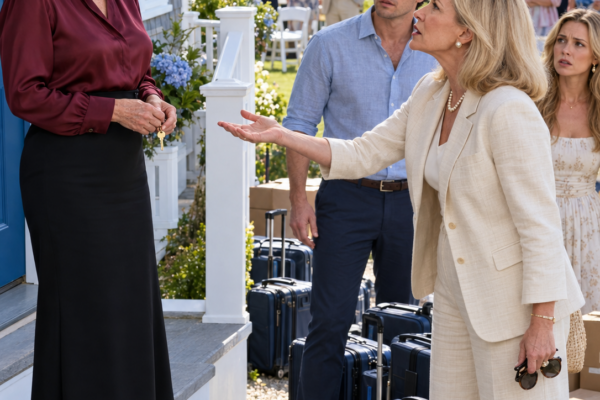
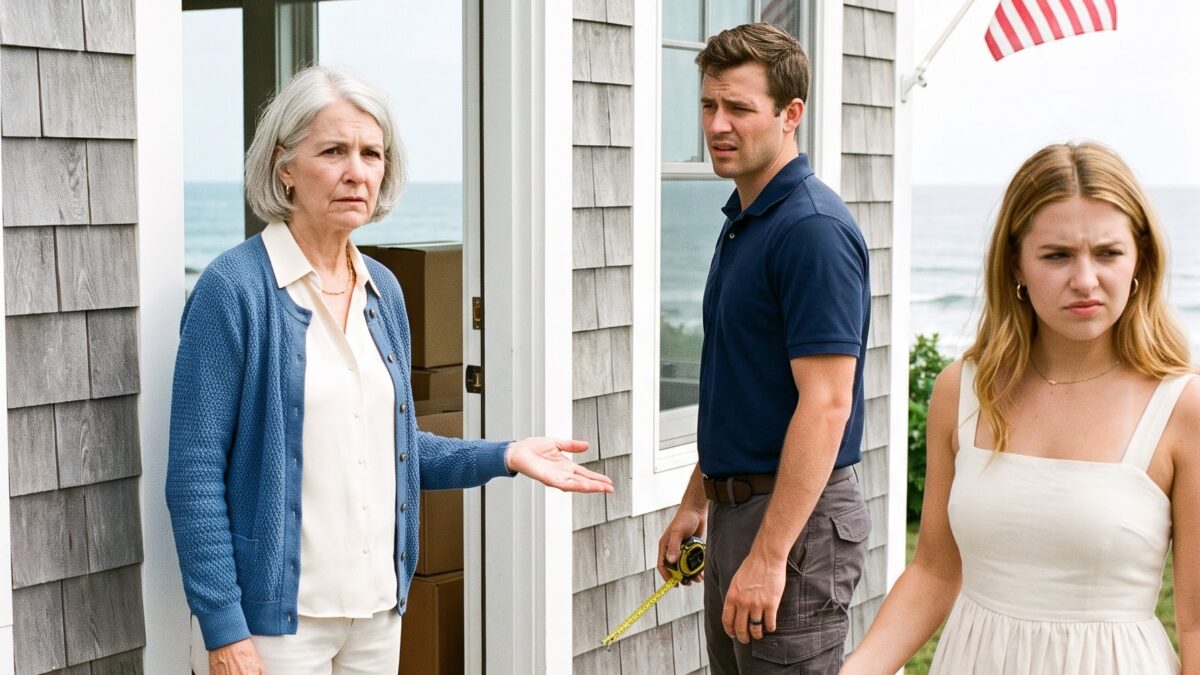
Outside, Lorna was holding one end of a tape measure while Evan held the other.
“Forty by sixty,” she called. “It works if that birdbath comes out.”
I walked onto the porch.
“Put the tape away.”
Evan straightened.
“We were in the area.”
“You used my emergency key.”
“We needed measurements.”
“You needed permission.”
Sienna came out behind me.
“The ceremony would be down there,” she said, pointing toward the dune. “The arch goes where that fence is.”
“No.”
“We can work around the birds.”
“You haven’t worked around me.”
Lorna let the tape snap back into its case.
“Surely we can discuss this without making it unpleasant.”
“I’ve discussed it several times. You need to leave.”
Evan stared at me.
It was the first time I had ever asked him to leave my home.
I had expected it to feel unnatural.
What felt unnatural was finding three people measuring my lawn after I had told them they could not use it.
At the door, I held out my hand.
“The spare key.”
Evan patted one pocket, then another.
“It’s in the car somewhere.”
“Then get it.”
He looked toward Sienna.
“I’ll find it when we get home.”
I waited until their car left before putting away the groceries.
The ice cream had softened.
On Tuesday, a locksmith changed the locks on both doors for $186.
I sent Evan a message explaining why.
“An emergency key does not give you permission to enter for wedding planning. Please arrange visits with me.”
He replied that Sienna had cried for an hour.
Ten minutes later, he added, “Your hotel is booked. Stop making it weird.”
I put the phone down and ate my lunch.
The next morning, Salt and Linen Events posted my porch online.
“Our summer house. Coming 2027: the Gannet Lane Collection. Intimate coastal weddings. Message us for dates.”
I read it three times.
There was my chair. My flowerpot. The little split in the porch rail I had been meaning to sand.
I saved the post.
Then I sent Sienna an email.
“You do not have permission to advertise my home, rent it, accept bookings for it, or represent it as belonging to your business. Remove the listing and correct any information you have given clients.”
I copied Evan.
Sienna answered that it was “an early concept,” not a listing.
The post stayed up.
That was when I understood that summer house had never meant a few towels drying over the porch rail.
She was looking at a venue without a lease, a purchase price, or an owner who expected to be paid.
On May 29, Meera knocked at seven.
“Four eggs,” she said.
I followed her down the established path.
We stopped well outside the cord, and she handed me her binoculars.
It took me a while to find the nest.
Four speckled eggs lay in a shallow scrape among bits of shell. Without Meera’s patient directions, I could have looked at that patch of sand for an hour and seen nothing.
“Late June, probably,” she said. “We’ll watch their progress.”
She installed a small weatherproof camera on an existing monitoring stake outside the enclosure. Its lens was aimed at the nesting area, not my house.
“It helps us understand disturbances,” she said. “Predators, loose dogs, that sort of thing.”
She showed me the limited view on her phone.
The camera did not cover the entire beach. It would not identify everybody walking along the water.
It covered the nest, part of the fence, and the approach beside the dune.
I asked whether I could help with morning observations.
She gave me instructions: stay back, use binoculars, report what I saw, do not approach the nest.
I was awake early anyway.
A few mornings later, I sent my first report.
“Two adults. One sitting. No loose dogs.”
Meera replied, “Perfect.”
There was something satisfying about being useful without being responsible for everybody.
I had also started volunteering on Thursday evenings at a free clinic two towns north.
My license was current. The clinic had checked my credentials and put me through its usual orientation.
For four hours a week, I did work I understood, with people who asked before handing me something.
The rest of the week belonged to me.
At least, that was the arrangement I was trying to establish.
On May 30, Lorna posted in the wedding chat.
“Heartbroken that Bobby changed the locks on her own son. Please be gentle with her. Some people struggle when their children start families.”
I answered beneath it.
“I changed the locks after my house was entered for wedding planning without my permission. My home remains unavailable for the wedding or summer use.”
Then I muted the conversation.
Marian called.
“Now may I say something?”
“You may say whatever you can live with tomorrow.”
“I’ve been a hairdresser forty years. I know how to phrase a correction.”
Her message was shorter than I expected.
“Bobby has been clear. Please stop asking her relatives to change her answer.”
My cousin Terry sent me a private note.
“Are you all right?”
“Yes. Just tired of repeating myself.”
“Understood.”
That small word helped.
I did not need forty-one people to take my side.
I needed a few people to stop treating my answer as a symptom.
On the first Friday in June, a tent supplier called.
“Mrs. Smallwood? Gary Lessard, Lessard Tent and Event. We have a request for a forty-by-sixty tent at your address.”
“I haven’t authorized a tent.”
There was a pause.
“Your son listed you as the property owner.”
“That part is correct.”
“And said you’d sign the site approval.”
“I won’t.”
Gary asked two more questions, then said he would suspend the order.
“We need owner authorization before we proceed. I’ll deal with the client.”
I thanked him.
Before we ended the call, I asked whether he had contact details for the other vendors.
“Only the planner,” he said. “I’m sorry.”
I sent him my refusal in writing so there would be no misunderstanding.
Sienna called that evening.
“Do you understand what you’ve cost us?”
“I didn’t order a tent.”
“We could have worked this out privately.”
“I’ve been trying to do that since April.”
“You’re making me look unprofessional.”
I looked at the printout of her advertisement on my table.
“Then stop advertising a property you don’t control.”
She hung up.
Lorna arrived the next morning with a blueberry pie.
She stood on the porch holding the box in both hands.
“Peace offering?”
I let her in because I still believed a person might come to apologize.
We sat outside.
She admired the view and asked whether the porch chair was teak.
“Hardware store,” I said.
“It looks expensive.”
“It wasn’t.”
She put her coffee down.
“Bobby, mother to mother. The groom’s family usually contributes something.”
“I was planning to.”
“Well, this is what they need.”
She gestured toward the lawn.
“They need a venue they’re allowed to use.”
“After what happened with the barn, we’re all stretched thin.”
I turned toward her.
“What happened with the barn?”
“Double booking. Whitcomb Barn, in Sturbridge. An absolute mess.”
“Evan didn’t mention that.”
“They’re embarrassed. You know how young people are.”
My son was thirty-six.
“Wasn’t there a contract?”
“Oh, there were emails. Deposits. It’s complicated.”
She picked at the cardboard tab on the pie box.
I did not know she was lying.
I knew only that she had arrived asking for a favor and was giving me a story with important pieces missing.
“Then they need to resolve that with the venue,” I said.
“Or we could all be generous.”
“I can be generous without giving up my house.”
At the door, she hugged me.
“Don’t make them choose, Bobby.”
I stepped back.
“Choose what?”
But she was already reaching for her car keys.
I sent the pie home with Rudy that afternoon.
He asked whether I didn’t like blueberries.
“I do,” I said. “I’m tired of what came with them.”
The following Friday, Doug called.
I had not heard his voice since Evan’s college graduation fourteen years earlier.
“Bobby. I hear there’s trouble.”
“Who told you?”
“Lorna.”
That explained how he had obtained my number.
He said we had all made mistakes. He said weddings brought out strong feelings. He said I ought to think about how Evan would remember this.
I stood at the sink, looking at a gull on Rudy’s chimney.
“Have you spoken to Evan?”
“Of course.”
“Have you offered to help him find another venue?”
“I’m not in a position to—”
“Then don’t call to volunteer my house.”
“After all this time, you’re still keeping score.”
“No. I stopped expecting you to pay years ago.”
He went quiet.
I ended the conversation before either of us said something that would have nothing to do with the wedding.
The next Monday, June 15, an email arrived from Sienna.
Not a personal message.
A shared planning document.
My address had been added to a vendor contact list because I was identified as the homeowner. The document’s sharing settings gave the listed contacts access to the schedule and its comments.
I could see how it had happened. Somebody had assumed the person whose house they were using should know when the florist would arrive.
The file was called Gannet Lane Run of Show, Version 4.
Nine pages. Color-coded.
I opened it at the kitchen table.
There were delivery windows, transportation details, meal counts, music cues.
Then I reached Thursday evening.
June 25. 7:30 p.m.
Evan, Sienna, Lorna: clear dune cord and stakes before sunset photographs and drone test.
Below that was a Friday entry.
Mom to Sandpiper. Lorna to collect at three.
The Saturday ceremony was now listed for four-thirty, though the printed invitation still said four.
At the end was a summer schedule.
July 3–August 30: Evan and Sienna in residence.
Mom: Sandpiper?
I stared at the question mark.
My entire summer had been reduced to a problem they expected somebody else to solve.
There were comments along the margin.
One, attached to the hotel arrangement, had been written by Lorna on June 9.
“She’ll fold once the guests are there. She always folds.”
Sienna’s reply was underneath.
“Counting on it.”
I stopped scrolling.
For a while, I could hear only the refrigerator and a loose halyard tapping against a boat mast somewhere down the shore.
I had read enough.
I downloaded the document, saved screenshots showing the dates and comments, and called Meera.
She asked me to email the material.
Then she gave me the number for Warden Rachel Quint.
Warden Quint called back that afternoon.
I explained the house dispute first because I did not want her discovering it later and wondering what I had left out.
She listened.
“The wedding permission is separate from the wildlife issue,” she said. “You can refuse the event without the birds. And they can’t disregard protections because they think you’ll eventually agree.”
“I understand.”
“I want the exact messages. Not just a description.”
I sent them.
She came the next day, looked at the site with Meera, and asked me to show her where the vendors had been proposing to work.
She did not tell me nothing could be done until somebody caused damage.
She explained that she could warn people, document the threat, and investigate any violation. She could not promise to keep a warden standing at my fence for the next eleven days.
That was reasonable.
I did not want a guard.
I wanted the people involved to understand that this was real.
At 7:02 that morning, before her visit, I had texted all three of them.
“You do not have permission to hold the wedding here. Do not remove or move the shorebird fencing or enter the marked nesting area. There is an active nest. I have contacted the project and the warden.”
Evan answered.
“Relax, Mom. It’s string.”
I showed her.
She read it without changing expression.
Then she asked for their numbers.
Over the next day, she reached Evan and Sienna. Lorna returned a message later.
I was not present for those conversations, but Warden Quint told me the outcome.
“They have been warned. They say they won’t touch the enclosure.”
“Did they say the wedding was moving?”
“They said they were making other arrangements. I can’t settle the family part for you.”
“Thank you for making the other part clear.”
That evening, Sienna removed the clearing task from the shared schedule.
The rest of the document disappeared from my access a few minutes later.
Evan sent one more message.
“Happy now? We’ll deal with our own arrangements.”
I wanted to believe that meant what it sounded like.
I still sent a final notice to the group.
“My property is not the wedding venue. Please contact Evan or Sienna for their replacement address. Do not come to Gannet Lane expecting an event.”
Then I left the chat.
I sent the notice directly to relatives whose numbers I had.
Terry replied that she had already asked Sienna.
“She says you two are sorting it out.”
“We aren’t.”
“I’ll wait for something definite.”
I could not call eighty people whose names I did not have.
I could stop allowing anyone to say I had been unclear.
That night, I opened my bread box.
Behind a loaf of rye was a white envelope I had brought from Worcester.
Inside was a cashier’s check for $25,000, payable to Evan Smallwood, dated April 8.
I had bought it before closing on the cottage so the wedding money would be separated from the house money.
He did not know about it.
During the hardest pandemic years, the hospital offered extra-shift incentives. I worked more of those shifts than I should have.
Some nights I came home with marks on my face from protective equipment and sat in my car until I could make myself walk upstairs.
I put part of each extra payment aside.
At first, I did not have a specific purpose.
Then Evan got engaged, and I decided.
I would give him something substantial. Something that would help him begin married life without a stack of bills.
I had pictured handing him the envelope after the first dance.
In that imagined moment, he would hug me.
I would tell him I was happy for him.
Neither of us would have to explain the years when I had been too tired or too busy or too worried.
Now I sat at the table with the check in front of me.
Twenty-five thousand dollars would have covered the missing venue payment, though I did not yet know there was one.
It would have paid for a perfectly good wedding somewhere else.
But nobody had come to me with a budget and a request.
They had come with instructions.
I put the check back.
I was not ready to decide what to do with it.
On June 19, Rudy came over with a bucket of mackerel.
“Too much,” he said.
“For you or me?”
“Both, probably.”
He stood at the edge of the porch.
“Your boy was down by the public access last Sunday. Him and that girl.”
“What were they doing?”
“Measuring.”
“Did they go inside the cord?”
“Not that I saw.”
I thanked him.
He shifted the bucket into my hands.
“If they come back and bother you, call.”
“I will.”
“I mean me, too.”
I watched him walk home.
Then I took the fish inside and found a pan.
It was a relief to be offered help that did not require me to surrender anything first.
Marian called that evening.
“I’m coming up next Friday.”
“You don’t have to.”
“I know. I’m bringing a casserole.”
“That sounds useful.”
“And shoes I can stand in.”
I laughed for the first time that day.
On Monday, Evan called.
His voice was careful.
“Mom, this is your last chance to be part of this.”
“I want to be at your wedding.”
“Then stop fighting us.”
“Pick another place. A restaurant. A church hall. I’ll come.”
“We’ve already put so much into this.”
“That doesn’t give you permission.”
He breathed into the phone.
“Sienna says you’re enjoying making us beg.”
“You haven’t asked me for anything I can agree to.”
“We asked for a wedding.”
“At my home. After I said no.”
He went quiet.
I asked whether he had understood the warden’s warning.
“Yes, Mom.”
“Then leave the fencing alone.”
“We said we would.”
“And the house?”
“We’ll work something out.”
“The house isn’t part of what you’re working out.”
He ended the call.
I sat there a moment, then wrote down the date and what he had said.
I hated doing that.
I had spent years writing objective notes about people on the worst days of their lives.
I had never wanted to keep a record of conversations with my son.
On Thursday, June 25, Meera checked the site in the early evening.
She texted that the fencing was intact and the adults were tending the nest.
I was at the clinic.
Because of the earlier threat, she had arranged an extra look that day. Because Evan and Sienna had received direct warnings and said they would leave the enclosure alone, none of us expected them to carry out the discarded task exactly as originally written.
I still checked my phone between patients.
Nothing.
That evening, I helped with dressings, medication lists, and a fisherman who had waited far too long to have a sore thumb examined.
An older man came for a blood pressure check and stayed to talk about his late wife’s tomato plants.
At nine, I helped wipe down the counter and empty the small trash bins.
I looked at my phone in the parking lot.
A cousin had sent me a screenshot from Sienna’s public account.
Sunset on the beach. A champagne glass. Evan’s sleeve at the edge of the picture.
In the background was a loose pile of orange cord.
I called Meera before starting the car.
She looked at the picture and said she would contact Warden Quint.
I called the warden myself as well and left a message.
Then I drove home.
It was nearly ten when I reached Gannet Lane.
From the porch, I could see that the line nearest the dune was missing.
I did not go down to the nest.
Warden Quint called while I was still standing there.
“Stay back from the marked area,” she said. “I’m on my way.”
She arrived a little after ten.
Under her flashlight, the empty stake holes showed pale against the sand. Farther along, one damaged sign lay near the path.
She took initial photographs from outside the nesting area and spoke quietly with Meera by phone.
An adult bird had returned to the nest.
They decided the detailed inspection and repairs would be safer at first light, when Meera could assess the birds without people stumbling through the nesting ground.
The warden remained long enough to make sure nobody was coming back.
Before leaving, she told me to call if I saw anyone near the dune.
I locked my doors.
Then I sat at the kitchen table until well past midnight.
I did not call Evan.
At that hour, there was nothing he could say that would put the stakes back without risking further disturbance.
At dawn, I went onto the porch.
Meera arrived shortly afterward.
We stood together at the edge of the safe route while she used binoculars.
Her expression changed.
“One egg is damaged,” she said.
I waited while she looked again.
“The other three are still there.”
She called Warden Quint.
I could see disturbed sand near the scrape, but I did not go closer to make my own inspection.
When the warden returned, she photographed the area with Meera’s guidance.
They documented a shoe impression near the nest, missing stakes, discarded cord, and the damaged egg.
Meera’s notes from the previous evening established that all four eggs had been intact.
The camera was still on its stake.
Warden Quint asked Meera to preserve the original memory card. They recorded how it was removed and handled.
Nobody told me the camera would solve everything.
It might have recorded a fox. It might have recorded nothing useful. A few inches outside its view could make a difference.
The warden also examined the public-access area.
Some of the missing materials were in a contractor bag beside the municipal trash barrel: wooden stakes, signs, cord.
She photographed them where they lay before collecting what she needed.
Meera saved Sienna’s public post while it was still available.
I supplied the messages and the earlier schedule.
The record was made of several things, each showing part of what had happened.
While they worked, Rudy came over with a mallet.
He waited until Meera showed him where he could stand.
Then he helped replace the outer line.
I made coffee and carried three mugs outside.
Nobody wanted anything to eat.
By midmorning, the adults had settled again.
Meera stayed for another observation before leaving.
At noon, Evan texted.
“Lorna will get you at three. Room is ready.”
I looked at it for a long time.
Then I replied.
“I am not leaving my home. The fencing was removed last night and a nest was damaged. The warden is investigating. Answer her calls.”
He did not answer mine.
I called Joan at the Sandpiper.
“My son is still telling people I’m coming,” I said.
She remembered the reservation.
“I’ve got your note right here.”
“Please don’t check anybody in as me.”
“We won’t.”
At three, Lorna’s white SUV pulled into the driveway.
She came onto my porch wearing large sunglasses and white wedge sandals.
I noticed the shoes because I had spent the morning watching someone photograph an impression in the sand.
That did not tell me whose foot had made it.
It was enough to make me look.
“Ready?” she asked.
“No.”
“Bobby, please. We’re all tired.”
“I told you I’m staying.”
She held out a small paper sleeve with the hotel’s logo.
“Reservation details. Evan paid.”
I did not take it.
“Did you speak to the warden?”
She glanced toward the new cord.
“I don’t know what you’re talking about.”
“Then return her call.”
Lorna placed the sleeve on my porch rail.
There was no room key inside. Just a printed confirmation.
“You’ll regret this tomorrow,” she said. “When everybody’s here.”
“I’ve told everybody I can reach not to come.”
“Sienna has handled the guests.”
I thought of the document.
She’ll fold once the guests are there.
Lorna returned to her car.
I left the paper on the rail until the wind lifted one corner. Then I took it inside.
Marian arrived a little after four.
She put the casserole in the refrigerator, set her bag in the guest room, and hugged me without saying anything for a while.
That was when I began to shake.
Not much. Just enough that I had to sit down before making tea.
Marian filled the kettle.
“What do you need?”
“I don’t know.”
“All right. We can start with food.”
Warden Quint called that evening.
She had reviewed the recording.
It showed Evan, Sienna, and Lorna entering the camera’s view. It showed Sienna pulling stakes, Evan gathering cord, and Lorna stepping inside the marked area.
It did not provide a close-up of an egg being damaged.
It showed enough, together with the other evidence, to require further investigation.
The warden had reached Evan.
He had acknowledged being there but said they thought they were removing “temporary decoration.”
“She spoke to you herself,” I said.
“I know.”
The warden would return the next afternoon to check the protection measures and speak with the three of them. Evan had said they would be in Marrow Point.
She told me not to arrange a confrontation.
“I won’t.”
“If deliveries arrive, keep them off your property and call if they refuse to leave.”
“I can do that.”
After we hung up, Marian set two plates on the porch table.
“Does he know she’s coming?”
“Yes. He knows she wants to speak with them.”
“And they’re still bringing people?”
“Apparently.”
Marian sat down.
For a minute, she pushed her casserole around with her fork.
“You can’t fix what they’re telling everybody.”
“I know.”
It was one thing to say it.
I was still learning how to sit with it.
At 5:30 on Saturday morning, I heard small, thin calls from the beach.
Meera had told me what newly hatched chicks sounded like, but I was not certain until I found them through the binoculars.
Three.
Tiny pale bodies on quick legs, moving in short bursts around the adults.
I called Meera.
She was there within half an hour.
We stood at the edge of the path while she counted again.
“Three,” she said.
My eyes filled before I could do anything about it.
For eleven weeks, people had been discussing my home as if I were an obstacle inside it.
Down on the sand, three small creatures were trying to get through their first morning.
I could help them by staying where I was.
That was all.
Meera adjusted the protective area as the chicks began moving away from the scrape. They needed feeding ground now, not simply a ring around eggs.
The safe route to the water changed.
She explained it to me and Marian and put up additional signs.
I called Warden Quint with the update.
Then I called Joan.
I did not book a replacement wedding.
I asked whether the inn had any indoor space available if a group arrived needing somewhere else to go.
“The function room,” she said. “Sixty maximum. It’s empty tonight.”
“There are eighty invited.”
“Then it won’t hold all of them.”
“I understand.”
Joan explained the rental fee, staffing limitations, and what the room did and did not include.
“I’m not promising anything on their behalf,” I said.
“Good. Because I’ll need one of them to call.”
She agreed to hold the option until three.
Then I asked about the prepaid room.
“If Evan wants to use it himself, can he?”
“Once he confirms the name change and gives us his identification. Certainly.”
I wrote everything on the back of his confirmation.
I could give him information.
He could decide what to do with it.
At eleven, a small truck with Salt and Linen Events on the side stopped near my driveway.
Two young men began opening the back.
A young woman with a clipboard came up the path.
“I’m here for ceremony setup.”
“I haven’t authorized an event here.”
She looked down at her paperwork.
“This is fourteen Gannet?”
“Yes.”
“Sienna said the family arrangements were resolved.”
“They aren’t.”
The young woman’s face changed.
She called Sienna from beside the truck.
I could hear only her half of the conversation.
“She says there’s no permission.”
A pause.
“No, I’m standing here.”
Another pause.
“I can’t take the crew onto somebody’s property after they’ve refused.”
I liked her immediately.
She returned to the porch.
“We’ll keep everything on the truck.”
“Thank you.”
“Can we wait in the public lot while she sorts it out?”
“As long as the parking rules allow it. Please don’t block the lane.”
They left.
The florist arrived twenty minutes later with the white rose arch in pieces.
I gave the same answer.
The driver called his dispatcher, then Sienna. His delivery instructions had listed the lawn as approved.
He asked whether he could put the assembled arch near the driveway temporarily while waiting for collection. The vehicle was shared with another delivery.
I allowed that, on a patch of grass well away from the beach.
When the wind caught the flowers, he and Marian lowered the arch carefully onto its side.
That was how it came to be lying in my lawn.
No warden had carried it dramatically out of a nesting enclosure.
I had refused delivery to the place Sienna wanted it.
The difference mattered.
At half past one, Warden Quint returned with Warden Jake Tibbetts.
They parked without blocking the lane and went down with Meera to inspect the revised protection area.
There were no sirens.
There was no announcement that justice had arrived.
There were two people doing a job while I tried to work out whether I should change into a nicer cardigan.
In the end, I did.
I would not be attending the wedding, but I was not spending the afternoon in the shirt I had cried into at breakfast.
Marian brushed lint off my shoulder.
“You look fine.”
“I wasn’t asking.”
“I know.”
At two-fifteen, the first guests arrived.
A couple stood at the end of my path with a gift bag.
“We’re early,” the woman said.
“I’m afraid there’s a problem with the location.”
Her smile faded.
“Wasn’t that settled?”
“No.”
“Sienna sent an update.”
She showed me her phone.
The message said the family had “worked through the house arrangements” and that the outdoor celebration would proceed as planned.
I read it without touching the screen.
“I’m sorry you were told that.”
The man looked toward the green trucks.
“Should we go?”
“Please wait by the public lot until they give you a different address. Don’t go onto the beach.”
Marian took over speaking to the next arrivals.
By then, cars were beginning to collect along the lane.
The shuttle driver pulled into the designated public-access lot instead of trying to turn at my house.
I was grateful for every ordinary decision somebody made that afternoon.
Then the white SUVs arrived.
Evan stepped out in a navy tuxedo.
Sienna followed, holding her wedding dress clear of the gravel.
Lorna wore pale pink.
Howard Price, Sienna’s father, got out of the second vehicle with the uncomfortable expression of a man who had been told the delay was somebody else’s fault.
The bridal party gathered behind them.
Sienna saw the arch first.
“Why is that on the ground?”
Then she saw the trucks.
Evan looked at me.
“Mom. What did you do?”
“I stayed home.”
Warden Quint approached from beside the driveway.
“Mr. Smallwood? We spoke yesterday.”
His eyes moved toward the guests.
“Can this wait?”
“We need to speak with you, Ms. Price, and Mrs. Price. Over here, please.”
She indicated the side of the truck away from the arriving crowd.
Sienna did not move.
“We have a ceremony in less than two hours.”
“Your mother has not authorized a ceremony on this property,” the warden said. “The nesting area is also restricted. Those are separate matters.”
Lorna gave a quick laugh.
“Bobby’s upset about the decorations. We were helping clean up.”
I was near enough to hear.
“I did not ask you to remove anything,” I said.
“Let’s not do this in front of people.”
“I asked you to leave it alone.”
Warden Quint held up one hand.
“We’ll discuss the evidence separately.”
They went with her.
I stayed on the porch.
That was where I belonged.
The guests could see uniforms and wedding clothes and the arch on its side. They could hear enough to know something was badly wrong.
They could not see the contents of the warden’s folder.
I did not walk down the line showing strangers my son’s messages.
Terry reached me first.
“I asked her again this morning,” she said quietly. “She told me you’d agreed.”
“I know.”
“I’m sorry.”
“Thank you.”
Behind her, Aunt Rita stood in traveling shoes with a gift clutched against her chest.
I felt sorry for her.
I felt sorry for several people.
That did not give them a wedding venue.
Near the truck, the conversation continued.
I learned later, from the records I was entitled to receive and what Evan eventually told me, that the wardens questioned them separately about the warnings and their actions.
They were shown relevant parts of the recording.
The footage placed all three at the enclosure.
It showed the dismantling.
Lorna’s movement near the nest, the scene photographs, and Meera’s observations formed part of the investigation into the damaged egg.
The warden did not claim the camera showed a perfect close-up of every act.
She did not need to.
After a while, Sienna’s voice rose enough for those nearby to hear.
“It was temporary fencing.”
Warden Quint answered too quietly for me to make out.
Sienna said, louder, “We weren’t trying to hurt anything.”
That, I believed.
They had not gone down to the beach hoping to damage an egg.
They had gone down certain that what they wanted mattered more than the warnings they had received.
The wardens completed the necessary paperwork.
There was no debate over whether signing a form was a confession. No threat invented to force a pen into somebody’s hand.
The three were given their documents and instructions about the court process.
Then Lorna stepped away from the truck.
Her face was flushed.
“This would not have happened if you’d gone to the hotel,” she told me.
Several people turned.
I stayed on the porch.
“This happened because you ignored a warning.”
“Over a few stakes.”
“Over what the stakes were protecting.”
Evan came after her.
“Lorna, stop.”
She turned on him.
“You told us she’d be gone by three.”
“You said you could talk to her.”
“Because you said she always comes around.”
Sienna pressed both hands against the front of her dress.
“Can everybody please stop?”
But Evan had begun looking at Lorna differently.
“You said the barn double-booked us.”
Howard stepped closer.
“What?”
Lorna looked toward him.
“Not now.”
“What about the barn?”
“We had a problem with the payment.”
Evan stared.
“You told us they canceled on us.”
“They did cancel.”
“Because they double-booked.”
Lorna’s mouth tightened.
“Because the balance wasn’t paid.”
The people nearest them stopped pretending not to listen.
Howard said, “I gave you that money.”
“I was going to replace it.”
“How much?” Evan asked.
Lorna looked at him, furious now.
“You know how much. Nine thousand five hundred.”
Howard’s hand dropped from the bridge of his nose.
“Where did it go?”
“I said I was going to replace it.”
She did not explain the spending on my lawn.
I would learn later that there had been household debt and purchases she had concealed from Howard. At the time, all I knew was what she had admitted in front of us.
There had been no double booking.
My cottage had become the solution to a problem I had never been told existed.
Lorna took a step back.
Then she said she felt faint.
Her knees bent, and she lowered awkwardly beside the truck.
I went to her.
Whatever I thought of her, I was not going to stand on a porch while a woman might need help.
“Don’t try to get up yet.”
I asked whether she had chest pain, trouble breathing, or dizziness before she sat down.
Marian brought water.
Warden Tibbetts asked whether he should call for medical assistance.
Lorna said no.
I checked her pulse and watched her breathing, but I did not pronounce her healthy because her heartbeat felt regular.
“A pulse doesn’t tell me why you nearly went down,” I said. “We can have somebody evaluate you.”
“I’m just hot.”
“Then we’ll get you into the shade. If this continues, you need help.”
She remained alert, answered appropriately, and insisted she did not want an ambulance.
Howard and Marian helped her to a chair.
I stayed nearby until she said the dizziness had passed.
Then I stood.
My knees hurt.
I was still sixty-seven, even when other people forgot.
Sienna approached me while I was straightening my cardigan.
“Fine,” she said. “We’ll do it on the lawn.”
“No.”
“The chairs are here. Everybody’s here.”
“No, Sienna.”
“We don’t need the house.”
“You don’t have permission to use the lawn either.”
She looked behind her at the guests.
Some were checking their phones. One man had already returned to the shuttle.
“You’re really going to do this?”
“I’ve given you the same answer since April.”
Evan stood a few feet away.
For once, he did not tell me to relax.
I took the hotel confirmation from my pocket and held it out.
“Room twelve is still paid for,” I said. “Joan can transfer the reservation into your name once you confirm it with her.”
He looked at the paper.
“You can stay at the hotel, Evan.”
He took it.
There was writing on the back.
“The function room is available until nine tonight. Maximum sixty people. There’s a rental fee. You’ll need to speak to Joan and arrange food.”
He looked up.
“You called?”
“I asked what was available. I didn’t book it.”
Sienna made a small, sharp sound.
“A motor inn?”
“It’s an option,” I said. “You’ll have to choose.”
For a moment, he stood with the paper hanging from his hand.
I could almost see him waiting for me to take the next step.
Call Joan. Pay the fee. Rearrange the guests. Explain it gently. Apologize for the inconvenience.
I stayed where I was.
Lorna spoke from the shade.
“You’ve humiliated your own son.”
I turned toward her.
“I read the comment on the schedule.”
She went still.
“‘She’ll fold once the guests are there. She always folds.’”
Howard looked at his wife.
I did not need to raise my voice.
“The guests are here, Lorna. My answer is still no.”
Marian came to stand beside me.
Not in front.
Beside.
The next half hour was untidy.
Nobody drifted away in a graceful silence.
People asked where they were supposed to go. The shuttle driver needed an address. A bridesmaid was crying because Sienna had snapped at her. Someone had left a gift in the wrong SUV.
Evan made calls.
Joan explained the room limit.
Twenty-two people decided not to continue to the reception. Some had long drives. Some were angry. Some simply did not want any more of that afternoon.
The remaining fifty-eight could fit.
The officiant agreed to meet them at the inn.
The caterer had already been booked for an off-site preparation arrangement, and Sienna spent several tense minutes working out what could be delivered to the replacement location.
There were extra charges.
There were things they could not have.
It was still possible to get married.
That fact seemed to offend Sienna almost as much as the rest.
One of the bridesmaids had recorded parts of the public argument on her phone. Another had filmed the arriving wedding party before she understood what was happening.
I did not ask for copies.
I wanted my lawn back.
At last, the shuttle left.
The florist’s driver returned for the arch.
The chair crew, who had never unloaded onto my property, went to the Sandpiper after confirming new instructions.
Sienna got into one SUV.
Lorna and Howard got into the other without speaking to each other.
Evan remained.
The wardens were talking with Meera near the path. Marian had taken the empty water glasses inside.
For the first time all afternoon, my son and I had a little space around us.
He stood looking toward the beach.
The chicks were moving along the damp sand, close to the adults.
“They hatched this morning,” I said.
He watched them.
Then he said, “Dad left.”
I waited.
“You were always working.”
“Yes.”
“I know why. I do.”
I could hear how much effort it took him to say that.
“But it still felt like I was always waiting.”
I looked at his profile.
He was old enough now to have gray at his temple. I could still remember him at Mrs. Gannon’s window, holding a toy he wanted to show me.
“I know you waited,” I said.
“I just wanted something that felt like ours.”
That nearly undid me.
There was a check inside my bread box.
Twenty-five thousand dollars.
I could walk inside, take it out, and put it in his hand. I knew exactly how quickly I could turn his face toward relief.
I kept my hands at my sides.
“You could have come here with me,” I said. “For dinner. For a weekend we agreed on. You could have asked me to help you look at venues.”
He stared at the sand.
“You didn’t ask for something to share, Evan. You told me to leave.”
He rubbed his thumb against the folded hotel paper.
For a while, I thought he might apologize.
Instead, he said, “I have to go.”
“Yes.”
He started toward the driveway.
At the corner of the house, he stopped.
“Are you coming?”
I thought about the inn, the fifty-eight guests, and Sienna waiting for him in the car.
I was tired enough that my feet ached inside shoes I had barely walked in.
“Not tonight.”
He nodded once.
Then he left.
I stood there until I could no longer hear the car.
Marian came out carrying my chipped mug.
The coffee inside it was fresh.
“I made enough for two,” she said.
We sat on the porch.
Neither of us tried to improve the afternoon.
Evan and Sienna married that evening at the Sandpiper.
I know because he sent a photograph the next day.
No message.
Just the two of them standing beneath a drop ceiling, her bouquet held a little too high, his hand at her waist.
I looked at it for several minutes.
Then I wrote, “I hope you build a good life together.”
It was not forgiveness.
It was a wish I could still honestly make.
Joan told me later that they had managed a serviceable reception. There had been enough food once the guest count came down. They had borrowed some smaller forks from the breakfast supply.
Nobody went hungry.
The room was plain.
The marriage was legal.
The ocean had not been necessary for either.
On Monday, I called the credit union about the cashier’s check.
I explained that I still had the original, that it had never been delivered to the payee, and that I wanted to know their procedure for returning it.
The employee told me what to bring.
I drove down with the check, the purchase receipt, and my identification.
They verified the details and handled the return through their process. I signed the required paperwork and kept my copies.
When the funds were credited back, the balance looked unfamiliar.
Not because it was more money than I had ever had.
Because I had not already promised it to someone in my mind.
I wrote the shorebird project a separate check for $500.
Meera said they would put it toward monitoring supplies and replacement fencing.
“That’s generous,” she told me.
“I can afford it.”
For once, I did not add an explanation.
The first court date was August 14.
It was not a single hearing where a judge watched a wedding video and immediately sorted everybody into heroes and villains.
There were attorneys, records, discussions, and later resolutions.
I provided a statement. Meera supplied monitoring notes and documented costs. The original footage and messages mattered more than anything a wedding guest had posted online.
By the time the matters were resolved that fall, Sienna and Lorna each owed a $1,000 fine and $1,500 in agreed restitution connected with the documented response and restoration work.
Evan’s resolution included a $500 fine.
Their individual conduct and the evidence supporting it were handled separately. I did not choose the charges or negotiate the amounts.
I received notice of the outcomes.
Then I put the papers in a folder and closed it.
There was no satisfaction in imagining a court date for my son.
There was relief in knowing I had not been required to pretend nothing had happened.
Salt and Linen Events removed the Gannet Lane post.
The business did not vanish overnight.
Sienna still had clients and work to do.
But two couples canceled after seeing the recordings of the public argument and asking questions about the property she had advertised. I knew about those cancellations because one couple contacted me to confirm that I had never agreed to host events.
I answered plainly.
The cottage was my residence.
It was not a wedding venue.
Howard moved into his brother’s house in Auburn by September.
Marian heard it from Lorna, who called her hoping for a sympathetic audience.
Marian did not offer one.
I knew nothing certain about what happened to their marriage after that.
I had enough family business of my own.
Doug never called again.
On July 23, Meera and I watched one of the chicks lift off the beach.
It flew a short distance and landed awkwardly.
I held my breath until it steadied itself.
“That counts?” I asked.
“That counts.”
The others were flying that week, too.
For almost a month, we had watched them survive things that looked minor from a porch: a loose dog, a hot afternoon, somebody ignoring a sign.
Now they could get off the ground.
Meera made her notes.
I went inside and brought out the good cookies.
By late August, the birds were gone.
The project removed the seasonal cord when it was appropriate. A few pale holes remained where the stakes had been.
I missed seeing them.
I did not miss having something else to defend.
I had the furnace serviced. I painted the guest room a soft blue. Rudy showed me how to shut off the outdoor water before winter.
On Thursdays, I still drove to the clinic.
Sometimes I stopped for supper on the way and read a paperback in a booth by myself.
I was getting better at being alone without explaining it as a temporary condition.
On Monday, August 31, Evan texted.
It was the first message since the wedding photograph.
“Can we come up for Labor Day weekend? Just Sienna and me. We’d like to talk.”
I read it at the kitchen counter.
Then I carried my coffee outside.
The second porch chair was empty.
I pictured him in it.
I wanted to hear him laugh without wondering what the laugh would cost me afterward.
I wanted to know whether he had begun to understand.
I also knew that wanting those things did not require me to hand over a key.
I typed my answer.
“You can visit on Saturday. Call first so we can agree on a time. Stay at the Sandpiper.”
I read it once.
There was nothing unkind in it.
There was a place to sit. There could be coffee. There could be a conversation if they were ready to have one.
I sent it.
Then I went inside to make breakfast, leaving both porch chairs where I wanted them.