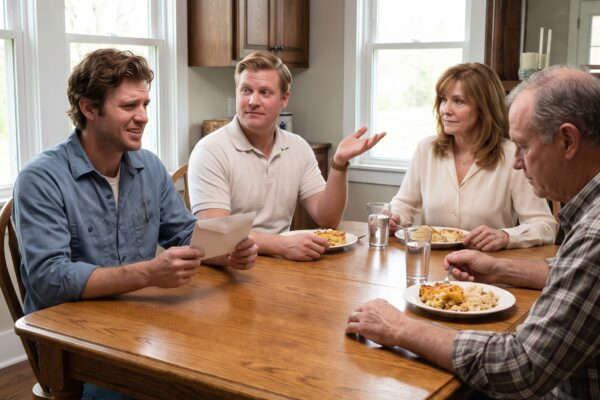
Whenever I was away, my daughter-in-law used the spare key I’d given my son without my permission, coming and going, signing for packages, and acting as though she owned the place. I had no idea this had been going on for a month—until the mailman asked, “Isn’t your wife coming out to get the package today?”
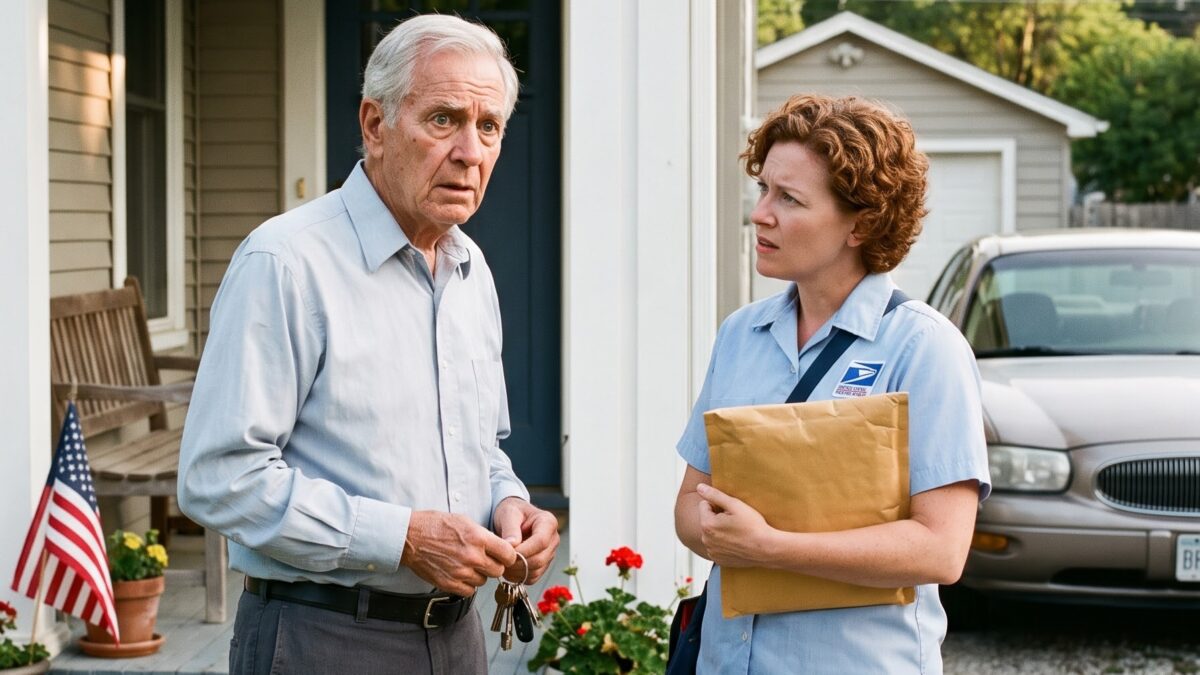
I came home early that Tuesday when the mail carrier stopped me at the curb.
“Mr. Voss? Your wife didn’t come out today. Should I leave this with you?”
“My wife died seven years ago,” I said. “I live alone.”
He looked down at the padded envelope in his hand.
“I’m sorry. I didn’t know. There’s been a woman here most afternoons since I took over this route. She’s signed for a couple of things. I assumed.”
I asked him to describe her, although I already had a sick feeling about the answer.
Then I opened the delivery notices I usually ignored on my phone. An expensive replacement part had arrived the previous week, and the private carrier had attached a photograph.
My daughter-in-law, Petra, stood in my open doorway.
Behind her, at the edge of the picture, a man’s hand rested against the doorframe. He wore a broad silver ring with an eagle spreading its wings.
My younger brother had worn a ring like that.
Everett had been missing for eighteen years.
The inspection that brought me home early had been canceled because the contractor hadn’t finished the stairwell. At sixty-seven, I still liked fieldwork better than sitting through meetings about it.
I had spent thirty-four years inspecting buildings, first for the city and later through the consulting firm I helped build. After a larger company acquired us, I kept a reduced schedule. Three days a week suited me. It gave me a reason to shave and somewhere to go after breakfast.
Denton Shaw had taken over our postal route about six weeks earlier. He knew my name from the mail, my Buick from the driveway, and very little else.
That probably explained why Petra had been comfortable with him.
“Did she say she was my wife?”
“Not directly.” He thought about it. “She said she was Mrs. Voss. Asked whether anything needed a signature.”
Petra was Mrs. Voss. She had married my son, Reed, four years earlier, when their daughter, Nora, was almost four.
A technically truthful answer could still do a great deal of damage.
I thanked Denton, took my mail, and drove past my house.
In the grocery store parking lot six blocks away, I enlarged the delivery photograph until the image blurred.
The ring was similar. That was all I could honestly say.
Everett’s had a nick across one wing. I couldn’t see enough detail to tell whether this one did.
I called Corbin Hail.
We had met years earlier after a fire at a commercial property I had inspected. He had investigated the insurance claim, found discrepancies in the owner’s account, and been careful enough to distinguish them from mistakes in mine. We had stayed in touch after his retirement.
“Who has a key?” he asked.
“Reed.”
“Anyone else?”
“Not that I know of.”
“Then start there. Don’t start with your brother.”
I stared at the enlarged hand.
“I haven’t said anything about my brother.”
“You sent me the picture. I remember that ring.”
He let me sit with that for a moment.
“Callum, a photograph is a reason to ask questions. It isn’t an answer.”
Petra’s silver Civic was gone when I returned that evening.
There were no broken windows or damaged locks. My house smelled faintly of a sweet hand lotion Margot had never used.
On my desk, the insurance folder sat beneath the electric bill instead of inside the filing cabinet. My blood pressure bottle was on the bathroom counter. I kept it in the drawer because the morning sun heated that side of the room.
In the bedroom, Margot’s mahogany watch box had been moved far enough to expose a clean rectangle in the dust.
I photographed those things. Then I checked the safe.
The cash was there. So were the deed, my estate papers, and the shareholder statements.
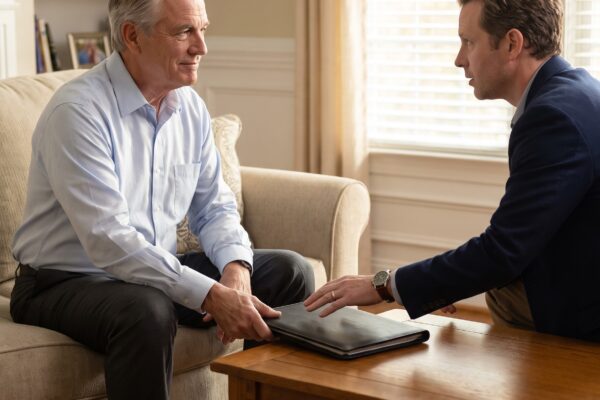
When Corbin arrived, I showed him the photographs.
“Could you have moved any of these yourself?”
“The folder, possibly. Not the watch box.”
“Write that down exactly. Don’t make your certainty bigger than it is.”
I wanted him to sound angrier. Instead, he made coffee and asked whether Petra had ever offered to help with paperwork.
“She offered after Margot died. Reed offered again last Christmas.”
“Did you accept?”
“No.”
He nodded toward the safe.
“What are we protecting?”
“My house. Savings. Eighteen percent of Veritech Holdings.”
He lowered his cup.
Veritech was privately held. When it acquired our consulting business, my partner took more cash and I took more stock. I had never become fabulously wealthy, but the shares represented most of what Margot and I had spent our working lives building.
Reed knew about them.
Six years earlier, he had sat beside me at this same desk and asked whether I still owned eighteen percent.
I remembered his question because I had been pleased he was interested.
Now I wished I remembered what else I had told him.
The next morning, I called my attorney, Gerald Ashworth.
He told me to secure my accounts immediately, document what I found, and avoid confronting anyone alone.
He also explained the difference between letting a trusted relative collect mail and letting that relative enter whenever they pleased.
“If you haven’t authorized these visits, say so clearly when we report them. But first, let’s establish what happened.”
Corbin brought Floyd Okafor, a retired colleague of mine who had installed security equipment for his own rental properties.
Floyd set up three motion-activated cameras: one facing the entry, one covering the study doorway, and one in the living room. He disabled their microphones. Gerald had cautioned us against casually collecting private conversations.
We left the bedroom and bathroom alone.
I changed my online passwords, called my bank, and arranged to have a locksmith come after work Thursday. Gerald suggested preserving one ordinary day of activity before the key stopped working, provided I stayed away and did not put myself at risk.
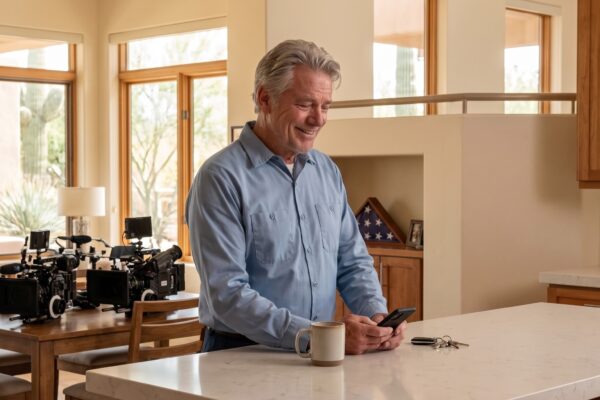
At ten seventeen Thursday morning, my phone alerted me.
Petra entered carrying a canvas tote. She hung her jacket on my hook and went straight to the study.
Eleven minutes later, she admitted a man I didn’t recognize.
They were in the house for nearly an hour.
That evening, Corbin and I watched the footage at my kitchen table.
The man photographed the safe and measured its exterior. Petra took papers from the filing cabinet and laid them on the desk.
Then she opened my medication bottle.
She tipped several tablets onto the study floor, took pictures with her phone, collected them, and returned them to the bottle.
Next she carried my spare car keys into the kitchen. The living room camera showed her returning without them.
I found them later beneath the dish towels.
I replayed the part with the pills.
Petra had knelt carefully, making sure her sleeve didn’t obscure the scattered tablets.
“She wants pictures of a man who can’t manage himself,” I said.
Corbin watched it again before answering.
“That’s a reasonable concern. Now we need evidence of what she intended to do with them.”
The locksmith arrived at six.
I had every exterior lock changed.
Friday morning, my physician’s office called.
Dr. Sylvie Grant asked whether I had authorized Petra to request my medical records.
“No.”
“She brought in a release. Our staff couldn’t verify it, so we didn’t process it. I wanted to check with you directly.”
“Was it signed?”
“Yes.”
“Please preserve it. My attorney will contact your office.”
Dr. Grant did not diagnose a conspiracy over the telephone. She told me that concerns about my memory should be addressed with me and that no one had been given my records.
That was enough.
At my bank, Monica, the branch manager, found an uncompleted request to give Reed authority over certain accounts.
The supporting paperwork included what appeared to be my signature.
The bank had held the request because it needed additional verification.
“Has any money moved?” I asked.
“Not under this request.”
I let out a breath so long she looked up from her screen.
We added security precautions, reviewed recent activity, and established a way for the bank to contact me directly. Monica explained what she could provide that day and what the fraud department would have to send later.
By the time I left, I had three pages of notes and an appointment to return.
Nothing had been fixed by one dramatic phone call.
But nothing had been handed over, either.
That afternoon, Petra posted in the family group chat.
Found a wonderful doctor who works with older adults. Callum, I booked Thursday morning for you. Just a check-in!
I looked at the message for several minutes.
Then I wrote:
Send me the office information. I’ll call them myself.
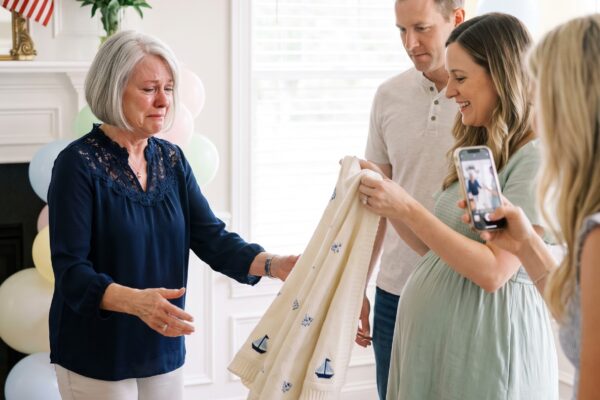
Nora turned eight that Saturday.
I almost stayed home. Gerald said that decision was mine, and Corbin offered to wait nearby if I went.
In the end, I took the bicycle bell Nora had asked for and a card with twenty dollars inside.
She met me at the door wearing paper butterfly wings.
“Grandpa, listen.”
She rang the bell before I had even removed it from its packaging.
For a few minutes, I could breathe normally.
Petra had arranged the adults around the dining table while the children ate pizza in the family room. Her father, Sterling Langden, sat at the far end in a sport coat.
He owned several businesses, although he usually described himself as an investor. Reed had once gone to him for financing on a small development project.
Petra placed me between her aunt and a cousin.
Reed told a camping story while someone passed the salad.
“Remember when Dad forgot the tent poles?”
“I remember the car being overloaded,” I said.
Margot and I had taken the tarp instead of the tent. Reed had complained about sleeping underneath it until the rain stopped.
He smiled without looking at me.
“Same difference.”
Petra touched my forearm.
“There have been a few little things lately.”
“What things?”
“Oh, nothing we need to get into at Nora’s party.”
She had brought it up at Nora’s party.
Sterling leaned back.
“Accepting help doesn’t mean surrendering your independence, Callum.”
I put my fork down.
“I’ll ask when I need help.”
Nobody argued. That almost made it worse.
Later, while Petra cut the cake, Nora pulled me toward the coat closet.
She pressed a blue flash drive into my hand.
“Mom dropped this when she took stuff out of her bag.”
“Does she know you found it?”
Nora shook her head.
“She was looking for it yesterday. I heard her tell Dad it had your house videos.”
I closed my fingers around it.
“Thank you for telling me.”
“Am I in trouble?”
“No.”
“Mom said nobody should give it to you.”
I crouched so we were eye level.
“You don’t have to solve anything between the grown-ups. And you don’t have to keep secrets for me. If somebody asks, tell the truth.”
She looked toward the kitchen.
“Are you mad at Dad?”
“I’m upset about something. I still love you exactly the same.”
She hugged my neck hard enough to bend the cardboard wings.
I carried that feeling home with me, along with the drive.
Corbin did not plug the flash drive into my laptop.
He labeled it, noted when and how I had received it, and called Gerald. A digital examiner Gerald regularly used made a preserved copy and reviewed it on a separate machine.
There were several short recordings.
One showed me opening my safe.
Another showed me at my desk, speaking to the bank and verifying personal information.
The camera angle was high and slightly to my left. Neither recording had come from the cameras Floyd installed.
I walked through the house with Floyd and pointed out where the image must have originated.
He examined the bookcase, the curtain hardware, and finally the hardwired smoke detector near the study entrance.
Inside the detector housing was a tiny camera with a storage card.
Floyd photographed it in place and stopped touching it.
The police arranged to collect it. I bought a replacement smoke detector before bedtime.
At first, we could establish only that someone had recorded me without my knowledge. Later, the examiner matched the flash drive clips to the device, and investigators found older copies elsewhere.
The monitoring had begun months before Denton took over the route.
I had eaten breakfast under that camera. Paid bills. Spoken to my son.
One recording showed me returning from a visit to Margot’s grave and sitting at the desk without turning on the light.
I asked the examiner to stop playing it.
He did.
Agnes Puya, who lived across the street, called Sunday evening.
“Did Petra tell you she visited me?”
“No.”
“She brought coffee cake. Asked whether you’d been wandering around or forgetting where you lived.”
I stood beside my kitchen window and looked at Agnes’s porch.
“What did you say?”
“That I’d seen you take your garbage out on the right day for fifteen years, which is more than I can say for myself.”
For the first time all weekend, I laughed.
Then she said she had noticed a dark sedan parked near my house on two afternoons.
“I wrote down part of the plate after the second time. Probably nothing, but I didn’t like it.”
I asked whether she would speak to the investigator.
“Of course.”
She didn’t claim to know who had driven it. She didn’t invent dates she couldn’t remember. Her account was useful because she kept it small and accurate.
Over the next week, I learned that Petra had been working on more than photographs.
Someone had changed the email address on my homeowners insurance account. A request to redirect shareholder correspondence had reached Veritech’s administrator. A mail-forwarding request I hadn’t submitted was being reviewed.
My property tax payment was still current. My insurance was still active. The danger was that future notices might disappear while I believed everything was being handled.
Untangling it took calls, identification checks, and written confirmations.
Gerald contacted Veritech’s counsel. I notified the insurance company and the postal inspection service. The bank continued its own review.
My kitchen table disappeared beneath folders.
Each afternoon, I put them away before dinner.
I refused to let Petra turn every room in my house into her office.
I kept the appointment with Dr. Gerald Crane because I wanted to know what had been requested in my name.
Beforehand, Gerald helped me prepare questions. Floyd drove me and waited outside the examination room.
I placed my phone on the desk.
“I’d like to record our discussion so I can review it later. Is that all right?”
Dr. Crane hesitated, then agreed.
Only then did I start recording.
He asked about sleep, appetite, and medication. I answered.
Then he introduced a memory screening.
“What did Petra tell you?” I asked.
“That the family had some concerns.”
“Did she provide photographs?”
He looked at the folder beside him.
“Some supporting material.”
“I’d like copies of anything you’re relying on.”
He said the office would handle a records request.
I completed the screening. I also told him that photographs of pills on my floor would need context because I had video of another person putting them there.
His pen stopped.
“I’m not making any determination today,” he said.
“That’s good. Neither am I.”
The appointment ended without a diagnosis.
A week later, Dr. Grant referred me for an independent evaluation. I went through it honestly, including the questions I found irritating.
The resulting report did not suggest that I was unable to manage my affairs.
It wasn’t a declaration that I would never become ill or forget anything. It described my condition at that time.
That was what I needed.
Gerald explained the proposed takeover one afternoon in his office.
“They appear to have been pursuing two routes. Get you to authorize control voluntarily, or build a case for a court proceeding if you refused.”
“Could a doctor give Reed my shares?”
“No. A medical opinion isn’t a transfer of ownership. And a court appointment would involve procedures they can’t simply skip.”
“Then why all the photographs?”
“To make their account look credible. To pressure you. Possibly to support allegations later.”
He pushed a draft across the desk.
It was a broad financial power of attorney prepared by Sterling’s longtime lawyer, Whitmore Fitch. Reed would have been the named agent, with extensive authority over investments.
Fitch had withdrawn after questioning the information provided to him. After obtaining his own legal advice, he had contacted Gerald through counsel. Other records would be handled through the investigation rather than an informal exchange of client files.
The draft was unsigned.
The accompanying proposal contemplated putting my Veritech shares into a new management arrangement. Sterling’s company would collect fees and gain influence over any eventual sale.
There was no court order. No legitimate reason for me to sign.
“What about Reed’s development?” I asked.
Gerald folded his hands.
“That’s something investigators are looking at.”
I already knew the project had failed.
I had not known how much my son owed.
The local detective reviewing the entry and forged documents referred parts of the case to other investigators. The use of mail, electronic submissions, and multiple financial institutions brought federal involvement.
Special Agent Lena Marsh met with Gerald and me several weeks after Denton stopped me.
She did not congratulate us on solving the case.
She asked who had handled each device, whether the camera clocks were accurate, and which statements I knew firsthand.
When I said Petra was trying to have me declared incompetent, she asked:
“What supports that conclusion?”
We went through the photographs, requests, appointment messages, and draft paperwork.
She took notes.
“Keep protecting your accounts,” she said. “Don’t take risks to get us more evidence. If they contact you, preserve the message and let us know.”
By then, the man in my house had been identified as Decker Poot, an associate who did contract work for Sterling.
His name meant nothing to me.
The ring still did.
Lena had a copy of an old photograph of Everett wearing his.
“Please don’t contact Mr. Poot yourself,” she told me.
I hadn’t planned to.
But I understood why she asked.
Reed came to my porch at eleven thirty-seven one night.
I remembered the time because I had just turned off the television and was checking whether the back door was locked.
He wore yesterday’s shirt. Rain had flattened his hair.
“Can I come in?”
I let him into the living room.
He sat in Margot’s reading chair, then immediately stood again.
“Dad, I did something terrible.”
I waited.
He said he owed six hundred forty thousand dollars connected to the failed development. Sterling controlled the lender.
There had been extensions, fees, promises that another deal would rescue the first.
Then Sterling began talking about my investments.
“He said you were sitting on assets you weren’t using. That we could manage them better. That the debt could be resolved.”
“Did you think those shares were yours?”
“No.”
“Did you give Petra your key?”
“Yes.”
“Did you sign my name?”
His eyes filled.
“On the bank form.”
I looked at the dark television screen. Our reflections were faintly visible in it.
“What about the camera?”
“Sterling called it a safety monitor. I knew you hadn’t agreed.”
That answer hurt more than the first excuse would have.
Reed said he had seen correspondence Petra left open on their shared computer. It described him as the person responsible for obtaining my authorization. Sterling and Petra were arranging to distance themselves from the requests if anyone questioned them.
“They’re going to put everything on me.”
“You put some of it on yourself.”
“I know.”
For once, he didn’t add anything.
I told him to get his own lawyer. Gerald could not represent both of us.
“If you want to tell investigators what happened, do it with advice. And tell the whole thing.”
“What happens to Nora?”
“We make sure the adults who care for her tell her the truth in a way she can carry.”
“Can she stay with you if she needs to?”
“Yes.”
He rubbed his hands together.
“Is there anything left between us?”
I wanted a clean answer. I didn’t have one.
“You’re my son. I’m angry enough that I don’t know what comes next.”
He nodded.
At the door, he asked whether he could hug me.
I said, “Not tonight.”
He left without arguing.
Two days later, an unfamiliar number sent me a message.
We know Reed visited you.
I forwarded it to Gerald and Lena.
Corbin did not tell me it was an automated trigger. We had no basis for knowing that. Someone could have watched the street, heard from Reed, or seen a message elsewhere.
The uncertainty was unpleasant enough without pretending we understood it.
Around the same time, Adult Protective Services contacted me about a report alleging confusion and unsafe living conditions.
I agreed to an appointment.
The worker asked about my routine, food, bills, medications, and support. I showed her the house and explained the financial concerns already under investigation.
She did not pronounce me mentally fit for all purposes. That wasn’t her job.
The matter was closed without protective intervention, and I requested the available written documentation through the proper process.
Meanwhile, Reed’s lawyer arranged for him to speak with investigators.
Cooperation did not make his responsibility vanish. It did provide records and details nobody else could supply, including how the debt had been used to keep him involved.
He told investigators about the ring.
Sterling had asked him for an old photograph of Everett.
Reed had sent one.
When Lena told me that, I closed my eyes.
My son had given them something else they could use against me.
The final invitation came in late spring, almost two months after Denton’s question.
Petra called it a family financial meeting.
Sterling’s office. Thursday. Two o’clock.
“Just come hear us out,” she said. “Nobody’s taking anything from you.”
I wrote down her exact words after the call.
Gerald reviewed the invitation with investigators. They already had substantial evidence and were preparing action independent of whatever I said at the meeting.
I would not sign anything. Gerald would accompany me. Investigators would control their own arrangements.
That made the decision easier.
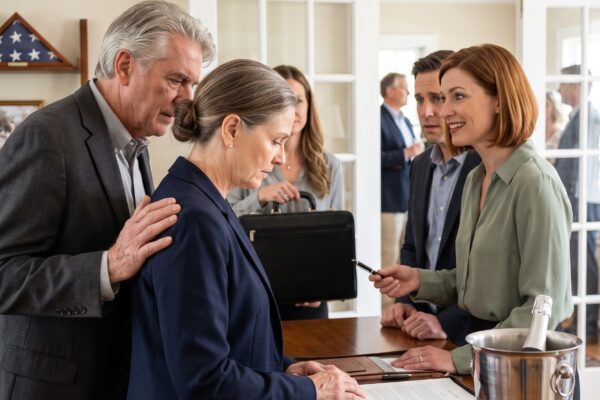
Sterling’s conference room overlooked a parking lot bordered by struggling ornamental trees. Petra sat beside him. Reed was already there, attending under advice from his own lawyer.
A different attorney placed a packet before me. Fitch was gone.
The new lawyer said he understood I wanted assistance organizing assets.
“I haven’t said that,” I replied.
He looked at Sterling.
Petra leaned forward.
“Callum, we’re trying to avoid a difficult process.”
“What process?”
“Having strangers make decisions about your care.”
Gerald spoke.
“His care is not the subject of this agreement.”
Sterling opened his hands.
“Then let’s keep this practical. Reed can handle the financial burden. You retain the benefit of everything.”
I turned several pages.
There were management fees. Broad authority. Provisions I had already reviewed with Gerald.
“You sent a doctor pictures of pills on my floor,” I said to Petra.
“We were concerned.”
“You put them there.”
She glanced at Reed.
He kept his hands flat on the table.
Sterling said, “This isn’t helping.”
I put the packet down.
“If you believe I understand this agreement, stop telling people I can’t manage my affairs. If you believe I don’t understand it, stop asking me to sign.”
The attorney closed his folder.
“I need to clarify what I’ve been told.”
That was the first sensible thing anyone on their side had said.
A knock came at the door.
Lena entered with other agents. They identified themselves, showed the appropriate paperwork, and directed everyone to remain where they were.
The evidence supporting their action had been developed before that afternoon. My refusal wasn’t a legal trick that created it.
Petra stood halfway up.
“Reed?”
He looked at her.
“I gave them the messages.”
“You promised—”
“So did you.”
Lena separated them before the argument went further.
Sterling asked for his lawyer. Nobody gave a speech about that request. The meeting was over.
I watched Petra look at the unsigned packet.
For weeks, she had arranged photographs in which I appeared to be losing control.
Now she couldn’t make me pick up the pen.
The cases took more than a year to resolve.
There were interviews, additional searches, plea discussions, hearings, and dates that changed. I learned to keep courthouse parking receipts in a separate envelope.
Sterling and Petra ultimately admitted to serious fraud offenses and received prison sentences. Decker pleaded guilty and provided information about the surveillance and the staged visits.
Records found during the investigation showed that the camera had been operating for months. The flash drive Nora found had been a working copy Petra carried while collecting material for their proposed case against me.
Decker also confirmed that Sterling instructed him to wear the eagle ring.
It had been purchased through a dealer handling estate and pawned jewelry. Investigators developed enough of its history to connect it to an older sale near Medford, though they could not explain every year it had been gone.
It was Everett’s.
They had used Reed’s photograph to recognize it.
Their hope was that I would see it, become distressed, and make claims about my missing brother they could portray as confusion.
Reed received a sentence that included probation and financial consequences. His cooperation mattered. So did his admission that he had knowingly signed my name.
There was no automatic forgiveness from the court or from me.
Dr. Crane’s conduct became the subject of a separate professional investigation. His license was later revoked on a broader record of misconduct established through that process.
Nora stayed with me for a time under arrangements worked out with the responsible adults and their lawyers.
I put a night-light in the upstairs hallway.
On her first evening, she asked whether her mother was a bad person.
“Your mother made some very serious choices,” I said.
“Does she still love me?”
“I believe she does.”
“Can I still love her?”
“Of course.”
She fell asleep with the bicycle bell on her bedside table.
Reed came on Saturdays.
At first, we talked almost entirely about Nora. School forms. Shoes. Whether she had finished her reading log.
He found work estimating repairs for another contractor and started rebuilding a life with less room for pretending.
He never asked me to pay his debt again.
One afternoon, he found me pruning Margot’s roses.
A neighbor had helped me keep them alive over the years, but I had avoided doing the hard cutting myself. Some canes had grown tangled through the fence.
Reed stood on the path.
“Mom would tell you to take that whole branch.”
“I know.”
He picked up the fallen cuttings without asking.
We worked for twenty minutes.
When he left, I let him hug me.
It didn’t settle everything.
It let us finish that afternoon.
After Sterling’s sentencing, Lena asked about Everett again.
Some older business records had raised questions extending beyond the scheme against me.
She couldn’t tell me everything. She asked whether he had ever mentioned holding companies, unusual investors, or arrangements involving older property owners.
I said no.
Then I thought of Margot.
She had been the person Everett called when he needed someone to listen without interrupting.
That evening, I began sorting the bottom drawer of her dresser. I had opened it since her death, but usually only to retrieve scarves or move a stack of photographs.
This time I emptied it.
The fabric liner lifted with the last folded quilt square.
Underneath lay an envelope.
On the front, in Margot’s handwriting:
Callum—if Everett’s trouble ever comes back.
I sat on the bed before opening it.
Inside were a brass key, paperwork for a safe-deposit box, and a letter.
She wrote that Everett had visited her shortly before he disappeared. He had been frightened by a pattern he believed he had found: older people with substantial assets, relatives under financial pressure, and businesses benefiting from the resulting transfers.
He had left copies of records with her.
He said he needed to go away.
Margot had believed him when he promised to contact us once it was safe.
By the time she realized he wasn’t coming back, she was ashamed of keeping the first secret and afraid of what the documents might bring to our door.
I read that paragraph twice.
My wife had been a good woman.
She had also made a decision that hurt me.
Both things could be true.
Near the end, she wrote:
I should have told you. If you are reading this, I waited too long.
Then, beneath her signature:
Please take care of the roses. Even when they look beyond saving.
The key alone did not open the box for me.
I called the bank named on the old agreement. There had been changes since Margot’s death, and access required documentation.
Gerald helped me establish my authority. The bank checked its records and arranged an appointment.
The box contained business papers, an old flash drive, and a note in Everett’s backward-leaning handwriting.
Sterling is part of it. Don’t assume he began it.
An examiner copied the drive. Some files were damaged. Others matched printed records in the box.
One holding company appeared in the early capitalization documents of three businesses.
One of those businesses was mine.
I did not decide that everyone who had ever helped me must have been part of the scheme. I gave the material to Gerald and Lena.
Still, I went home and took my original partnership papers from the safe.
There, on a page I had signed decades earlier, was the same company name.
Circled in blue in Everett’s copy.
I remembered the investor who had introduced it.
I remembered trusting the accountant who said the arrangement was ordinary.
I could no longer remember asking enough questions.
Several weeks later, my phone rang from an unfamiliar number.
“Gideon.”
Only a few people used my middle name.
I stood so quickly that the kitchen chair scraped the floor.
“Everett?”
“Yeah.”
His voice had changed. It was older, rougher. But he still swallowed the end of my name the same way.
“Where are you?”
“I saw the article about Sterling.”
“Where are you?”
He breathed into the phone.
“I can’t explain everything in one call.”
“Then explain one thing. Eighteen years.”
“I was scared.”
“We were scared too.”
He said nothing.
I looked at the window above the sink. Outside, the rose canes I had cut were putting out small leaves.
“Margot died,” I said.
“I know.”
That nearly ended the conversation.
“You knew?”
“I found out later.”
“And you still didn’t call.”
“I thought staying away kept you out of it.”
“It didn’t.”
His breathing became uneven.
For years, I had imagined this call ending with relief. I hadn’t imagined anger arriving beside it.
Everett said there was a holding company in the documents that investigators needed to examine. He warned me that Sterling had worked for people whose names weren’t on the recent paperwork.
I told him the records were already with my lawyer and the investigators.
“Who’s helping you?” he asked.
I named them.
He paused at Corbin’s name.
“Be careful about old introductions. I remember how some of those people knew each other.”
“If you know something about Corbin, say it.”
“I don’t know enough.”
“Then don’t ask me to accuse him.”
Another silence.
“You’re right.”
It was the first answer he had given me that felt like a beginning.
“Call Lena Marsh,” I said. “I’ll give you her office number. Tell her who you are. You don’t have to tell me your location tonight, but you need to stop leaving clues and disappearing.”
“I don’t know if I can.”
“You called me. Do the next thing.”
He asked about the roses.
“I’m taking care of them.”
“Good.”
“Everett?”
“Yeah?”
“I’m glad you’re alive. I’m still angry.”
“I know.”
This time, before the call ended, he let me give him the number.
I reported the call.
The older records became part of an ongoing investigation. They did not resolve Everett’s disappearance in a week, and they did not turn every suspicion into a fact.
For the first time in eighteen years, though, there was a voice to follow instead of an empty space.
I returned to work the next Monday.
At lunchtime, Reed texted to ask whether he could bring Nora for dinner Friday.
I told him to bring something for the grill.
Later, Denton stopped at my gate with a package that needed a signature.
“Just you today?” he asked.
“Just me.”
He handed over the pen.
I signed my own name.
Then I carried the package inside, set it on the kitchen table, and went out back to water the roses.
Certain details in this story have been fictionalized for educational and entertainment purposes.