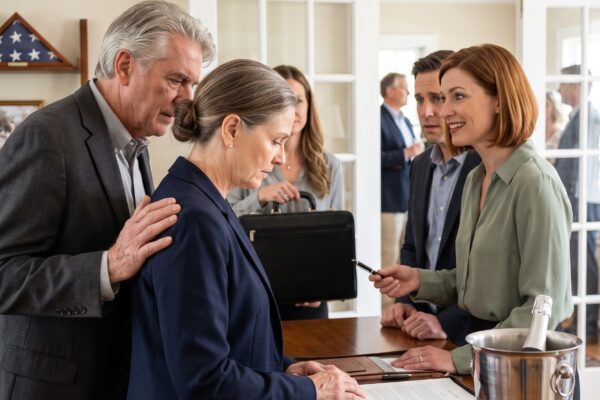
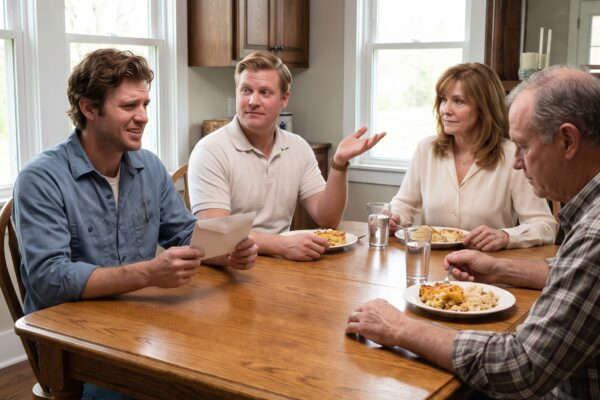
I was holding my wife’s hand after heart surgery when my daughter-in-law called to brag: “Your son chose my mother’s birthday party over the hospital.” I heard him laughing after ignoring my eleven calls. Days later, he stood in our living room: “I hope you’re not angry, Dad.” I smiled. “Angry? No. Actually, I should thank you.” His face went pale…
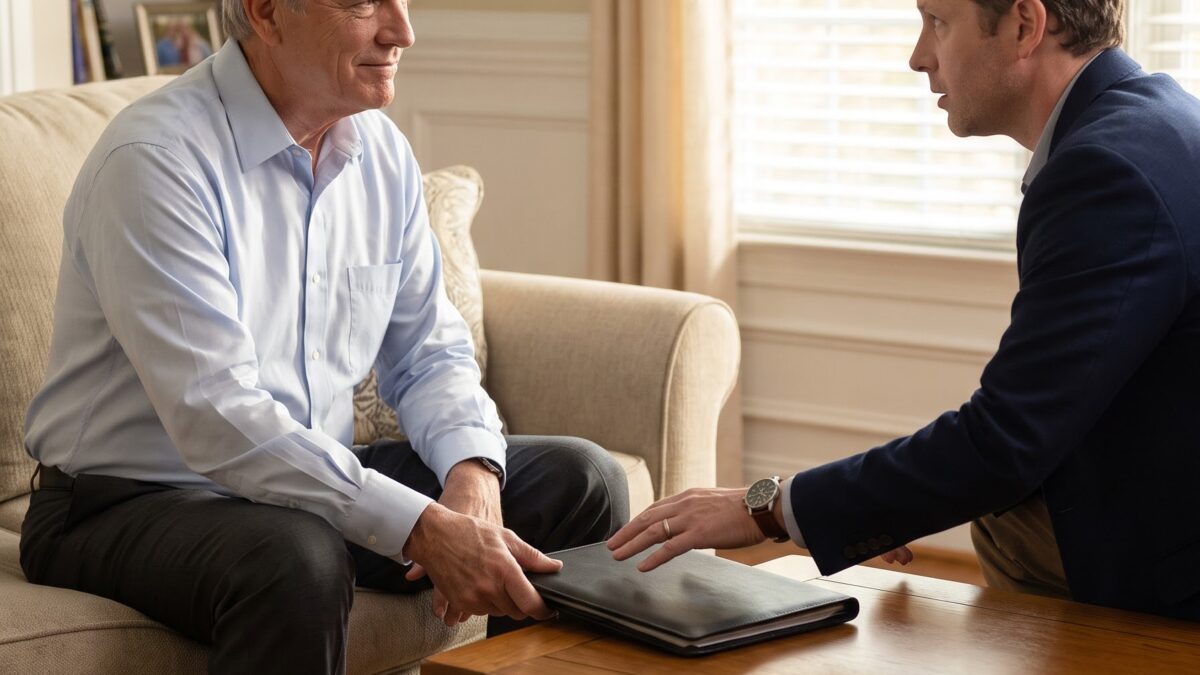
My daughter-in-law called while I was sitting beside my wife’s hospital bed after open-heart surgery.
“Your son chose my mother’s birthday party instead of sitting at the hospital with you people.”
Behind her, I could hear music and glasses touching. A moment later, I heard Derek laugh.
Eight days afterward, he came into our living room and said, “I hope you’re not still angry, Dad.”
That morning, I had been to the bank.
By the time he left our house, he understood that the monthly payments were over—and that the loan he expected me to guarantee would have to stand without me.
But I didn’t yet know what my wife’s money had paid for.
My name is Otis Mercer. I was sixty-nine that September, and Evelyn was sixty-seven. She had taught second grade for thirty-two years, long enough to know the difference between a frightened child and one inventing a story.
With our own son, she sometimes chose not to know.
Two days before her surgery, we sat at our kitchen table in Charlotte. She had toast on a plate and coffee cooling beside it. Usually, she finished breakfast while correcting something in the newspaper crossword.
That Sunday, she kept lifting her mug and putting it down.
“You don’t have to pretend with me,” I said.
“I’m not pretending.”
Then she looked at the untouched toast.
“Maybe a little.”
Her surgeon had explained why she needed an open-heart valve replacement. He expected a good outcome, but he hadn’t called it minor. Neither had we.
The surgery had been scheduled for three months.
Derek knew the date. He knew which hospital. Evelyn had sent him the preoperative instructions because he had offered, back in June, to help with transportation.
Her phone buzzed.
She read the message, typed a reply, then turned the phone facedown.
“Derek?” I asked.
“He wanted to confirm Tuesday.”
“Good.”
She nodded without looking at me.
That afternoon, I opened my laptop to check a parts order for a 1947 Philco radio I was restoring. Among my emails was an invitation Evelyn had forwarded.
Valerie Monroe’s sixty-first birthday celebration.
The Meridian Room.
Tuesday, September 10, six o’clock.
Valerie was Vanessa’s mother. Vanessa, our thirty-six-year-old daughter-in-law, owned a small event-planning business. Her company’s name appeared at the bottom of the invitation.
So did a line identifying it as an updated invitation.
I found the original farther down the email chain.
Saturday, September 14.
I carried the laptop into the kitchen.
“Did you see they changed the date?”
Evelyn looked at the screen.
“Yes.”
“When?”
“Last week.”
“And Derek’s going?”
She pressed her lips together.
“He says he’ll try to do both.”
The party began well after the operation was expected to finish. On paper, attending both was possible.
But Evelyn had asked him to stay with us that evening. She was afraid of waking up confused, afraid of the breathing tube, afraid of hearing bad news before she could understand it.
She had said all of that to him.
I called Vanessa.
“Could you move the party back to Saturday?”
“Otis, everything’s booked.”
“It was booked for Saturday before.”
“The arrangements changed. We’d lose almost three thousand dollars in deposits.”
“Evelyn’s having heart surgery.”
“I know. That’s why Derek plans to check in with you first.”
“His mother asked him to stay.”
There was a pause.
“My mother has been looking forward to this for months.”
“So has yours,” I said. “Just for a different reason.”
Vanessa sighed.
“I can’t reorganize an entire event this late.”
She ended the call before I could answer.
For two years, Derek had been working toward opening an event center in South Charlotte. He had leased temporary office space, paid consultants, collected drawings, and talked about bookings as though the building already existed.
Every month, we sent him $4,200.
It began as help while he got established. Then there was always another delay: a permit question, a contractor’s estimate, a lender needing additional information.
I had retired from maintaining commercial heating and cooling systems. We weren’t wealthy, but we had saved, paid off our house, and lived comfortably.
The payments were becoming uncomfortable.
Evelyn knew it. I knew it.
Neither of us had wanted to be the first to say so.
Years earlier, I had guaranteed a smaller equipment loan for Derek. That loan had been paid off. Now he wanted my guarantee for a proposed $820,000 development loan.
I had supplied financial information to the bank and said I was willing to consider it. The final documents were still pending.
Derek spoke of my signature as if it were already on the page.
Monday night, Evelyn called him from the hallway outside our bedroom.
I could hear her through the partly open door.
“I thought perhaps you’d changed your mind.”
A pause.
“No, honey. Your father can manage. I’m asking because I want you there.”
His voice came faintly through her phone.
Then Vanessa said something louder.
“We have guests coming from out of town, Derek. You promised me.”
Evelyn listened.
“All right,” she said. “Drive carefully.”
When she came back, she folded her robe over the chair instead of putting it on its hook.
“He’ll come when he can,” she told me.
I moved the robe to the hook after she got into bed.
Neither of us slept much.
We reached the hospital before seven Tuesday morning.
In the preoperative room, Evelyn gave me her glasses, wedding ring, and a little zippered pouch containing her phone.
“Don’t lose that ring.”
“I’ve kept track of it for forty-four years.”
“You’ve kept track of the finger.”
She smiled, and for a moment she was herself again.
Before they took her back, she asked me to tell Derek she loved him.
“I will.”
“And eat something.”
“I will.”
She knew which promise I was more likely to keep.
Shortly after nine, a staff member told me the operation had begun.
I texted Derek.
Mom’s in surgery. I’m in the family waiting area.
He answered twenty minutes later.
Keep me posted. I’ll come this afternoon.
I bought a sandwich from a refrigerated case and left it unopened beside my chair.
Around one, a nurse called me into a small consultation room.
The operation was taking longer than expected. Evelyn had developed an abnormal heart rhythm, and the team was treating it before completing the procedure.
The nurse didn’t give me a prediction she couldn’t support.
She said they would update me as soon as they could.
I called Derek.
Voicemail.
I sent a text explaining what she had told me.
Then I called again.
By the time the surgeon came out shortly after three, I had called eleven times.
Dr. Caldwell sat down beside me.
“The valve replacement is complete. We had difficulty stabilizing her rhythm, but she’s responding to treatment.”
“Can I see her?”
“When the ICU team has her settled. She’ll still be sedated.”
“Is she going to be all right?”
He waited before answering.
“She’s stable now. We’ll be watching her closely.”
I thanked him because there was nothing else to do with the relief.
At four, I stood beside Evelyn’s bed.
There were monitors, pumps, a breathing tube, and a nurse who explained where I could sit without getting in anyone’s way.
I held the hand without the IV.
I told Evelyn the operation was over.
She couldn’t answer.
At 6:03, Derek finally texted.
Sorry. Phone was on silent during setup. Traffic on I-77 is awful. Trying to get over there.
I read it twice.
During setup.
He had spent the afternoon preparing a birthday party while my calls lit up his phone.
I answered.
She’s in ICU. Come when you get here.
At 7:23, Valerie posted a photograph on her public social-media page.
I saw it because she had tagged Derek, and we were connected online.
He stood beside her in the Meridian Room, his jacket buttoned, a champagne glass in his hand.
Gold balloons filled the corner behind them.
The caption thanked her daughter and son-in-law for making the evening special.
I looked from the photograph to Evelyn.
Her nurse was checking a line near the bed.
I put my phone down.
Seventeen minutes later, Vanessa called.
“Otis.”
I stepped into the corridor.
“How’s Evelyn?”
“She’s stable. There were complications.”
“Well, the doctors know what they’re doing.”
I waited.
“I wanted you to hear this from me. Derek chose to be here for my mother’s birthday. He needs to be allowed to make decisions without feeling guilty.”
“He told me he was trying to come to the hospital.”
“He has a wife.”
“He also has a mother.”
Behind Vanessa, someone laughed. Then Derek said something I couldn’t make out.
Vanessa lowered her voice.
“Your son chose my mother’s birthday party instead of sitting at the hospital with you people. You need to accept that.”
For a moment, I couldn’t find words.
Then I said, “I’ve heard you.”
I ended the call.
Back in Evelyn’s room, I opened the notes app on my phone.
Stop protecting them.
Three words.
I set the phone beside the unopened sandwich.
Evelyn was awake the next morning after the breathing tube had been removed.
Her voice was rough. She tired quickly.
I gave her a small sip of water when the nurse said she could have it.
“Did Derek come?”
“No.”
She closed her eyes.
“I’m sorry,” I said.
She shook her head slightly.
“Don’t.”
Later, when she was more alert, she asked whether he had called.
“Not yet.”
She looked toward the window.
“There’s something in my desk at home. Green envelope. Left drawer.”
“What is it?”
“Bring it when you can.”
I didn’t leave her that day. A neighbor, Mrs. Henderson, brought me clean clothes and collected the envelope after Evelyn gave her permission to go into the house.
I opened it the following afternoon, after Evelyn had moved out of intensive care.
Inside were notebook pages, bank-transfer confirmations, and a signed loan agreement.
The first pages covered nearly six years.
Five hundred dollars here. Two thousand there. Help after a slow business month. Money for equipment, a deposit, an unexpected bill.
Those earlier payments totaled $27,000.
They had come from Evelyn’s separate savings account, where she kept money inherited from her mother along with savings from her teaching years.
I knew the account existed.
I hadn’t known how much of it she had given Derek.
Then I reached the loan agreement.
One hundred forty thousand dollars.
Made that spring to Derek’s event-center company, with Derek personally responsible for repayment under the document.
Evelyn had asked him to put that larger amount in writing. The agreement described it as development funding and required records showing how it was spent.
“You loaned him this much?”
She watched my face.
“He said it would secure the property and finish the work the bank needed.”
“Why didn’t you tell me?”
“Because you were already worried about the monthly payments.”
“That’s a reason to tell me.”
“I know.”
She pulled the blanket higher over her knees.
“I kept thinking it was the last thing he needed.”
I turned back through the papers.
Beside several entries, she had written reminders.
Asked about cardiology appointment.
Said venue opening would be before surgery.
Promised to visit after consultation.
Those notes didn’t prove he had planned around her illness. They showed something smaller and, to me, worse: how often she had attached a hope to a payment.
“I thought once he stopped worrying about money, we’d get him back,” she said.
I laid the pages on my lap.
“He didn’t need money to answer the phone.”
“No.”
Her eyes filled.
“I know that now.”
I moved my chair closer and held her hand.
We didn’t settle everything that afternoon. She was recovering from major surgery, and there were some conversations we could only manage a few minutes at a time.
But she made one thing clear.
“No more money, Otis. Not from either of us.”
Derek called the next morning.
“I should have come,” he said.
“Yes.”
“I thought she’d be asleep.”
“You could have sat with me.”
“I know.”
“Why did you tell me you were trying to get here?”
“I intended to.”
“Then why were you at the party?”
He went quiet.
I told him his mother was improving and ended the call.
Evelyn came home the following Monday.
I put her medication schedule on the refrigerator, moved a lamp beside the downstairs recliner, and placed a chair near the shower.
For the first few days, our world became pills, short walks, naps, and the discharge instructions I checked more often than necessary.
Wednesday morning, while Mrs. Henderson stayed with Evelyn, I went to the bank.
Mr. Brennan, the loan officer, brought out the file for Derek’s proposed development loan.
“I’m withdrawing my offer to guarantee this,” I said.
He reviewed the documents.
“You haven’t executed a guarantee on this loan. We’ll record that you’re no longer willing to proceed.”
“What about the financing?”
“They’ll need to satisfy our requirements another way. I can’t discuss the rest of their application with you.”
“That’s fair.”
He gave me written confirmation concerning my own involvement.
Then I canceled the recurring $4,200 transfer from our account.
The next payment had not yet gone out.
I sat in the car afterward with the documents on the passenger seat.
There was no victory in it.
I was relieved that our money would remain available for our own lives, and sick at how late that relief had come.
Derek arrived that evening.
He had called first, and I had told him he could stop by briefly. Evelyn was resting in the bedroom.
He sat on the edge of the couch.
“I hope you’re not still angry, Dad.”
“I’m tired, Derek.”
“I’ve apologized.”
“You haven’t told the truth.”
He rubbed his hands together.
“Vanessa was under pressure. Her mother had people flying in. Everybody expected me there.”
“Your mother expected you at the hospital.”
“The operation was supposed to be routine.”
“No one promised that.”
He looked toward the hallway.
“Can I see her?”
“She’s asleep.”
“I’m trying to fix this.”
“I went to the bank today.”
He stopped moving.
“I withdrew my offer to guarantee the new loan. I canceled the monthly transfer.”
“You can’t.”
“It’s done.”
“Dad, we’ve spent two years on this.”
“And your mother has spent six years helping you.”
His eyes lifted.
“You know about that?”
“I’ve seen the envelope.”
He stood, then sat again.
“We have obligations.”
“So do we.”
“You promised you’d help.”
“I promised to consider the guarantee. I should have been more careful about what I said, and much more careful about what I allowed.”
He stared at the rug.
“I’m your son.”
The answer came before I could soften it.
“I’m not angry. I’ve simply realized I no longer have a son.”
He went pale.
I regretted the words almost as soon as I heard them. But I couldn’t take back what lay beneath them.
“The son I thought I had would have answered one of those calls,” I said.
“I saw them,” he whispered.
That was the first honest thing he had told me.
“Then you knew.”
“I didn’t know how serious it was until I read the message.”
“And after you read it?”
He had no answer.
His phone came out of his pocket.
He called Vanessa from the front porch.
“My father isn’t signing,” I heard him say.
He left without asking when his mother would wake.
Vanessa called fifteen minutes later.
“You’re destroying everything we’ve worked for.”
“I’m stopping our payments.”
“We’ve relied on that money.”
“I know.”
“You can’t punish Derek because he attended one party.”
“Evelyn loaned the company a hundred forty thousand dollars. She’s asking for the records required by the agreement.”
“Why?”
“Because she wants to know where her money went.”
Vanessa stopped talking.
Then she said, “You should speak to Derek.”
“We will. Through the proper channels.”
I gave Evelyn the short version after dinner.
She looked at the bank confirmation.
“Good,” she said.
Then she asked me to help her walk to the mailbox.
We contacted Mr. Patton, the attorney who had prepared our estate documents years earlier.
He reviewed the loan agreement and explained what it did and didn’t allow.
Evelyn could request the spending records. Recovering the money might take negotiation or legal action. An agreement on paper did not create money in a struggling business.
“Do you want repayment,” he asked, “or do you want to make them suffer?”
Evelyn answered immediately.
“I want my savings back. I understand I may not get all of them.”
He sent the request.
The company’s accountant, Ms. Whitfield, provided the project ledger and supporting invoices after Derek authorized her to respond. Evelyn’s loan agreement had made those records part of the arrangement.
The review took more than a week.
When Ms. Whitfield called, she asked us to sit down with the packet she had sent.
Most of the expenses were ordinary development costs.
One was not.
A $9,400 payment to the Meridian Room.
The description in the ledger read: Promotional launch event.
The venue’s invoice described a private birthday celebration for Valerie Monroe on September 10.
I checked the bank entry.
The payment had come from the development account holding Evelyn’s loan proceeds.
There were other funds in that account, so I couldn’t honestly say which dollar had paid which expense.
What I could say was that money Evelyn had loaned for an event center had been used to cover a private birthday party.
The party Derek chose while she was in the hospital.
I took the packet into the living room.
Evelyn was sitting with her reading glasses on, trying to concentrate on a mystery novel.
“What is it?”
I showed her the invoice.
She read the description, then the amount.
Her finger stayed on the date.
“Mine?”
“The project account. The one you funded.”
She removed her glasses.
For a long time, she said nothing.
Then she asked, “Did he know?”
“We don’t know yet.”
“Find out.”
Two weeks after the operation, Vanessa posted a photograph of a sunset on her business page.
Sometimes the people closest to you are the ones who sabotage your dreams.
A cousin sent it to me.
I asked him not to send me anything else from her page.
A few days later, Valerie’s sister Ruth called.
We knew Ruth from family dinners and Derek’s wedding. She had been at the birthday party.
“I didn’t understand what was happening,” she said. “Valerie told me Evelyn’s surgery had gone well and Derek had already checked on her.”
“He hadn’t.”
“I know that now.”
Ruth said Vanessa had sent her a voice message afterward, complaining about our decision to stop helping.
“Would you listen to it?”
I said yes.
The message arrived while Evelyn was napping.
Vanessa sounded irritated, almost impatient with the fact that anyone could disagree.
“I moved it to Tuesday because Derek keeps dropping everything for them. I wanted him to follow through on a promise to me for once. He stayed. Now Otis is making the whole thing about money.”
I played it once more.
It wasn’t proof of every ugly thought I had imagined. It was proof that the date change had been deliberate, and that Vanessa had turned Evelyn’s surgery into a test.
I thanked Ruth.
I didn’t post the message.
Evelyn listened that evening.
Then she asked me to put the phone away.
“I need to sleep tonight,” she said.
By early October, she was taking longer walks and attending follow-up appointments. Some mornings were better than others.
I drove her where she needed to go.
Mrs. Henderson brought soup. A retired teacher Evelyn had worked with sat with her while I bought groceries.
None of them needed a reminder that she mattered.
Around that time, an acquaintance sent me a saved video from Valerie’s birthday.
Valerie had posted it publicly, then removed it after relatives began asking questions.
Derek stood beside her with his glass raised.
“Today I proved my real family is right here in this room.”
There was applause.
The video didn’t show the hospital or the unanswered calls. To a stranger, it might have looked like an ordinary toast.
People who knew our family understood the date.
I watched it with the sound low.
When Evelyn asked what I was looking at, I told her.
“I don’t want to see it,” she said.
I closed the screen.
Vanessa called a week later.
“Did you send that video to people?”
“No.”
“Two clients are asking whether the development money paid for my mother’s party.”
“They should ask you.”
“You’re enjoying this.”
“I’ve been taking Evelyn to medical appointments. I haven’t contacted your clients.”
One event had been postponed. Another customer wanted clarification before making a further payment. Vanessa’s business depended heavily on local referrals, and questions were traveling through the same network that had brought her work.
The video alone wasn’t destroying her business.
But it was making explanations harder.
Then she asked to meet me.
I agreed to a café near our house and told Evelyn beforehand.
Vanessa arrived with a folder.
She looked exhausted.
“Derek approved the payment,” she said.
“Were you unaware of it?”
“No. But he said the development loan would cover the shortfall.”
She pushed the folder across the table.
Inside were printed emails about the Meridian Room invoice.
One from Derek, dated August 22, read:
Use the project account for now. Once Dad signs and the financing closes, we can replace it before the next report.
I checked the sender, date, and thread.
Vanessa watched me.
“I have the originals. My attorney can provide them.”
“What do you want?”
“The bank is reconsidering the structure. If you support an application with me running the business, we could still save it.”
“You brought this to persuade me to back you?”
“I brought it because you should know Derek made the decision.”
“You arranged the party.”
“He approved the money.”
“Both can be true.”
She leaned forward.
“Otis, I’m trying to give you a way out.”
“I have a way out.”
I pushed the folder back.
“You can send those records to Mr. Patton. I’m not guaranteeing another loan.”
She looked toward the window.
“My mother won’t help either,” she said.
I waited.
“She let everybody think she was our investor. She doesn’t have anything to invest.”
“That’s between you and your mother.”
Vanessa took the folder and stood.
For once, there was no final speech.
I finished my coffee.
Later that month, Derek asked to visit.
“I want to help with Mom.”
Evelyn agreed to see him for twenty minutes.
He arrived carrying a large envelope under his arm.
She noticed it before he sat.
“What’s that?”
“Just some paperwork.”
“Put it on the table.”
“Mom, I came to talk.”
“Then you won’t mind.”
He laid it beside the tissue box.
Evelyn sat upright in her recliner.
“Can I ask you something?”
“Anything.”
“If your father hadn’t offered to guarantee that loan, and I hadn’t had money to lend you, would you still be here?”
He looked at me.
I stayed where I was.
“I want to say yes.”
“I want you to be able to say yes.”
“I’ve behaved badly.”
“What’s in the envelope?”
He rubbed his thumb along its edge.
“The bank gave me another proposal.”
“Does it need your father’s signature?”
“Yes.”
She nodded once.
“And you brought it today.”
“I wasn’t going to ask immediately.”
That answer hurt her more than denial would have.
I could see it in the way she reached for the tissue box and then changed her mind.
“Go home, Derek.”
“Mom—”
“I’m tired.”
He stood slowly.
“I am sorry.”
“Then let me recover without another request.”
He took the envelope.
After the door closed, Evelyn held out her hand to me.
I sat beside her until she fell asleep.
In November, we met with Mr. Patton again.
We discussed the unpaid loan, our estate plans, and how to keep our own expenses protected.
We did not give away our savings.
Evelyn still needed care. We both needed enough money to live without depending on anyone else.
But we changed what would happen to the remainder of our estate after we were both gone.
Instead of leaving everything to Derek, we designated a substantial portion to a hospital foundation’s patient-assistance program, with support directed toward older cardiac patients who needed help after discharge.
We discussed transportation, home assistance, and practical care with a foundation representative before finalizing anything.
I thought about the man I had met in the waiting room whose wife would have no one at home during his workday.
Evelyn thought about the patients she had seen waiting alone for rides.
“This is something we can do,” she said.
Mr. Patton also sent Derek a formal proposal concerning repayment.
It accounted for the loan terms, the company’s condition, and what could realistically be recovered. He requested that the business stop using our names or photographs to suggest continuing financial support.
There was no instant court order.
There was a letter, a response, and more work for the attorneys.
Evelyn wanted to explain our decisions herself.
So we invited Derek and Vanessa for a short meeting.
They sat together on the loveseat, though neither looked at the other.
Vanessa began.
“Your husband has decided to take everything away.”
Evelyn placed the green envelope on the coffee table.
“My husband and I made these decisions together.”
“He went to the bank.”
“After I told him I would not give you more money.”
Derek looked down.
Evelyn opened the envelope and removed the birthday invoice.
“I lent money to build your business. You used the project account for this.”
Vanessa started to speak.
“Please let me finish.”
Evelyn put Derek’s email beside the invoice.
“You knew what you were doing.”
Derek nodded.
“Yes.”
“And you knew I was afraid.”
“Yes.”
She took a breath.
“I can accept that you have a marriage and a life separate from ours. I cannot accept being lied to, ignored during a crisis, and then asked to finance the people doing it.”
Vanessa folded her arms.
“You’re choosing money over your son.”
“No,” Evelyn said. “I’m deciding what happens to money I earned and saved.”
She showed them the attorney’s letter.
“The repayment discussions go through the attorneys. There will be no more monthly support. Don’t tell lenders or customers that we are backing the project.”
Derek glanced at the envelope.
“Are you cutting me off forever?”
“I don’t know what forever looks like,” she said. “I know what I can manage now.”
Neither of them answered.
Evelyn reached for the glass of water beside her.
“I need to rest.”
I walked them to the door.
Three days later, Derek came back alone.
He had only his keys in his hand.
“I’m not asking to come in,” he said.
I stepped onto the porch.
“Vanessa and I are separating.”
“I’m sorry to hear that.”
“Her attorney’s talking to mine.”
He looked toward the driveway.
“The property deal isn’t going through. We can’t get the financing.”
“What about the money your mother loaned?”
“My attorney is working on a repayment proposal. I’ll sign personally for what we agree I owe. I know the company won’t be enough.”
I nodded.
Then he asked, “Can you ever forgive me?”
I thought about what I had said in the living room.
“I shouldn’t have told you I no longer had a son.”
He looked up.
“That was meant to hurt you. It did, and I knew it would.”
“I deserved—”
“Let me finish. You’re my son. That doesn’t mean I can trust you right now.”
His eyes were wet.
“I understand.”
“Your mother gets to decide what she can forgive. I won’t decide it for her.”
“I know.”
He put his keys into his pocket.
“I’m not going to ask you to fix this.”
I wanted to believe him.
I didn’t tell him that.
The settlement took time.
There were records to reconcile, equipment to sell, obligations to sort out, and attorneys making sure promises became signed documents.
We recovered part of Evelyn’s money from remaining project funds. The balance became a repayment obligation Derek could not satisfy quickly.
The first scheduled payment arrived seven days late.
Evelyn recorded the date and amount.
She didn’t call to ask why.
The next arrived on time.
Then another.
Derek sold his SUV and moved to a smaller rental. Vanessa continued planning modest events while their attorneys worked through the separation.
I knew those things because Derek told me, or because they affected the repayment paperwork.
I stopped collecting reports from cousins.
One evening in February, I was in the garage working on the Philco when Derek called.
“How’s Mom doing?”
“Better. Rehab tires her out.”
“Is she still doing the crossword?”
“She complained about yesterday’s clues for twenty minutes.”
He laughed softly.
I told him which clue had annoyed her.
Then he asked about the radio.
“The replacement transformer finally came,” I said.
“Did it fit?”
“With some persuasion.”
“I remember that phrase.”
We talked about the cabinet, the dial, the old stations I used to listen to.
Then he told me he had taken a night shift at a distribution warehouse near the airport.
“It’s steady,” he said.
“Steady helps.”
He didn’t ask for money.
Before we hung up, he said, “I saw every call that day.”
I set the soldering iron in its stand.
“I know.”
“I kept telling myself you’d call Vanessa if it were serious. Then I read the message and decided I’d leave after we finished setting up. Then after the guests came.”
He stopped.
“There was always another thing.”
I looked at the radio’s open cabinet.
“I needed you, Derek.”
“I know.”
“I don’t think you did. But I hope you do now.”
He stayed quiet.
Then he said, “Tell Mom I called. Only if she wants to hear it.”
“I will.”
That evening, Evelyn and I made dinner together.
She chopped vegetables at the kitchen table while I stood at the stove.
“He asked about you,” I said.
“What did you tell him?”
“That you’re improving.”
“Good.”
I told her about the warehouse job.
She put down her knife.
“Has he kept making the payments?”
“Yes.”
She thought for a moment.
“Perhaps Thanksgiving.”
“This year?”
“If he keeps going like this. And if I feel ready.”
“We don’t have to decide tonight.”
“I know.”
She picked up the knife again.
The following afternoon, I found an old photo album while clearing a garage shelf.
There was Derek on his first bicycle. Derek asleep against Evelyn on a long car ride. Derek at ten, standing beside my workbench with grease on his cheek.
I remembered taking that photograph.
He had spent the afternoon handing me tools, usually the wrong ones, and asking when he would be old enough to help repair something himself.
I left the album open on the bench.
For months, I had looked at my son and seen only the man at the birthday party.
The boy had existed too.
Remembering him didn’t erase the invoice, the unanswered calls, or the papers he brought to his mother’s chair.
But I no longer needed to pretend one version of him made the other impossible.
Evelyn came to the garage doorway.
“Does it work yet?”
I switched on the Philco.
The tubes warmed. A station emerged through the static.
She listened, then looked at the open album.
“That shirt,” she said. “He wore it until the sleeves were halfway up his arms.”
“I remember.”
She stood beside me a little longer.
Then she asked if I wanted tea.
I turned off the radio and followed her inside.
The green envelope remained in her desk. The repayment agreement stayed in the file cabinet. We hadn’t changed our estate plans back.
Derek’s next payment arrived when it was supposed to.
A few days later, he called again.
I answered.
And a quick note, some details have been adjusted for storytelling. What matters is the message.