My son called from the airport, heading to Hawaii with his new wife, and announced they’d move into my beach house afterward. I asked why I hadn’t been invited to their wedding. “Just close friends, Mom. People with status.” I wished them a lovely trip. When they returned, his mother-in-law brought a crowd onto my lawn and demanded I hand over the keys…
My son called from an airport gate on a Sunday morning to tell me he had gotten married the day before.
Forty-six people had been there. I wasn’t one of them.
“It was really just close friends, Mom,” Cullen said. Then, after a pause, “People with status. You wouldn’t have enjoyed it.”
He said it gently, which somehow made it worse.
I was standing in my kitchen in Cranston with my second cup of coffee. Outside, a neighbor was starting his lawn mower. It was September 13, and the small red numbers on the stove said 9:40.
“Yesterday?” I asked.
“At the Chadbourne Club. We moved the date up. Everything came together pretty fast.”
I set down my cup.
I had known they were engaged. I had sat through an engagement dinner the previous November and been told, more than once, that they were looking at dates for the following summer. In July, when I’d asked whether they needed help with anything, Cullen had said Blythe’s mother was handling the arrangements and they would let me know.
They hadn’t let me know.
“Who gave the toast?”
“Miles. It was nice.”
Miles Haverstock. Blythe’s father. A man who had known my son for less than two years.
Behind Cullen, an announcement came over the airport speakers.
“Listen, we’ve got to board soon. Boston to LA, then Maui. Twelve nights. We get back on the twenty-sixth.”
“Twelve nights,” I repeated.
“And we’re heading straight to the point afterward. Just until we find something permanent. You’re never down there much in the fall.”
The point was my beach house.
He had moved from telling me about his wedding to telling me where he would live without asking a single question.
“Cullen—”
“Mom, they’re calling our group. I’ll send pictures.”
“Congratulations, sweetheart. Have a safe flight.”
I ended the call before he could hear anything change in my voice.
Then I stood at the counter, looking at the coffee I’d spilled into the saucer.
My name is Saraphina Tumi. I was seventy-one that September, old enough to know the difference between an oversight and a decision. Still, I gave myself several minutes to pretend there might be another explanation.
Perhaps he had meant a civil ceremony followed by a larger celebration. Perhaps he had expressed himself badly. Perhaps forty-six chairs could somehow leave room for a mother without giving her a seat.
At ten past ten, I took my keys from the hook.
Before I tell you what I found at the house, there are a few things you should know about it.
My father worked in a jewelry factory in Cranston, polishing brooches and cuff links. He came home with red compound worked into the creases of his hands. He died in 1973, when I was eighteen. My mother and I discovered how little his years of work had left behind.
At nineteen, I took a typing job at Upham Mutual Insurance. I went to college at night, one or two courses at a time. Seven years later, I had a mathematics degree. After that came the actuarial exams, taken around a full-time job and, eventually, a husband who learned to cook because I studied through dinner.
I spent thirty-eight years in actuarial work before retiring in 2019. By then I was chief actuary. People who met me at neighborhood cookouts sometimes assumed I’d spent my career doing clerical work. Usually, I let them.
Niall Tumi never made that mistake.
We married in 1984. He taught shop at a public high school, repaired things other people threw away, and could spend forty minutes deciding which screws a job required. Cullen arrived in February 1993, when I was thirty-seven.
We were comfortable by then, but comfort was something I trusted only after checking the bank statement.
In 1991, a hurricane badly damaged a cottage on Wicket Point, a small waterfront neighborhood near Charlestown. The owners boarded it up. For five years, it sat behind a faded real-estate sign, with a missing porch and a yard that needed more work than the listing admitted.
Niall found it. Naturally.
He brought home photographs from a disposable camera and spread them across our kitchen table.
“Look past the plywood,” he said.
“I am. I’m looking at the foundation.”
He grinned. “We can have someone check that.”
We bought it in June 1996 for eighty-six thousand dollars, using most of our savings for the down payment and taking out a mortgage. We paid professionals for the structural work, electrical service, and anything the town required licensed people to handle. Niall rebuilt the porch and did the framing he was permitted to do. I managed the bills, permits, and paint.
For six summers, our weekends belonged to that house.
Cullen was three when we started. His first contribution was handing his father nails from a coffee can, one at a time, with tremendous concentration. Later he sanded porch rails and complained about it. Later still, he brought friends down and accepted compliments as though the cottage had risen from the ground fully furnished.
The front door was blue. Niall painted it in 2001, three coats, sanding between them because he believed a front door deserved patience.
In 1997, he’d put a dab of blue paint on my brass key so I would stop giving him the key to our Cranston house.
“There,” he’d said. “Now you’ll know.”
We paid off the cottage in 2004. When Niall died in November 2012, his interest passed to me under the way we held title. Our lawyer handled the necessary paperwork. After that, the property was mine alone.
In August, while reviewing my estate plans, I’d obtained a market appraisal. The little house we had bought for eighty-six thousand dollars was now worth about $1.94 million.
Cullen knew it had become valuable. He had recently started asking how valuable.
I hadn’t told him the number.
The drive south usually took about an hour. That morning, I stopped for gas and then sat in the car longer than necessary, holding the receipt. I didn’t reach the point until shortly after noon.
My key opened the door with its familiar little hitch.
Four navy suitcases stood beside the stairs. Next to them were six cardboard boxes labeled KITCHEN, LINENS, BEDROOM, and POINT.
Each suitcase had a leather tag stamped in gold: MR. & MRS. C. TUMI.
They had ordered matching luggage tags. Someone had discussed the spelling, selected the lettering, paid for them, and attached them to bags. All before anyone had told me my son was getting married.
I walked into the main bedroom.
A white bathrobe hung behind the door. My robe had been folded and placed on the top shelf of the hall closet. New shelf liner covered two dresser drawers. On the kitchen counter lay a hardware-store receipt dated September 9, two days after Labor Day.
That was when they must have come.
I’d spent Labor Day weekend at the house and locked up Monday evening. Cullen had an emergency key, one I’d given him years earlier so he could check the pipes or let in a repairman if I couldn’t get down.
He had never been given permission to move in.
I returned to the living room and noticed the empty place on the mantel.
Niall’s photograph was gone.
It showed him on the unfinished porch in an old paint shirt, smiling at something outside the frame. Cullen had taken it. For fourteen years, it had stood beside a small dish of sea glass.
I found it in the hall drawer, face down beneath takeout menus.
The glass wasn’t broken. I checked it anyway, running my thumb around the frame before putting it back.
That was when I stopped looking for an innocent explanation.
I checked the rest of the house. No beds had been slept in. The refrigerator was empty. Their belongings appeared to be stored there, ready for the move they had already announced to everyone but me.
I took pictures of the rooms and the luggage. Then I called Mort Gilman.
Mort had handled our purchase thirty years earlier and my estate documents since Niall died. His office was closed, but his voicemail gave an emergency number. I left a message saying I needed advice about someone attempting to move into my property without permission.
He called back before I’d finished walking around the yard.
“Start at the beginning,” he said.
I told him about the call, the key, the boxes, and the wedding.
He asked whether I’d ever agreed they could live there. Whether they had paid anything. Whether they had stayed there recently, received mail, transferred utilities, or moved out of another residence in reliance on anything I’d said.
“No agreement. No rent. No utilities. They haven’t stayed here this year. As far as I know, they still have their apartment.”
“Don’t assume the last part,” he said. “And don’t throw anything away.”
“I wasn’t planning to.”
He explained that changing locks was a serious matter if someone had an occupancy right. A lease wasn’t the only thing that could create a dispute. Based on what I had told him, however, this sounded like an unauthorized drop-off, not an established tenancy.
“Put it in writing that you haven’t agreed to their moving in. Give them a way to collect their things. Send me whatever they send back.”
“Can I secure the house?”
“On these facts, yes. If anything turns up suggesting a different arrangement, call me before taking another step.”
I called Palumbo Lock & Safe next.
Nunzio Palumbo arrived a little after three with reading glasses hanging from a cord around his neck. Before touching a lock, he asked for identification and proof that I controlled the property. I showed him my license, the current tax bill, and the insurance paperwork bearing the address.
“Sunday service costs extra,” he said.
“I expected it would.”
He rekeyed the front, back, and garage side-door locks. While he worked, I brought the suitcases to the grass beside the drive, rolling them over the gravel instead of lifting them. The boxes were small enough to carry. I lined everything up, photographed it, and checked the picture before sending it to Cullen.
Congratulations again. I have not agreed to your moving into the point. I’ve changed the locks. Your things are safe, and we can arrange collection when you return.
I didn’t write what I wanted to write.
Nunzio handed me the new keys. After he left, I tried the old brass one. It wouldn’t turn.
I put it back on my ring.
At five-thirty, my phone began buzzing.
WHAT ARE YOU DOING?
Then: We told everyone we’re living there.
I sat on the porch with the phone in my lap.
Everyone knew where my son was going to live. Everyone knew he was getting married. I was apparently the only person whose information arrived afterward.
A voice message came from Blythe. Airport announcements echoed behind her.
“We have nowhere to go, Mrs. Tumi. We gave up the apartment at the end of August. Cullen said it was settled.”
I listened twice, then forwarded it to Mort.
Had Cullen told me they were surrendering their apartment? No. Had I offered them the cottage afterward? No. Mort asked me to preserve the messages and keep their property secure while he reviewed the situation.
I answered them once.
I did not agree to a move. Your belongings will be available when you return. Please enjoy your honeymoon. We can speak when you’re home.
Cullen replied: Miles thinks it’s done. You don’t understand.
I typed, What does Miles think is done?
No answer came.
By early evening, rain was in the forecast. I moved all ten pieces into the locked garage, photographed them again, and sent Cullen that picture too. The grass had been useful for showing him that his belongings weren’t part of my household. It wasn’t a place to store somebody’s clothes for two weeks.
I stayed at the point that night. There were clean sheets in the linen closet, coffee in the freezer, and enough soup in the pantry for supper.
When I took Niall’s photograph from the mantel to dust it, a bit of grit caught beneath my finger. I carried it to the kitchen and cleaned the glass properly.
Then I sat at the table and remembered the engagement dinner.
It had been November 15, 2025, at the Chadbourne Club in Barrington. Miles owned Haverstock Marine, a successful boat dealership on the bay. I’d met him twice before. He was pleasant when discussing a subject he understood and inclined to assume everyone else wanted to understand it too.
He spent much of the first course explaining engines.
Blythe’s mother, Lorelei, watched the table while he spoke, checking wineglasses and the placement of people’s chairs. She had arranged the dinner. Cullen had explained that fact before we arrived, as though it were a reason to be especially agreeable.
“And what did you do, Saraphina?” she asked me over the fish.
“I was an actuary.”
“Insurance numbers?”
“Among other things.”
“Oh, good. Something safe.”
She smiled toward Cullen, who gave a small laugh instead of saying what my job had been.
I could have corrected them. I didn’t want to turn an engagement dinner into a recital of my résumé.
A few minutes later, Lorelei asked about the cottage.
“Cullen tells me you have something on Wicket Point.”
“A house.”
“How many bedrooms?”
“Three.”
“Water views?”
“From two of them.”
“Year-round?”
“Now it is. We winterized it years ago.”
Blythe looked at her mother before she looked at me.
“We’d love somewhere like that,” she said.
“It’s a lovely neighborhood,” I answered.
Lorelei asked twice more about the house before dessert. She wanted to know whether there was beach-club membership and whether the property had enough lawn for entertaining.
I said the club handled its own admissions and the lawn was large enough for our family cookouts.
At the time, I thought she was making conversation badly.
Now I remembered the way she had watched the valet bring around my fourteen-year-old station wagon. She’d looked from the car to me, then handed the attendant her ticket without saying goodnight.
On Monday afternoon, Blythe posted the first honeymoon picture.
It was a sunset at Wailea, two glasses held against an orange sky. The caption said: Twelve nights in paradise. Next stop, our beach house on the point.
The photograph had been taken the previous evening. At two in Rhode Island, it was still morning in Hawaii. I knew because I checked the difference before calling Cullen and then decided against calling him at all.
Instead, I looked at the comments.
Can’t wait to visit.
Living the dream.
Such a beautiful wedding gift.
I put down the phone.
At six, Lorelei called.
“You have upset my daughter on her honeymoon.”
“Good evening, Lorelei.”
“They were promised that house.”
“By whom?”
“Don’t be difficult.”
“I’m asking a straightforward question.”
She drew a breath close to the receiver.
“They’ve made arrangements. You can’t pull the rug out now because you’re upset about a guest list.”
“I wasn’t told there was a guest list.”
“That wedding was complicated. There were limits.”
“Forty-six limits?”
She let that pass.
“You’ll open the house when they come home. We can discuss hurt feelings afterward.”
“No.”
For a moment I heard only the faint sound of a television at her end.
Then she said, almost kindly, “Women like you don’t want a scene, Saraphina.”
I looked out at the porch rail Niall had replaced twice because the first wood had warped.
“Ask your son,” she added. “Ask him what he promised my husband.”
She hung up before I could ask anything else.
I had raised Cullen to be considerate. I could produce evidence of it if anyone required evidence. At eleven, he’d shoveled a neighbor’s walk without being asked. At sixteen, he’d sat through an entire Saturday appliance delivery because Niall was working and I couldn’t get away.
He could also take the easiest path through an uncomfortable conversation and leave somebody else to straighten it later.
After Niall died, I had helped him do exactly that.
Cullen was nineteen, a college sophomore. I drove up to collect him after the call. For most of the ride home, he cried with his face turned toward the passenger window.
Afterward, I paid tuition. I covered the car repair he couldn’t afford and the deposit on his first apartment. When a bill frightened him, I made it disappear.
He did finish college. He worked in commercial insurance for nearly ten years, starting in a support position and eventually selling policies. He wasn’t helpless. He had simply become accustomed to knowing where help could be found.
In May 2025, Miles offered him a sales-management job at the dealership.
After that came the expensive watch, the new shoes, the dinners Cullen described by naming who had attended rather than what they had eaten.
Once, at Easter brunch, he referred to a server as “the help.” I asked him to repeat it.
He said he hadn’t meant anything.
I let the matter go. I had let too many things go because correcting an adult son felt like admitting I’d missed something earlier.
On Tuesday, a bridesmaid named Reagan posted the wedding photographs publicly and tagged Cullen. They appeared on my feed. I opened the album.
White hydrangeas. Sand-colored linens. Blythe’s lace train arranged on a staircase. My son smiling with a hand at his wife’s waist.
I looked at that picture longer than I intended.
He resembled Niall around the eyes when he smiled like that.
Then I reached the cake.
It had three white tiers. On top stood a little sugar cottage with gray shingles, a wraparound porch, and a blue front door.
I enlarged it until the image blurred.
Our house. Not a generic seaside cottage. Our porch, our roofline, the little upstairs window Niall had insisted on saving.
They had sent the baker a photograph.
A few pictures later, I found my next-door neighbor, Anoria Endicott, raising a glass at table three.
Anoria was eighty-six. She had lived on the point longer than I had. We had exchanged spare plants, watched each other’s houses during storms, and driven each other to appointments when necessary.
She had been at my son’s wedding.
Under a photograph of the toast, someone had written, Sorry your mom couldn’t make it, Cullen. Hope she’s feeling better.
I read that comment three times.
Then I shut the album and washed the one cup in my sink.
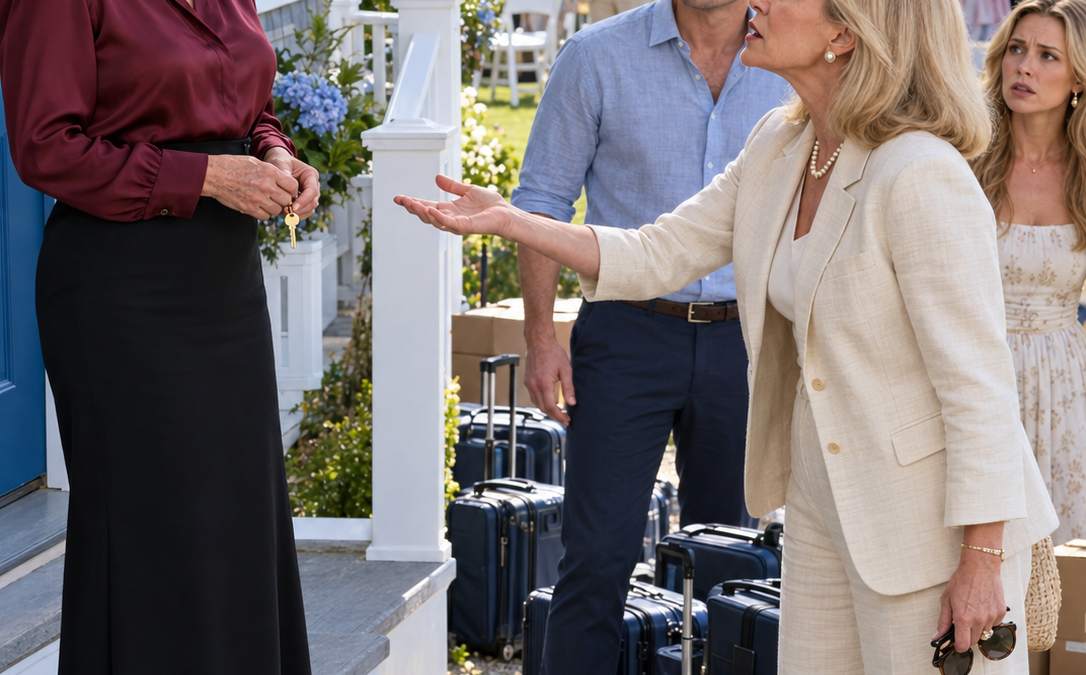
On Wednesday morning, Lorelei arrived with a locksmith.
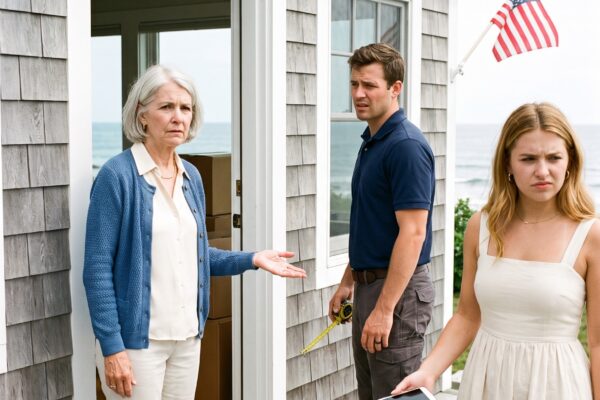
I was on the porch when her white SUV pulled into the drive, followed by a van. She stepped out wearing sunglasses and linen trousers. The locksmith stopped beside his vehicle, looking first at her and then at me.
“My daughter’s away,” Lorelei told him. “Her key isn’t working. We need access before she gets back.”
“Do you have authorization from the owner?” he asked.
“I’m her mother.”
“I own the house,” I said from the porch.
Lorelei turned toward me as though I’d interrupted a private discussion.
The locksmith looked back at her.
“Is there an ownership dispute?”
“There’s a family misunderstanding,” she said.
“I haven’t authorized any work,” I told him. “I can show you my documents, but there won’t be a lock opened today.”
He didn’t ask to inspect them. He picked up the toolbox he had just set down.
“You’ll have to sort this out first.”
Lorelei followed him a few steps, speaking too quietly for me to hear. He shook his head, got into the van, and left.
She stood beside her SUV, gripping her purse strap.
“You’re enjoying this.”
“No.”
As she turned away, her eyes went to the iron gate in Anoria’s hedge.
“That gate still sticks,” she said.
Then she got into her car.
I watched her leave, wondering how she knew.
That evening, Blythe called.
“Mrs. Tumi, please. My mother is so upset.”
“I understand she’s upset.”
“She says you’re going to ruin everything.”
“What is everything?”
“Saturday. After we get home. The twenty-sixth.”
“What happens on the twenty-sixth?”
“Nothing. Just coming home.”
“Then why does your mother need to enter my house?”
Blythe didn’t answer.
I could hear water and people talking behind her. Somewhere, someone laughed.
“Cullen said you knew we were moving in,” she said at last.
“He didn’t ask me.”
“But the house—”
“What about the house?”
She hesitated. “He said it was handled.”
“Then you need to ask your husband what he means.”
Before we ended the call, she said, “Please don’t make him choose.”
I stood in the kitchen afterward, holding the phone long after the screen went dark.
I hadn’t asked my son to choose between his wife and me. I had asked, without even getting the words out, whether anybody intended to ask my permission.
On Thursday afternoon, Miles called.
Unlike his wife, he sounded cautious.
“I’m hoping you can clear something up.”
“I’ll try.”
“Is there a problem with the paperwork?”
“Which paperwork?”
“For the property.”
There was machinery somewhere behind him, then the solid click of a door closing.
“Cullen told me in June that the transfer was signed and the recording was being handled. Is that correct?”
I put my hand flat on the counter.
“No.”
“No, there’s a problem, or no, it wasn’t signed?”
“No transfer has been signed by me.”
He said nothing for several seconds.
“He was very definite.”
“Then he was definitely mistaken.”
“I’ve made decisions based on what he told me.”
“What decisions?”
“Financial ones. I need to speak with him before I say more.”
“Miles, this is my property. If there is a document bearing my signature, I need to see it.”
“I haven’t seen one,” he said. “He told me the lawyer was taking care of it.”
“Please send me anything you do have concerning my house.”
He agreed, then ended the call.
I sat down.
Until that moment, I had thought the dispute was about a son assuming he could use a vacation house. Now somebody else had made financial decisions based on owning it.
There was one document Cullen might have seen.
It was in a drawer in my front hall in Cranston.
That night, I remembered a Sunday dinner in April.
Cullen had come alone because Blythe was working. I made lasagna. During coffee, Niall’s sister called from Florida about a procedure she was nervous about. I took the call into the kitchen.
When I returned, Cullen was standing beside the hall table, closing the drawer where I kept stamps, receipts, and the envelope from Mort.
“Looking for a pen,” he’d said.
I pointed to the mug on the desk in the next room. He followed me there and borrowed one.
I had not checked the drawer afterward.
At six the next morning, I drove to Cranston. Just before seven, I unlocked my front door and went straight to the hall table.
The envelope was where I’d left it.
Mort’s return address was printed in the corner. On the front, his assistant had written: Proposed deed—14 Wicket Point Road—review copy.
I turned it over.
The flap had been sliced open and fastened with clear tape.
Mort had sent the papers inside a larger mailing envelope. After reviewing them and adding Niall’s note, I had sealed this inner envelope myself. The flap had been intact. There had been no tape.
For a few seconds, I could only stand there.
Inside was the draft Mort had prepared in March at my request. It named Cullen as the person who would receive the cottage. The signature line was blank. The acknowledgment was blank. Across the cover sheet, Mort had typed that it was a draft for discussion and that nothing would proceed without my approval.
Clipped to it was a square of yellow paper in Niall’s handwriting.
For the boy when he marries. N.
Niall had written it during one of our conversations about what we wanted to do with the house. We’d been sorting old receipts into a box in his workshop. He had put the note with the property papers. I found it again after his funeral and kept it.
It wasn’t a deed or a legal instruction. It was something my husband had hoped we might do.
That spring, I had decided I wanted to do it.
Mort had asked the sensible questions. Where would I live if I gave it away? What happened if Cullen sold it? What would the tax reporting involve? Would retaining control or arranging an eventual inheritance make more sense?
I had asked for the draft while I considered those questions. I could afford the gift. I wasn’t yet ready to surrender the house without discussing how it would work.
Still, in my mind, I had pictured handing the finished papers to Cullen around his wedding, with Niall’s note on top.
He had found the unfinished version first.
I couldn’t prove that from the tape. I couldn’t prove the date from my memory of him standing at the drawer. What I could do was put the envelope in my purse and take it to Mort.
Before leaving Cranston, I walked through the living room. A photograph of Cullen in his college gown stood on the bookcase. I straightened it, though it wasn’t crooked.
Then I locked the house and drove back to the point.
On Saturday morning, Anoria knocked on my screen door.
She held a cream invitation with a gold border.
“I should have called earlier,” she said.
I opened the door wide enough for her cane.
She handed me the card before sitting down.
Aloha Home. Please join us in welcoming Blythe and Cullen to their beach house. Saturday, September 26, noon. Hosted by Miles and Lorelei Haverstock.
Underneath was my address.
“Yesterday’s mail,” Anoria said. “Though Lorelei mentioned it before that.”
“Did she.”
“She told me in August you were giving them the property. I thought you’d want to tell me yourself, so I didn’t pry.”
I turned the card over. There was no mention of me hosting or attending.
“Did she tell you why I wasn’t at the wedding?”
Anoria took off her glasses.
“She said you weren’t well enough. Cullen confirmed it when I asked after you at the reception.”
“I wasn’t invited.”
She looked at me, then down at the glasses in her lap.
“Saraphina.”
“I learned about it the next morning.”
“I should have telephoned.”
“Yes,” I said. Then, because she had the decency not to defend herself, I added, “I understand why you believed them.”
Anoria had recently stopped driving at night. Lorelei had arranged for another wedding guest to bring her to the club and home again. That answered one of the questions I’d been turning over: how a neighbor who used to bring me soup could have attended without once asking me about the wedding.
They had made it easy for her to accept their account.
“There is something else,” she said.
I waited.
“I sponsored their application to the bathing association. Lorelei told me the transfer was complete. Cullen put ownership on the form.”
The association was the little private beach club at the end of the point. Its membership rules required qualifying ownership or documented year-round residency. Anoria had served on the admissions committee for years.
“I wrote that I understood they were the new owners,” she said. “I shouldn’t have done that without checking.”
“They aren’t.”
“Then I need to correct it.”
She put her glasses back on and studied me.
“Lorelei says thirty-four guests have accepted for Saturday. She’s calling it a welcome-home brunch and a key presentation.”
“Has she asked you to keep that part a surprise?”
Anoria nodded.
I laid the invitation beside my coffee.
“I suspect it’s meant to be a surprise for me.”
We sat without speaking for a while. Then Anoria asked if I wanted her to tell people not to come.
“No. I’ll contact Lorelei.”
“Will she listen?”
“I don’t know.”
I had learned enough that week to stop pretending certainty made a person safer.
That afternoon, I sent Lorelei a message.
I have seen the invitation. I have not given the house to Cullen or Blythe. I have not agreed to host a brunch or a key presentation. Please move your event and tell your guests.
I sent the same message to Cullen and Miles, then forwarded everything to Mort.
Miles replied that he would speak with Lorelei. Cullen read it and didn’t respond.
Lorelei answered two hours later.
This is becoming ridiculous. We will be there Saturday. Everyone knows what you promised.
I set the phone beside the invitation.
For the first time all week, I felt something other than hurt. It wasn’t excitement. I wasn’t planning an audience for my son’s embarrassment. I was tired of finding out what I had supposedly agreed to from people who had never asked me.
On Sunday morning, fog lay over the water. I wore Niall’s old canvas jacket and sat in the porch rocker. Offshore, the bell buoy sounded through the gray.
Niall used to claim he could predict the weather from that buoy. Mostly, he could predict that a buoy would ring when the water moved. I missed the certainty with which he had offered his forecasts.
I took out my key ring. The dab of blue on the old brass key was worn thin.
I had told Cullen, over the years, that someday the cottage would be his. I needed to be honest about that. I had said it at cookouts, while we washed dishes, once when he was worrying about whether he’d ever afford a house of his own.
I had meant someday, as part of a future we would discuss. He had taken it as permission to begin spending.
Those were different understandings. Only one of us had taken money on his understanding, though I didn’t know that yet.
What I knew was that I had spent years making my generosity sound automatic. Now I was asking everyone to recognize a choice I’d hardly ever exercised in front of them.
That evening, I called Mort and arranged to see him Tuesday morning.
“Bring the envelope,” he said. “And the messages.”
On Monday afternoon, Cullen called.
He sounded tired. For a few seconds, hearing his ordinary voice made me want to forget the photographs, the cake, and the brass key that no longer opened my own door.
“Mom, I’m sorry about the wedding.”
I sat down at the kitchen table.
“What are you sorry about?”
“How it happened. We moved it up because there was a cancellation at the club. Then Blythe’s mother got involved with the list, and it just got away from us.”
“Did you know I wasn’t on it?”
“Yes, but—”
“Did you tell Anoria I was sick?”
A pause.
“I didn’t know what else to say.”
“You could have said I wasn’t invited.”
“I know.”
He let out a breath. I heard a door shut, then his voice became clearer. I supposed he’d stepped away from Blythe, but I couldn’t see him and didn’t ask.
“Can we fix this when we get home?”
“We can talk.”
“Okay. Good.” He hurried on. “Because you were going to give us the house anyway.”
I looked at the envelope on the table beside me.
“What makes you say that?”
“You’ve always said it would be mine.”
“Eventually. We never discussed a wedding gift.”
“Dad wanted—”
“Your father wanted many things. He’s not here to answer questions about them.”
Cullen went quiet.
“If you had called me about getting married, I would have been glad for you,” I said. “I would have put on a dress. I would have sat wherever you asked me to sit.”
“Mom, please.”
“Why wasn’t I invited?”
“Blythe’s mother had a picture in her head of how it should be.”
“And you?”
“I didn’t want a fight.”
I pressed my thumb against a small nick in the table’s edge. Cullen had made it with a toy truck when he was five. Niall had sanded it smooth enough that it wouldn’t catch a sleeve but never quite removed it.
“You didn’t avoid one,” I said. “You arranged for me to be the only person who didn’t know it had happened.”
For a moment, I thought he might answer that.
Instead, he said, “Miles is counting on this. You don’t understand what’s riding on it.”
“Then explain it.”
Behind him, Blythe said his name. I heard that clearly. Cullen told me he’d call back, and the line went dead.
He didn’t call back that day.
Tuesday morning, I climbed the stairs to Mort’s office above a bakery in Cranston. The hallway smelled of anise cookies. His assistant offered coffee and then, after looking at my face, brought water too.
Mort read the messages first.
He did not make speeches about ungrateful children. He asked for dates, checked the photographs, and wrote notes in the margin of a yellow pad.
He had already arranged a check of the land records. No deed transferring my ownership had been recorded. My utilities and insurance remained in my name. Nothing in the material Cullen had sent suggested I had agreed to let them establish a residence there.
“That doesn’t mean nobody can make a claim,” Mort said. “It means we have a clear record of what actually happened.”
He examined the envelope and its taped flap.
“Do you remember putting tape on this?”
“No.”
“Then don’t say you know who did it unless he admits it. Say what you found.”
He took the draft out and checked every page.
“This is the copy I sent you in March. It was never signed or delivered as a completed conveyance. Your plan to make a gift did not make the gift happen.”
He tapped the cover letter.
“We hadn’t even finished deciding how to structure it.”
“I remember.”
“We also talked about having your tax preparer involved before any transfer. None of those steps happened.”
I nodded.
“Do you still want to proceed?” he asked.
“No.”
It was the first time I’d said that plainly.
Mort drew a line across his notes.
“All right. I’ll close that proposed transaction in your file. We can revisit the rest of your estate plan separately when you’ve had time to think.”
I hadn’t asked him to disinherit Cullen, create a foundation, or turn my life into a punishment. I wanted the house to remain mine. That was enough for one Tuesday.
“What about Saturday?”
“You’ve told the hosts the event isn’t authorized. Do you want a formal letter?”
“Yes.”
He sent one that afternoon. It confirmed that ownership hadn’t changed, that no occupancy agreement existed, and that I had declined to host the event. It asked the Haverstocks to move it and confirm arrangements for collecting the belongings.
“Call me if anyone tries to enter,” Mort said. “You don’t have to handle a confrontation alone.”
“I won’t open the house.”
“Good. And the luggage stays protected until collection.”
On the way out, I bought six anise cookies. I ate one in the car before turning the key.
The next afternoon, a catering van pulled into my driveway.
A woman carrying a clipboard stepped out and introduced herself as Clea Moulton. Her company was catering Saturday’s brunch. She had come to inspect the lawn and confirm where the tent could be placed.
“Are you Mrs. Haverstock?”
“No. I’m Saraphina Tumi. This is my property.”
She glanced at her clipboard.
“Mrs. Haverstock listed her daughter as the owner.”
“Her daughter isn’t the owner.”
Clea lowered the clipboard.
“Then I need to ask whether you have approved an event here.”
“I haven’t. I’ve told them that in writing.”
She didn’t pretend this was a little problem. She asked whether she could stand in the driveway while she called her client. I said yes.
I heard only Clea’s side.
“No, Mrs. Haverstock. The property owner is here, and she has declined consent.”
A pause.
“A key ceremony doesn’t change our contract.”
Another pause.
“If you find an approved location, we can discuss what is still possible. We cannot install a tent here without permission.”
When she ended the call, she looked tired.
“She says you’ll change your mind Saturday.”
“I won’t.”
“I’ll put that in my file.”
Clea told me the contract required site authorization and allowed her company to keep the agreed cancellation payment after the preparation deadline. She didn’t claim every caterer in Rhode Island followed the same rule. This was the agreement Lorelei had signed.
“I’m sorry you were put in this position,” I said.
“It happens more often than you’d think.”
She returned to her van without measuring the lawn.
At nine that evening, Lorelei texted me.
You will sign on Saturday in front of everyone, or they will see what kind of mother you are.
I sent it to Mort.
Then I answered her.
I will not sign a deed or event authorization. Please relocate your party. The belongings can be collected Saturday between eleven and one.
She replied: We’ll see.
I placed the phone face down and made tea.
There were things I could have done differently. I could have left town and let Mort field every call. I could have insisted that the belongings be collected by a moving company on a weekday. I considered both.
But I wanted to be at my house when my son returned. I wanted to tell him no without a phone between us. After all the accounts other people had given of my health, intentions, and promises, I wanted him to look at me while I said it.
On Thursday morning, Miles called again.
“I got your lawyer’s letter.”
“Then you know where matters stand.”
“I do.”
“Are you moving the brunch?”
“I told Lorelei we should cancel it.”
“That wasn’t my question.”
He breathed out.
“She says she has spoken to you.”
“She has. I’ve said no.”
“I understand.”
“Miles, if you come Saturday, there will be no party and no keys.”
He said he understood again. I wasn’t sure whether he believed me or simply wanted to get off the phone.
That evening, Anoria came through the hedge gate and sat on the porch.
“Lorelei telephoned,” she said. “She tells me the caterer has had a scheduling issue, but the presentation is still happening.”
“She knows that isn’t true.”
“Yes.”
Anoria studied her cane handle.
“I’ve sent the committee a correction. The application is on hold. They need the applicants to explain the ownership statement before the meeting Wednesday.”
“Thank you.”
“Don’t thank me for correcting my own mistake.”
We watched a small boat move across the water.
“Do you know why Lorelei would recognize your gate?” I asked.
Anoria looked toward the hedge.
“I don’t know. Why?”
I told her what Lorelei had said after the locksmith left.
“People have been complaining about that gate for forty years,” she said. “My husband used to say fixing it would deprive our friends of something to discuss.”
She smiled briefly, then became serious again.
“Do you want me here Saturday?”
“Yes.”
“As a guest?”
“As my friend.”
“All right.”
She didn’t offer to make a speech. I was grateful for that.
I spent Friday doing ordinary things. I washed towels, took the trash to the collection point, and bought groceries. The weather forecast for Saturday was clear. I checked it twice because I would be bringing the luggage outside for collection.
I also checked my accounts, a habit I resorted to when other parts of life wouldn’t balance.
My cottage was paid off. I had a pension and investments accumulated over decades of work. Excluding the house, they were worth about $3.4 million. I had enough to maintain the place and care for myself without asking Cullen for anything.
He knew I’d done well. He knew I had paid his tuition. But he had never asked how I lived or what my retirement income was. He seemed to have filed me away as a widow in an old car, receiving something connected to his father’s teaching pension.
There was a time I would have wanted to correct him with numbers. That Friday, the numbers were for me. I needed to remember that keeping the house was possible, practical, and my own decision.
I wasn’t bluffing to obtain an apology.
In the afternoon, I ironed a burgundy blouse and a black skirt. I used to wear them to board meetings. They still fit, though I chose flatter shoes than I would have worn seven years earlier.
I took the blue-marked brass key off my ring and hung it on the little nail inside the front door. Niall had used that nail for his truck keys while we worked on the house.
Then I checked the garage.
Four suitcases. Six boxes. Nothing damp or damaged. I made sure the garage path was clear so whoever collected them could carry them out safely.
Before bed, I put the envelope in my purse. The deed was still only a draft. I no longer needed it for any transaction. But Cullen had been talking about paperwork, and if he asked me about it, I wanted the actual paper there.
At 1:40 Saturday morning, my phone received a message. I read it after six.
We land after eight. Be there around noon. Please don’t do this in front of everyone.
The message was from Los Angeles, where they had changed planes after flying from Maui. Twelve hotel nights, September 13 through September 24, then an overnight journey home. I had finally worked out a schedule that made sense.
I answered: I have asked that the event be moved. Your things are ready for collection. We can speak privately when you arrive.
He didn’t reply.
At seven, I moved the luggage and boxes to the grass beside the driveway. I put the boxes on an old outdoor table so they wouldn’t pick up moisture. The suitcases stood on a groundsheet. Anyone looking could tell they had been prepared for pickup, not thrown away.
I dressed and made coffee.
At ten-thirty, Lorelei’s SUV arrived. Miles followed in his own vehicle. Their rear seats were folded down, and between the two cars they had brought a stack of folding chairs.
I went to the porch rail.
“There is no event here,” I said.
Lorelei opened her hatch.
“People are already coming.”
“You’ve had a week to tell them otherwise.”
“We’re not doing this in the driveway.”
“Then take the chairs somewhere else.”
Miles stood beside his SUV, looking at her.
“Lorelei.”
“Help me with these.”
He didn’t move for a moment. Then he took two chairs from her and put them on the grass.
I watched him do it. Later, I would remember that small choice almost as clearly as anything he said.
I could have called for help and ended the gathering before it began. I considered the phone in my hand. Then I looked down the road at the first arriving car and decided I would let people wait for Cullen, provided they stayed outside and left when asked.
That was my choice, not their right.
“You may wait on the lawn until they arrive,” I told them. “There will be no food, no access to the house, and no key presentation. After they collect their belongings, everyone leaves.”
Lorelei waved a hand as though I’d reminded her about parking.
I sent Cullen the same terms so there would be no later argument about what I had allowed.
At ten-forty-five, Clea called. She wanted to confirm that no authorization had been given, because Lorelei was still insisting by text that it would be.
“No authorization,” I said.
“Then we won’t be coming.”
“Thank you.”
Her van never entered the point that morning.
The first guests climbed out of a silver sedan carrying a bottle in a gift bag. Lorelei greeted them with a bright smile.
“A small change of plan. We’ll start outside.”
I stood at the top of the steps.
“Good morning. I’m Saraphina. I own the house. There’s been a misunderstanding about the brunch. You’re welcome to wait outside for Cullen, but we aren’t hosting a party.”
The woman holding the bottle looked at Lorelei.
“Oh.”
“I understand if you’d prefer to leave,” I added.
They moved a little aside to talk. They stayed, with the bottle still in its bag.
As other guests arrived, I repeated the same explanation. Some looked embarrassed. A few said they’d only come to wish the couple well. One man returned to his car and left before eleven.
Lorelei arranged twelve folding chairs in a loose crescent facing the porch. She told people the caterer had encountered a problem. She offered mimosas that didn’t exist.
Nobody asked me for a glass.
By a quarter to twelve, there were twenty-eight invited guests on the lawn. Then Anoria came through her gate on her grandson’s arm. He helped her to the porch rail and went home, leaving twenty-nine visitors waiting for the newlyweds.
Thirty-four had accepted. Five never appeared. I knew that only because Lorelei mentioned the missing people while checking her phone, still trying to make the afternoon resemble something she could manage.
Miles stayed near the hedge. He had stopped unfolding chairs.
At 11:52, a black car-service sedan pulled into the driveway.
Cullen got out first. He wore travel clothes and carried a jacket over one arm. Blythe followed, looking pale beneath her tan. The driver lifted two carry-on bags from the trunk, set them on the gravel, and waited until Cullen took the handles before leaving.
They saw the crowd. Then they saw the suitcases.
Blythe stopped beside the car’s retreating tire tracks.
“Mom?” she said, looking toward Lorelei.
Cullen looked at me.
“Can we go inside?”
“We can talk privately after you’ve collected your things.”
His eyes moved across the guests. Two men he knew lifted their hands awkwardly in greeting. He didn’t acknowledge them.
“This is ridiculous,” he said. “Open the door.”
“Cullen.” I kept my voice low. “Don’t start giving me orders.”
Lorelei came forward.
“Saraphina, give the children their keys. Everyone has made the effort to be here.”
“I asked you to move the event.”
“Let’s not make this ugly.”
“Then stop telling people I’m giving away my house.”
Several guests looked toward Miles. He kept his eyes on Cullen.
My son set his carry-on beside one of the navy suitcases.
“You were giving it to me.”
“We had no such agreement.”
“You’ve said it for years.”
“I said someday. I didn’t say you could move in without asking.”
Lorelei turned halfway toward the guests.
“It’s a family misunderstanding. Saraphina has had a difficult time with the wedding.”
I looked directly at her.
“Yes. I wasn’t invited.”
A woman in the second row lowered the folded program she had brought from the wedding, perhaps hoping for the couple to sign it. I hadn’t noticed it until then.
“I was told you were ill,” someone said.
“I wasn’t.”
Cullen rubbed a hand across his mouth.
“Mom, can you please stop?”
“We can stop now. I’ve offered to speak privately.”
“But you’re acting like I invented it.”
“What did you tell Miles?”
He shook his head.
“It’s done. I saw it.”
“What did you see?”
“The deed. In your front hall. My name was on it.”
I let him finish.
His gaze moved to my purse beside the porch chair.
Then he looked back at my face.
I reached for the envelope.
“This?”
He didn’t answer.
“I found the flap cut and taped,” I said. “Did you open it?”
Cullen looked at Blythe. She was staring at him.
“Did you?” I asked again.
“Yes.”
“When you came for dinner in April?”
“Yes, Mom. I saw the lawyer’s name, and I thought—”
“You thought you could read it.”
“I wanted to know.”
I took the draft from the envelope. I didn’t hold it up as though the guests at the back could read small print from thirty feet away. I turned to the signature page and showed Cullen, then Miles when he stepped closer.
“There is no signature.”
Cullen looked at the paper.
“I thought you’d sign it.”
“You told Miles I already had.”
He said nothing.
I unclipped Niall’s note.
“This was with it.”
For the boy when he marries. N.
I read the words aloud because Cullen had been using his father to explain a decision his father had never made.
“Your dad wrote that when we were talking about what we hoped to do someday,” I said. “I kept it. This spring, I asked Mort to prepare a draft so I could consider giving you the house around your wedding.”
Blythe sat down abruptly in one of the folding chairs.
“I hadn’t finished making that decision,” I continued. “But I had imagined being there when you married.”
Cullen’s eyes filled. I wished that helped me more than it did.
“I wasn’t asking for a toast,” I said. “I would have been happy with a chair.”
Nobody offered an explanation this time.
Offshore, the buoy sounded. A car passed slowly on the road and kept going.
Anoria shifted her cane.
“Cullen, your membership application says you own this property,” she said. “I wrote a sponsorship letter based on that statement. I’ve notified the committee that it was incorrect, and I’ll be withdrawing my sponsorship.”
“Anoria—” Lorelei began.
“No. I should have checked. I’m correcting it.”
She didn’t insult anyone. She didn’t claim the power to expel them from every club in Rhode Island. She rested both hands on her cane and waited.
Miles stepped away from the hedge.
“You came into my office in June,” he said to Cullen. “You told me the deed had been signed and would be recorded the following week.”
“I was going to explain.”
“When?”
Cullen looked at the grass.
Miles took out his phone, searched for a moment, and read from it.
“It’s signed. Mort’s office is handling the rest. That’s what you wrote.”
My son didn’t deny it.
“I advanced you forty-five thousand dollars,” Miles said. “You said owning this place meant you wouldn’t have housing expenses and could pay the advance back from commissions.”
That was the first time I heard the amount.
Blythe stood up again.
“Dad, please.”
“No. Your husband can answer.”
Miles’s voice had risen, but he wasn’t addressing the entire neighborhood. The people nearest the steps heard him. Those farther away moved closer or looked away.
“Was my house pledged for that money?” I asked.
“No,” Miles said quickly. “No lien. It was an advance against future commissions. I relied on what he said about his finances.”
That mattered. Whatever Cullen had claimed, nobody had acquired an interest in my property by lending him money.
“Was there an agreement?”
“With him. Not you.”
Cullen put his hand on the stair rail.
“I thought if it was all arranged, you’d just finish it.”
I looked at his hand. There was a small scar across one knuckle, from a bike accident when he was twelve. I remembered holding ice against it at this very kitchen sink.
“Even after you left me out?”
“I didn’t think you’d take the house away over that.”
“It hasn’t been taken away from you. It was never yours.”
Blythe turned toward him.
“You told me it was signed.”
“I know.”
“You told me your mother wanted us there.”
“I thought she would.”
She stepped back from him, one short step that left more space than either seemed prepared for.
Lorelei came up to the bottom stair.
“You waited for this,” she said to me. “You could have settled it quietly.”
“I told you privately. My lawyer told you privately. You brought the audience.”
Her sunglasses were in her hand. One arm had caught in her bracelet, and she pulled at it before speaking again.
“Do you know what it took to get people to see us differently?”
I didn’t answer.
She pointed down the road.
“I cleaned these houses. Three summers. Eighty-four, eighty-five, eighty-six.”
She was fifty-eight. She would have been sixteen the first summer. For the first time, her age and that sticking gate fit together.
“Side entrances,” she said. “Always leave the car behind the hedge. Don’t use the front walk if guests are coming.”
Anoria looked toward her gate.
“Lorelei,” she said quietly, “did you work for us?”
“One summer.”
Anoria’s fingers tightened on her cane. She didn’t pretend recognition she didn’t have.
Lorelei looked back at me.
“I told myself my daughter would come through the front door of one of these houses. She’d belong here.”
I could understand the girl she was describing. I’d spent enough years beside my mother, calculating what we could afford, to recognize the hunger to be regarded differently.
But Blythe stood six feet away, looking at her mother as though she had just become another thing people had arranged without asking.
“There was nothing wrong with the work you did,” I said.
Lorelei shook her head impatiently.
“You don’t understand.”
“I understand wanting better for your child. I don’t understand deciding mine is the house that owes it to you.”
Her mouth opened, then closed.
“You could still do this,” she said.
“No.”
I didn’t explain my bank accounts or list what Niall and I had spent. I didn’t need to prove I belonged in a house I had bought and maintained for thirty years.
Behind her, one of the guests folded a chair. Another couple began walking toward their car. The woman with the bottle brought it to the foot of the porch steps.
“I think we’ll leave this with you,” she said awkwardly.
“Please take it home. You didn’t cause this.”
She gave a small nod and took her husband by the arm.
Once the first few people left, the rest followed. Some said goodbye. Some simply slipped away. No one applauded. There wasn’t anything to applaud.
Miles stood with both hands at his sides until the lawn had begun to clear. Then he walked to his SUV and opened the hatch.
Cullen looked up at me.
“Where are we supposed to sleep tonight?”
“You’ll need to arrange that.”
“We gave up our apartment.”
“I know. You made that decision without speaking to me.”
He looked toward Blythe, then toward her father.
I stood and put the deed back into its envelope. Niall’s note went into a separate pocket of my purse.
“When you’re ready to talk about what happened between us, call me,” I said. “Come by yourself. We won’t discuss a property transfer.”
“Mom—”
“I love you, Cullen. That hasn’t made this all right.”
He wiped his face with the heel of his hand. For a moment, I wanted to go down the steps and do what I had always done: get him inside, feed him, make the immediate problem smaller.
Instead, I picked up my coffee cup.
Miles came back for the luggage. Cullen helped him load it. Four suitcases and six boxes didn’t fit with the seats as they were, so they folded down the remaining rear section. Lorelei took the carry-ons in her SUV with the chairs. Two of the guests helped fold the last chairs before leaving.
Blythe sat in the front passenger seat of her father’s car. Cullen got into the back.
Lorelei was the last person still standing on the grass.
She looked at the house, then at me. For a second I thought she might say something plain enough for us to answer each other.
Instead, she put on her sunglasses.
By twenty to one, they were gone.
Anoria remained beside the rail.
“Would you like me to stay?”
“Yes.”
I opened the screen door. She followed me into the kitchen, and I put the kettle on.
Neither of us mentioned status.
For a while, neither of us mentioned anything.
The following week, the consequences arrived in pieces, not as a neatly packaged account of everyone getting what they deserved.
On Monday, Blythe emailed me.
She and Cullen were staying in her parents’ finished lower level in Barrington. She wanted to know whether a small jewelry case had been left in the bedroom. I checked the drawers and found it behind a box of tissues.
I sent a photograph.
She thanked me and asked if she could collect it the next afternoon. I said yes.
When she came, she stood outside the screen door until I opened it.
“I knew you hadn’t said yes to the party,” she said.
I handed her the case.
“My mother kept saying she’d manage it. And Cullen said you didn’t really mean no.”
“What did you think?”
She looked down at the case in her hands.
“I thought it was easier not to ask.”
I had no reason to improve that answer for her.
“Thank you for telling me,” I said.
She nodded. Before she left, she said she had moved Niall’s picture because her mother thought the room needed to look less personal for photographs.
“I should have put it back.”
“You shouldn’t have moved it without asking.”
“I know.”
She didn’t ask me to tell her it was all right.
On Wednesday, Anoria withdrew her sponsorship formally. Cullen and Blythe withdrew the application rather than provide a qualifying address they didn’t have. Anoria told me only that the file was closed. She didn’t send around committee notes or turn their membership problem into neighborhood entertainment.
On Thursday, Cullen texted to say Miles was moving him out of sales management and back to an individual sales role while they addressed the commission advance. I asked whether he still had a job.
Yes, he wrote. We’re working out repayment in writing.
Later he told me the plan was fifteen hundred dollars a month, with the details handled through the business and its accountant. Thirty months for the principal. I didn’t ask for the agreement and didn’t offer to pay it.
He had experience selling insurance and boats. He could work. Losing a title was uncomfortable; it wasn’t the end of his life.
Lorelei’s catering cancellation cost her thirty-nine hundred dollars. I learned that from a message she sent demanding I reimburse her for “wasted preparations.”
I forwarded it to Mort and did not pay it.
In early October, Lorelei resigned from the Chadbourne Club’s social committee. Anoria heard it directly from a committee member she knew and mentioned it over coffee. I didn’t know whether someone had asked her to resign or she had chosen to avoid questions. I wasn’t going to invent a conversation I hadn’t heard.
Blythe removed the public posts calling the cottage hers. Some wedding photographs remained. When I saw Cullen in one of them, I closed the page before reaching the cake.
Anoria came over that week with a loaf of cranberry bread.
“I keep trying to remember her,” she said after we’d poured coffee. “That summer she worked for us. I remember a woman who came on Thursdays. She sometimes brought a girl to help.”
She stopped, looking at the bread knife.
“I don’t remember the girl’s face.”
“You weren’t expecting to need to.”
“No. That’s what troubles me.”
She didn’t tell me the admission entitled Lorelei to my property. She didn’t excuse what had happened. She was thinking about something smaller and more uncomfortable, and I let her.
On Saturday, October 3, the evening turned cold enough for the wood stove.
I had already told Mort in writing that I wasn’t proceeding with the proposed gift. His office retained its own file. Burning my copy wouldn’t undo or create any legal act. It would simply get a document I no longer wanted out of my purse.
I removed Niall’s note first.
Then I fed the draft into the stove a few pages at a time.
The paper curled at the edges. The black type broke apart. I sat nearby until it had burned down and the stove door was safely closed.
I put the yellow note in the small box where I kept Niall’s watch, a Father’s Day card from Cullen, and a photograph of the three of us eating sandwiches on the unfinished porch.
I hadn’t stopped loving either of them.
On Sunday morning, Cullen sent a message.
You weren’t invited. I let that happen. Then I lied about why. I’m sorry, Mom.
There was no mention of housing or money.
I read it several times before answering.
Thank you for saying that.
That was all I was ready to write.
I began staying at the point full-time. It had proper heat, the roads were maintained, and I already knew which neighbor would help with snow removal when winter came. I arranged the practical things one at a time: mail, prescriptions, a regular delivery of stove wood.
The Cranston house could go on the market in spring. I didn’t need to rush a sale because I’d had a bad September.
Some mornings, I still woke expecting to hear Niall downstairs. That hadn’t changed because I had new locks. I would make coffee, take it onto the porch, and let the familiar sounds arrive: the buoy, a truck on the road, Anoria arguing with her gate.
I started reading novels again. Long ones. I bought a lamp bright enough to read by and moved the armchair closer to the window.
On Wednesday, October 7, Cullen asked whether we could talk.
Just us, he wrote.
I let the message sit while I finished my coffee.
Then I answered.
Sunday at noon. Just us. I’ll make lunch.
He replied, Okay. Thank you.
A few minutes later, another message came.
I’ll knock.
I put the phone on the table.
The old brass key still hung on its nail beside the door. The new ones were in my purse and the kitchen drawer. I hadn’t made a copy for him.
I didn’t know how Sunday would go. An apology by text wasn’t the same as a conversation. A conversation wouldn’t repair everything in an afternoon.
But I could make lasagna. I could listen without agreeing to anything. I could ask a question and wait for my son to answer it himself.
Before bed, I checked the front lock out of habit. Then I straightened Niall’s photograph on the mantel and turned off the lamp.
Cullen knew where to find me.
He would have to ring the bell, and I would decide when to open the door.