At 68, I spent four months knitting a blanket for my first grandson. At the baby shower, my daughter-in-law threw it into the trash and said, “We only use designer things here.” My son looked away while her friend kept filming. That night, he called me, his voice breaking: “Mom, what was inside that blanket?”
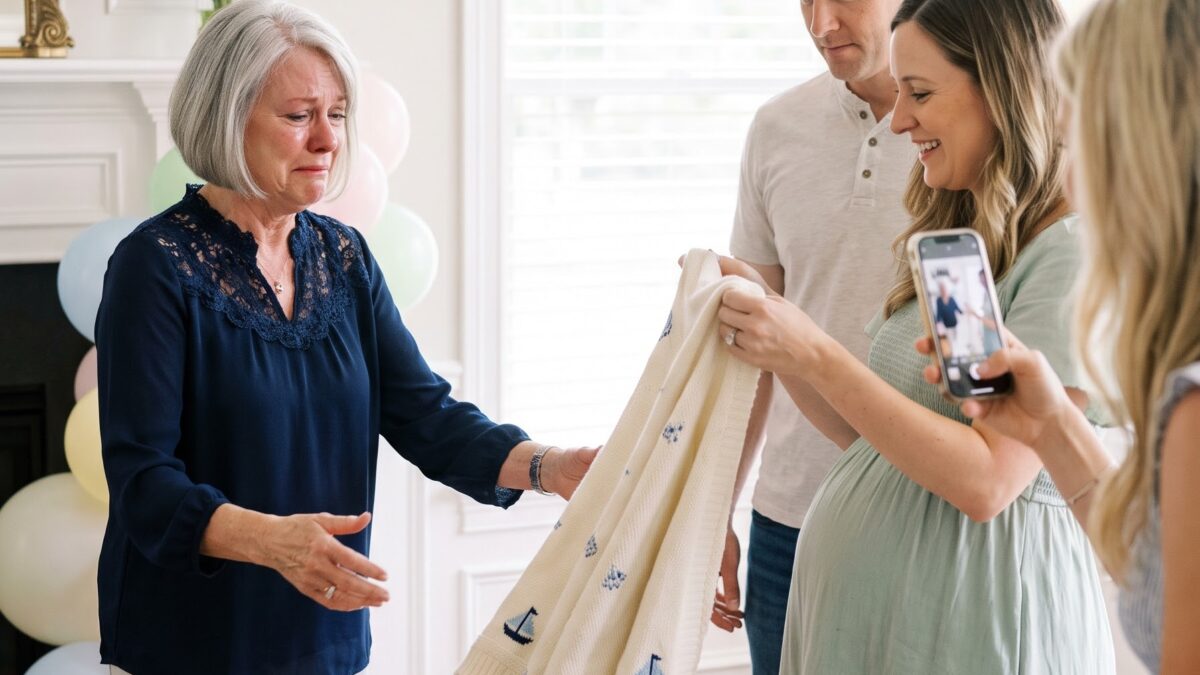
The Blanket She Threw Away
At my grandson’s baby shower, my daughter-in-law held up the blanket I had spent four months knitting, glanced toward her friend’s phone, and smiled.
“We only use designer things here.”
Then she dropped it into the trash can beside the gift table.
A few people laughed. My son made a short, uncomfortable sound that might have been a laugh, too. He was standing close enough to reach the blanket before it fell.
He didn’t move.
I got up, lifted it out of the bin, brushed away a scrap of tissue paper, and folded it into my bag. Then I thanked our hostess and went home.
That evening, Kyle called.
“Mom,” he said, “please tell me what Aunt Caroline said is true. What was inside that blanket?”
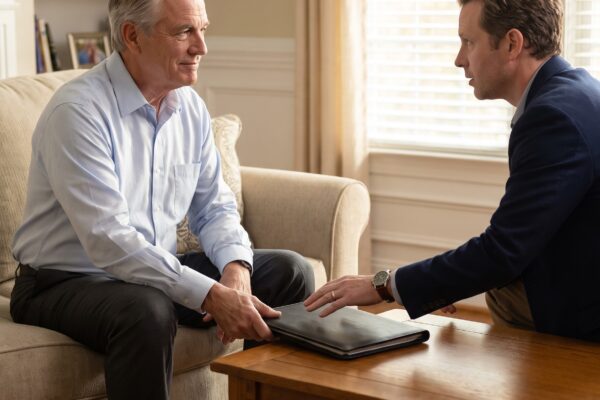
I was sitting at my kitchen table with the cream wool across my knees. Beneath the small blue sailboats, inside a pocket I had sewn by hand, was the last gift his father would ever give our family.
“Before we talk about that,” I said, “I need to know something.”
“What?”
“If there had been nothing inside it, would you still be calling?”
He didn’t answer right away.
That silence hurt more than anything Madison had said.
My name is Darlene Mercer. I was sixty-eight that summer, and until two years earlier, I had owned a tailoring and fabric shop on Bell Street.
For forty years, people brought me wedding dresses, school uniforms, torn coat linings, and trousers they insisted had shrunk in the wash. I knew which customers needed a little extra time to pay. I knew whose husband had died before they told me, because they came in carrying a suit instead of wearing it.
My husband, Frank, used to collect me at closing on Fridays. He would stand by the door with his truck keys in his hand while I finished one last seam.
“You’ve been finishing one last seam since 1983,” he would say.
“And you’ve been complaining about it since 1983.”
Then he would carry the heavy bags to the truck.
We were married forty-three years. Six months before that baby shower, I lost him.
I still caught myself buying the coffee he liked.
I still turned toward his chair when something funny happened on television.
And when I began knitting that blanket, I kept thinking I would have to show him the sailboats before I gave it away.
### What Frank Had Saved
Frank was not a man who announced his generosity.
He drove the same pickup for nineteen years. When its heater stopped working, he wore gloves until he could afford the repair. He checked the grocery receipt before we left the parking lot, but he never asked whether I had charged enough when I altered a widow’s funeral dress.
Some months we saved very little.
Other months, after a good stretch at my shop or a bonus from his maintenance job, he put something aside.
When Kyle turned ten, Frank began buying savings bonds for the grandchild he hoped we would have someday.
I knew he bought bonds. I knew there was a cigar box on the closet shelf where he kept them. What I didn’t understand was that he had set those particular bonds apart from our ordinary savings.
At first he bought them regularly. Later, as our circumstances changed and buying paper bonds became less convenient, he stopped adding to that collection. He left what he had bought alone and kept the records with it.
By the time Kyle married Madison, nearly thirty years had passed since the first purchase.
Kyle was forty when Hudson was born. He had married later than most of his friends, and he and Madison had waited several years for a pregnancy that stayed.
Frank knew about the baby.
That was one mercy we were given.
Kyle and Madison told us when she was a little over six weeks along. They came to our house after dinner, both trying so hard to look casual that Frank asked whether they had backed into his truck.
Madison set a small ultrasound picture on the table.
Frank looked at it, then at Kyle.
“Really?”
Kyle nodded.
My husband took off his glasses and wiped them with his shirt, though they were perfectly clean.
A few weeks later, his heart condition worsened. There were appointments, medication changes, and finally a hospital stay from which he would not come home.
The doctors spoke plainly with us. Frank listened, asked a few practical questions, and then asked me to bring the old cigar box.
I carried it into his room in a grocery bag.
“That’s a dignified presentation,” he said.
“You want dignity, you should have picked a better box.”
He smiled, and for a moment he looked like the man who used to tease me through the shop window.
Inside were the bonds, arranged by purchase year, along with a handwritten list and an envelope.
On the envelope, in Frank’s square, careful writing, were the words:
For our first grandbaby.
I sat down beside his bed.
“Frank.”
“I know. A little early to start planning.”
“Thirty years early.”
“Well, the kid was taking his time.”
He was tired. We both pretended not to notice how often he needed to stop between sentences.
He told me the collection was worth a little under fifty thousand dollars by his last calculation. Different bonds had different dates. The oldest were nearing the end of their interest-earning years; the others were still earning.
He had written down where to check the values.
Both our names appeared on the bonds. He had arranged that years earlier, so I would not be left trying to sort out a box of securities that belonged only to him.
“The money’s yours to handle if I’m not here,” he said. “But you know what I wanted it for.”
“I know.”
“I don’t want it turning into a stroller nobody remembers.”
“Strollers are expensive now.”
“So I’ve heard.”
He reached for my hand.
“Make something for the baby. Something they’ll keep. Put the papers with it. Let them find out where it came from.”
“You want me to sew a bank into a baby blanket?”
That got a laugh out of him, followed by a cough that made us both stop smiling.
“Not forever,” he said when he caught his breath. “Just for the giving. Open it with them. Then put the money wherever it ought to go.”
That distinction mattered later.
Frank wanted a surprise. He did not want financial documents left in a blanket that would go through a washing machine.
He wanted the family to understand that the gift had been waiting for this child long before any of us knew the child’s name.
He also wanted to leave a letter.
Over two afternoons, he dictated it while I wrote on a yellow legal pad. I read every paragraph back. He changed a few words, crossed out a sentence that sounded too formal, and made me add something about the first fish Kyle caught.
“That part’s embarrassing,” I told him.
“That’s why it belongs.”
Once I had copied it neatly, he signed beneath the words Love, Grandpa Frank.
We sealed it in an envelope marked for the baby’s eighteenth birthday.
Then he asked for one more page.
“This one you can read when you give them the present,” he said. “So they don’t think the old man just sent money.”
I wrote that, too.
A week later, Frank died.
The cigar box came home with me. For several days, I could not bring myself to open it.
### Four Months of Work
I started the blanket in January, a month after the funeral.
Madison’s due date was in July. There was time, I thought, even with my hands.
Arthritis had been troubling my fingers for about five years. Some mornings I could work comfortably after warm water and a little gentle movement. Other mornings I had to leave the needles in their basket.
I did not knit through every bad day. I learned long ago that forcing an angry joint only steals tomorrow’s work.
But on the good days, I sat near the living room window and made a few rows.
The yarn was cream, soft and washable, a wool blend I had used for baby gifts before. Around the edge, I worked a border of small blue sailboats.
Frank loved the water.
We never owned anything grander than a secondhand fishing boat, but he had treated that little boat as if it could take us anywhere.
When Kyle was young, Frank taught him to cast from the county lake’s muddy bank. They usually came home with one fish, four new mosquito bites, and a detailed explanation of why the big ones had escaped.
After the pregnancy announcement, Frank had started talking about teaching another child.
“I’ll need a smaller life jacket.”
“You haven’t even met the baby.”
“I’m trying to get ahead of the paperwork.”
I put his initials in one corner of the blanket.
FM.
They were small enough to miss unless you looked closely.
By May, the blanket was finished.
There were a few uneven stitches along the border where my fingers had stiffened. I corrected what I could and left the rest. The sailboats looked like sailboats. The blanket lay flat. It was soft against my cheek.
I stood in the bedroom and held it up.
For a second, I turned toward the doorway, ready to call Frank.
Then I sat on the bed until that feeling passed.
The pocket took another afternoon.
I made it from lightweight cotton and attached it securely to the underside, near the border. It was large enough for the folded bonds and the sealed letter, but not so large that it changed the shape of the blanket.
The collection was a noticeable packet, not a magical flat square that disappeared into the knitting. Once the blanket was folded, though, the papers rested between its layers.
I put them inside a protective sleeve first.
Then I closed the pocket with small basting stitches that I could remove in front of Kyle and Madison.
The family note went into my handbag.
That was the plan.
Madison would unwrap the blanket. I would tell her there was something from Frank inside. We would open the pocket together, put the documents somewhere safe, and give the blanket to the baby without any papers attached.
I never imagined that I would need a plan for retrieving it from a trash can.
### The Family I Was Entering
Madison had always cared about appearances.
That alone did not bother me.
I made my living helping people look their best. There is nothing wrong with a beautiful coat, a carefully chosen room, or a woman wanting photographs of a happy day.
What troubled me was the way Madison sometimes used those things to sort people.
At our first Thanksgiving together, she asked whether my serving platter was “supposed to look that old.”
It had belonged to my mother.
I told her it was older than I was.
“Oh,” she said, and reached for another dish.
When Kyle mentioned that I had altered his wedding suit myself, she smiled and said, “We still had it professionally checked.”
I had let that pass.
There were other small moments. Invitations that arrived late. Conversations about the nursery that stopped when I offered a suggestion. A knitted cardigan I gave her one Christmas that remained in its tissue paper when I visited months afterward.
None of those things seemed worth a family argument by itself.
Together, they had taught me to be careful.
Madison’s mother, Gail, encouraged the same habits.
Gail had a lovely home, knew how to organize an event, and could make a guest feel welcome when she chose. She could also look someone up and down while maintaining a perfectly pleasant expression.
Once, at dinner, she asked how long I had worked “out of that little sewing place.”
“Forty years.”
“How sweet.”
Then she turned to Madison and asked whether the nursery furniture had arrived.
Kyle usually tried to smooth things over.
He changed the subject. He offered to get more coffee. Afterward, he told me nobody meant anything by it.
Sometimes that was true.
Sometimes it was simply easier for him to believe.
My son was kind in ways that did not require confrontation. He brought groceries when I was sick, repaired the loose railing on my porch, and called after Frank died even when he had nothing to say.
But if keeping Madison happy required him to ignore a remark at my expense, he often ignored it.
I had begun to notice how much work I did to make those choices comfortable for him.
I said I understood.
I said it was fine.
I said I did not need to be included in every little thing.
Then I went home and ate dinner alone.
The baby shower was different.
I had Frank’s gift. I had four months of work folded in cream tissue paper. I had something joyful to bring into a house where I had too often felt like an obligation.
I wanted that afternoon to go well.
I bought a navy blouse with a small lace collar. I wrapped the blanket in a plain box and tied it with blue ribbon.
On the morning of the shower, I put the box beside my handbag and checked twice that I had the family note.
Then I drove to Gail’s house with the gift on the passenger seat.
“Here we go,” I said aloud.
Talking to Frank in the truck was a habit I had not yet given up.
### The Baby Shower
Gail’s house sat at the end of a quiet suburban street, behind a lawn so evenly cut it looked brushed.
The shower was in late June. By noon, the heat had driven everyone inside, though the invitations had called it a garden party.
There were white peonies on the tables, pale balloons around the fireplace, and a tray of iced tea near the kitchen island.
Twenty guests had been invited. Most were Madison’s friends or relatives. Kyle had come for the gift opening, along with Gail’s husband and a few others who had been helping set up.
Caroline was there, too.
She was Frank’s younger sister, sixty-five, with sensible shoes and a laugh I could identify from another room.
She saw me coming through the doorway and took the box before I could juggle it with my handbag.
“You made it.”
“I was invited.”
“That doesn’t always stop you from inventing an appointment.”
She knew me too well.
Caroline helped me find a chair, then leaned close.
“Is this it?”
I nodded.
She had known about Frank’s plan since his hospital stay. After I finished the blanket, I had shown her the pocket and explained how I would present it.
“Tell Madison before she starts waving it around,” she whispered.
“I’ll tell her as soon as she opens the box.”
Caroline squeezed my arm.
“He would have enjoyed this.”
That was what I had been thinking all morning.
Across the room, Kyle was carrying a tray of glasses. He set it down and came over to kiss my cheek.
“You look nice, Mom.”
“So do you.”
He glanced at the box.
“The blanket?”
“Yes.”
“Hudson’s going to love it.”
They had already chosen the name.
Hudson Mercer.
I liked saying it to myself.
Madison came over a few minutes later. She wore a pale green dress and looked tired beneath her makeup.
“How are you feeling?” I asked.
“Ready to stop being pregnant.”
“Not quite yet, I hope.”
She smiled at that, and I relaxed a little.
Then Brooke called from the gift table.
“Madison, come look at the lighting here.”
Madison turned before I could say anything about Frank.
Brooke was her friend, the one who helped take photographs and short videos for her social media account. Her phone was mounted on a small grip, and she had been filming the decorations, the food, and people arriving.
I did not mind being photographed.
I did mind discovering later that a painful family moment had been treated as something to post.
The gift opening started after lunch.
Madison sat in a white chair near the fireplace. Gail handed her the packages while Brooke filmed.
There were practical things among the expensive ones: diapers, bottles, a thermometer, a stack of small cotton sleepers. But the gifts that received the longest attention were the ones with recognizable labels.
Madison held up a diaper bag.
“Oh, this is the one.”
Gail told everyone where it came from.
Another guest had bought an expensive stroller that was still in its shipping box in the hallway. Madison got up to admire it while Brooke followed.
Caroline leaned toward me.
“I hope the baby knows he’s supposed to appreciate all this.”
I laughed.
For a while, it felt like an ordinary shower.
People talked over one another. Someone spilled tea. Gail’s sister complained that the house was too cold, then took off her cardigan.
I watched Kyle standing near the wall, checking his phone once and slipping it back into his pocket.
Then Gail picked up my box.
“From Grandma Darlene.”
I sat a little straighter.
Madison untied the ribbon and pulled away the paper. She opened the lid, lifted the blanket, and let it unfold.
The sailboats caught the light.
For one brief moment, I thought she liked it.
She ran a hand over the border.
“Did you make this?”
“I did.”
I began to stand.
“There’s something tucked—”
“Oh, that’s sweet.”
She said it quickly, cutting across me.
Then she looked toward Brooke’s phone.
“It’s very homemade.”
Gail laughed softly.
“Bless her heart. Think of all that work.”
Caroline’s hand closed around the edge of her chair.
I was still halfway out of mine.
“It’s from both of us,” I said. “There’s something from Frank—”
But Madison had already turned away.
She draped the blanket over her arm and glanced toward the nursery gifts arranged beside her chair.
“It’s just not really the look we’re doing.”
No one had asked her to explain.
She could have folded it and set it down. She could have thanked me and decided privately never to use it.
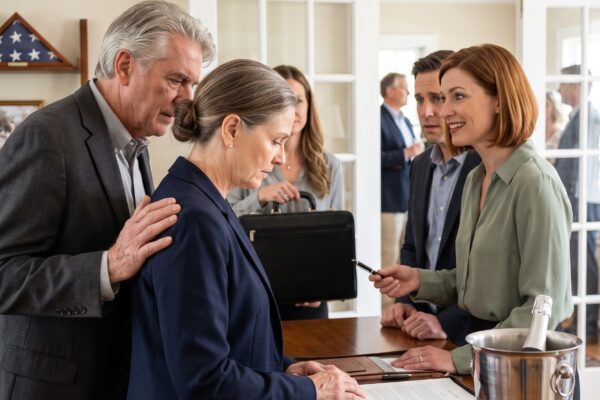
Instead, with Brooke still filming, she stepped toward the tall wastebasket at the end of the table.
It held the wrapping paper from the gifts.
“Grandma’s going to have to forgive me,” she said, smiling.
I stood all the way up.
“Madison.”
She held the blanket over the bin.
“We only use designer things here.”
Then she let go.
### The Sound My Son Made
The blanket landed on a sheet of silver wrapping paper.
It did not fall into food scraps or anything wet. It was a clean liner filled mostly with tissue and ribbons.
That should have made it easier.
It didn’t.
A few guests laughed.
One looked down at her plate. Another said, “Oh, Madison,” in a voice that made it sound like a harmless little joke.
Gail smiled.
Brooke kept the phone pointed at the bin.
I looked at Kyle.
He had stopped leaning against the wall. His mouth was slightly open, and he made that small sound I have never forgotten.
A nervous laugh.
Then he looked away.
Caroline was saying my name as I crossed the room.
I reached into the basket and took out the blanket. A ribbon had caught in the sailboat border. I eased it free rather than pulling.
Madison lowered her hand.
“Oh. Did you want it back?”
I folded one edge over the other.
“Yes.”
“I was kidding.”
I brushed a piece of tissue from the wool.
“You can give me the box, please.”
She stared at me, then handed it over.
I put the blanket inside, slid the box into the large tote I had brought, and picked up my handbag.
Kyle took a step toward me.
“Mom—”
“I’m going home.”
“We haven’t done the cake.”
“I know.”
Caroline rose from her chair.
“I’ll walk you out.”
I thanked Gail for lunch. The words came out automatically, the way manners sometimes do when the rest of you has stopped functioning.
At the door, Kyle tried again.
“Let me take that.”
“I’ve got it.”
He let his hand fall.
Outside, Caroline stood beside my car while I unlocked it.
“Darlene, I’m sorry.”
“You didn’t throw it.”
“I should have stopped her.”
“It happened fast.”
That was true. It was also kinder than I felt.
She glanced back toward the house.
“Do you want me to tell them?”
I knew what she meant.
The bonds. The letter. Everything that had gone into the bin with the blanket.
“Not right now.”
“All right.”
I put the tote on the passenger seat.
Caroline leaned down to look at me.
“Don’t drive until you’re ready.”
I nodded.
She waited on the sidewalk until I closed the door.
Then I sat with both hands resting on the steering wheel.
I had walked into that house excited.
That was the part I could not stop returning to.
I had imagined Kyle touching his father’s handwriting. I had imagined Madison opening the envelope marked for her son’s eighteenth birthday and realizing that Frank had thought about this baby for years.
Instead, I had watched my son stand still while his wife made a joke out of my gift.
I opened the box and touched the corner where I had worked Frank’s initials.
“I’m sorry,” I whispered.
For a few minutes, I cried hard enough that I could not have driven safely.
Then I wiped my face, drank some water from the bottle in my cup holder, and waited.
I was not going to decide anything in Gail’s driveway.
But one thing was already clear.
Hudson would still receive what Frank had saved for him.
The child had done nothing wrong.
The adults would not be getting an envelope they could treat as another shower gift.
### The Call
Caroline called after I got home.
I was setting the box on my kitchen table.
“You’re home?”
“Yes.”
“Good.”
She hesitated.
“Kyle asked what you meant about Frank.”
I sat down.
“What did you tell him?”
“The truth. That Frank saved bonds for the baby, and that you had put them in the blanket with his letter.”
“Did you tell him I have it?”
“Yes. I saw you take it. He saw you take it, too.”
“Then he knows it’s safe.”
“He knows you took the blanket. I don’t think he’s able to think much beyond that right now.”
I looked toward Frank’s empty chair.
“What did he say?”
“He asked if I was sure.”
“And?”
“I said I’d seen the pocket myself.”
Caroline let out a breath.
“He went outside. Madison was asking where he was going when I left.”
“Thank you for telling me.”
“Do you want me to come over?”
“Not tonight.”
“Tomorrow, then.”
“Tomorrow.”
After we hung up, I took out my sewing basket.
The basting stitches were easy to remove. I used the seam ripper to lift them one at a time, then opened the cotton pocket.
The protective sleeve was exactly where I had put it.
I took out the bonds and checked them against Frank’s list. Then I examined the sealed letter.
Nothing was torn. Nothing was stained.
I put everything in the cigar box and closed the lid.
That was when the phone rang.
Kyle’s name appeared on the screen.
“Mom.”
He sounded as if he had been running.
“I’m here.”
“Please tell me what Aunt Caroline said is true. What was inside that blanket?”
“Your father’s savings bonds. And the letter he dictated for Hudson.”
“How much?”
“His last estimate was a little under fifty thousand. I haven’t had every value checked recently.”
Kyle drew a sharp breath.
“And the letter?”
“It’s safe.”
“All of it?”
“Yes.”
Then I asked the question I had been holding since I saw his name on the phone.
“If there had been nothing inside it, would you still be calling?”
He went quiet.
I waited.
“I was going to call,” he said finally.
“To say what?”
“That I was sorry.”
“Or that Madison didn’t mean anything by it?”
He did not argue.
“That was probably going to be part of it.”
I closed my eyes.
There was my son, telling me the truth at last, and I hated how much it hurt to hear.
“Kyle, I tried to tell her there was something from your father. She didn’t let me finish.”
“I know.”
“You heard me?”
“Yes.”
“And you laughed.”
“I know.”
His voice broke on the second word.
“I don’t know why I did that.”
I had a few ideas, but he needed to find the words himself.
After a while, he said, “I thought if I made it seem like a joke, it would stop being so bad.”
“Did it?”
“No.”
I heard movement on his end, then a car door closing.
“Where are you?”
“In the driveway at Gail’s. I went back in for a minute. I couldn’t stay.”
“Are you driving?”
“No.”
“Good. Stay where you are until you’re settled.”
He cried then.
I did not tell him to stop. I did not say it was all right.
It wasn’t all right.
“I kept thinking I’d fix it later,” he said when he could speak. “I always think that. I’ll talk to you afterward. I’ll explain it. I’ll bring you dinner.”
“And I’ll make it easy for you.”
“Yes.”
The word came out barely above a whisper.
I looked at the cigar box.
“Your father wanted you to open it with me. That’s what today was supposed to be.”
“I’m sorry.”
“I believe you.”
“What do you want me to do?”
“Start by not explaining your wife’s behavior to me.”
“All right.”
“And don’t tell her the money makes this worse. She hurt me before either of you knew about the money.”
“I understand.”
“I hope you do.”
He stayed on the phone while I made tea.
For once, neither of us rushed to fill the quiet.
### The Explanation Madison Wanted
Kyle told Madison about the bonds that evening.
I was not there. I know what happened because he told me the next day, and because Madison later gave me her own version.
According to Kyle, her first response was to ask why I had hidden something valuable in a blanket.
When he explained Frank’s plan, she said she had not known.
He told her that did not excuse throwing away the gift.
They argued.
Not about whether it had happened. There was a video, and twenty people had been in the house.
They argued about whether it counted as a joke.
Madison called me two days later.
“Darlene, I think this has gotten out of hand.”
I was standing at the sink, rinsing a cup.
“What has?”
“The whole thing.”
“The blanket?”
“Yes.”
I dried my hands and sat down.
She began with how tired she had been, how many people were watching, how Brooke had been filming funny little moments throughout the day.
Then she said, “I wasn’t really throwing it away.”
“You dropped it in a trash can.”
“I thought you knew I was joking.”
“Why would I know that?”
She sighed.
“I wouldn’t have done it if I’d known what was inside.”
There it was again.
“I’m not asking whether you would have thrown away money.”
“I didn’t say that.”
“You said knowing what was inside would have changed what you did.”
“Of course it would have.”
I let the silence sit between us.
Eventually, she said, “You could have told me.”
“I was trying to.”
“I mean before. Not while I was opening it.”
I looked at my sewing basket beside the chair.
“You’re right about one thing,” I said. “The papers should have stayed safely at home until we could look at them without distractions. I won’t do that again.”
She seemed relieved.
“So you understand.”
“I understand that I was careless with valuable documents. That does not make me responsible for you putting my work in the garbage.”
Her voice cooled.
“I feel like whatever I say is going to sound wrong to you.”
“Then don’t explain it. Tell me what you think happened.”
She did not answer.
I could hear someone speaking in the background, possibly Gail, but I could not make out the words.
At last, Madison said, “I’m sorry you were upset.”
I pressed my thumb against a knot in the tabletop.
“I was upset because you humiliated me.”
“That wasn’t my intention.”
“What was?”
Another long pause.
“To make people laugh, I guess.”
“People did.”
She started to say something, then stopped.
I told her I had an appointment and ended the call.
I did not tell her about the appointment.
It was with the bank.
### Putting the Gift on Firm Ground
I took the cigar box, my identification, and the documents I had gathered after Frank’s death.
The woman at the bank who helped me had known us for years. She had helped Frank replace a damaged debit card once and had patiently explained why his old checkbook ledger did not show a pending payment.
She asked whether I was ready to redeem the bonds.
“I’m ready to find out exactly what I have first.”
We went through them carefully.
There were different issue dates and different values. The oldest had stopped earning interest. Others had not.
The total was a little over forty-seven thousand dollars.
Frank’s estimate had been close.
The bank could help with the paperwork, but handling the whole collection was not something I could finish at the counter that morning. There were identification requirements, redemption arrangements, and tax questions to settle.
I took notes.
At my shop, I had learned that when a person says, “We’ll take care of it,” it is still useful to know what happens next.
The following week, I met Patricia, an estate-planning attorney a longtime customer had recommended.
I did not arrive asking her to punish Madison.
I brought the bond inventory and said, “My husband wanted this money saved for our grandson. I need a way to make sure it stays for him.”
Patricia asked who owned the bonds, what Frank had put in writing, and whether there were any other obligations connected to them.
I showed her the registrations and the records.
She explained that the handwritten words on Frank’s envelope expressed his intention. They did not, by themselves, create a trust or transfer the bonds to an unborn child.
As the surviving named co-owner, I had the authority to handle them.
If I wanted to make a protected gift for Hudson, I needed to do it properly.
That was what I had come for.
We discussed several options.
I did not need something elaborate enough for a millionaire. I needed a modest, workable arrangement that would not eat itself up in fees.
Patricia explained the difference between money that parents managed for a child and money controlled by an independent trustee under written terms.
She also explained that “locked away” was not a legal plan.
Someone would still have to manage it. Someone would have to approve permitted expenses, keep records, and follow the document.
We settled on an irrevocable trust for Hudson, to be completed and funded after his birth.
An independent professional would manage it. Neither parent would have withdrawal authority. I would not be able to treat it as my emergency savings or change my mind and take it back.
The terms would allow payments for Hudson’s education and training, made for his benefit rather than handed to his parents. Whatever remained would become his outright at a specified adult age.
We chose twenty-five for that final distribution.
Frank had said “a head start,” not “a blank check on the eighteenth birthday.”
I thought he would have approved.
The letter was different.
Hudson would receive that at eighteen, exactly as Frank had asked.
Patricia told me to keep it protected and make sure someone knew how to deliver it if I was no longer around. Caroline agreed to be the backup person for that promise.
I made copies of the financial records.
The original letter stayed sealed.
I also spoke with the tax preparer who had handled my business returns. Interest, costs, and paperwork were not going to vanish because the money had a sentimental purpose.
I decided that any taxes and setup expenses I was responsible for would come from my own funds. If necessary, I would add enough to make Hudson’s starting gift a full forty-seven thousand dollars.
I could afford that without touching the money I needed to live on.
It was not a dramatic fortune. It was the result of two people working, saving, and occasionally doing without.
That seemed like a good way to finish what Frank had started.
### Before the Dinner
Kyle came over while the trust was being drafted.
He brought groceries I had not requested and a small container of soup.
I thanked him for the soup. Then I moved the grocery bags off the chair so he could sit.
“You don’t have to bring something every time you want to talk.”
“I know.”
He looked toward the living room.
“Where’s the blanket?”
“Drying.”
I had removed the cotton pocket and washed the blanket according to the yarn instructions. Then I laid it flat on clean towels in the spare room.
There had been no real damage.
I was grateful for that, though gratitude did not erase what had happened.
Kyle went to look at it.
From the kitchen, I heard him say, “I never noticed the initials.”
“They’re small.”
He came back with his hands empty.
“Mom, Madison’s worried you think she’s a terrible person.”
“I think she did a terrible thing.”
He sat down.
“She’s embarrassed.”
“She should be.”
“I know.”
He looked at the soup container between us.
“I’m trying not to do it again.”
“What?”
“Come here and make you help me feel better about her.”
I nodded.
That was a more useful apology than another bag of groceries.
We talked about the money.
I told him what Patricia and I were arranging, including the independent trustee.
“So neither of us can use it.”
“Correct.”
“Even if we say it’s for Hudson?”
“You can ask for an expense the trust allows. The trustee decides whether it qualifies and how to pay it.”
He listened without interrupting.
Then he said, “That’s fair.”
“It includes me.”
“I know.”
“I’m not going to use the money to make you visit or make Madison behave. Once it’s given, it’s Hudson’s under the terms we set.”
Kyle rubbed both hands over his face.
“Dad would have wanted that.”
“I think so.”
He asked whether I still wanted the family gathering.
“Yes. After the baby’s here and you’ve had time to settle.”
“Who do you want there?”
“You, Madison, Caroline, and Gail.”
He looked uneasy at Gail’s name.
“She was part of it, Kyle.”
“I know.”
“I won’t invite the shower guests. I’m not planning an audience.”
He nodded.
“I’ll talk to Madison.”
“Tell her why she’s coming. Tell Gail, too.”
I did not want to repeat what had happened to me by bringing someone into a room where everybody else knew a difficult conversation was waiting.
They would know we were discussing Frank’s gift.
They could decide whether to come.
Before Kyle left, he stood by the back door.
“I should have picked it up.”
“Yes.”
“I keep thinking about that.”
“So do I.”
He swallowed.
“I’m sorry, Mom.”
This time, I did not have to wonder what he meant.
### Hudson
Hudson arrived four weeks after the shower, on a rainy Thursday in July.
Seven pounds.
A furious little face.
Kyle called from the hospital and said both Madison and the baby were doing well.
I did not drive over until they said they were ready for visitors.
Caroline wanted to come with me, but we agreed one visitor at a time would be enough.
When I entered the room, Madison was sitting against a stack of pillows, her hair loosely tied back. There were water cups, a phone charger, and an unopened sandwich on the bedside table.
No carefully arranged shower decorations.
No gift-opening chair.
Just a tired woman who had given birth and a man trying to fasten a diaper with the seriousness of a mechanic rebuilding an engine.
“You’re putting it on backward,” Madison told him.
“I knew that.”
“No, you didn’t.”
She laughed, and he did, too.
For a moment, I saw them without the habits that had worn on me for years.
Then Kyle turned.
“Mom. Come meet him.”
He placed Hudson in my arms while I sat in the visitor’s chair.
The baby made a disgruntled little sound and pulled one hand toward his mouth.
There was something of Frank around the brow.
I knew newborn faces change. I knew grief makes us search for the people we miss.
Still, I looked down and had to blink hard.
“Oh,” I whispered. “There you are.”
Kyle heard me.
He looked toward the window.
Madison watched us quietly from the bed.
I did not mention the shower.
I did not bring the blanket.
I brought a casserole to their home two days later, left it in the refrigerator, and washed the bottles in the sink while Kyle took out the trash.
When Madison thanked me, I said, “You’re welcome.”
It was possible to care for her and still be hurt.
It was possible to love my grandson without pretending his parents had done nothing wrong.
Over the next few weeks, I visited when invited. I did not arrive unannounced. I did not criticize how they fed him or insist my old methods were better.
Kyle began calling to ask rather than assuming.
“Would Tuesday afternoon work?”
“Would you mind holding him while Madison showers?”
“Can I bring him over for an hour?”
Those were small changes.
I noticed every one.
### Opening the Blanket
We had the dinner six weeks after Hudson was born.
By then, the trust document was ready, the trustee had agreed to the arrangement, and the redemption paperwork was prepared. I had kept the original bonds for the family presentation before completing that last step.
Patricia knew the timetable.
There was no pretending the account was already funded when the papers were still in my hands.
Afterward, the originals would be submitted through the proper process. Copies and receipts would remain in the file.
The afternoon before dinner, I attached the clean cotton pocket to the blanket again.
I placed the protected bonds and Hudson’s sealed letter inside and closed it with a few loose basting stitches.
Then I put Frank’s family note beside my place at the table.
Caroline came early to help.
“You don’t have to cook a whole meal,” she said.
“I know.”
“Then why are you?”
“Because I would rather be peeling potatoes than watching the clock.”
She took the peeler from me.
“Fair enough. You can do the carrots.”
Kyle and Madison arrived just after five, with Hudson asleep in his carrier. Gail came a few minutes later.
Everyone knew why they had been invited.
That did not make the first few minutes comfortable.
Gail handed me a bakery box.
“I brought dessert.”
“Thank you.”
Madison stood near the dining room doorway, looking at the blanket folded on the sideboard.
I had not put it under their plates or arranged it like an exhibit.
It was simply there.
Kyle took Hudson out of the carrier when he woke and held him while we sat down.
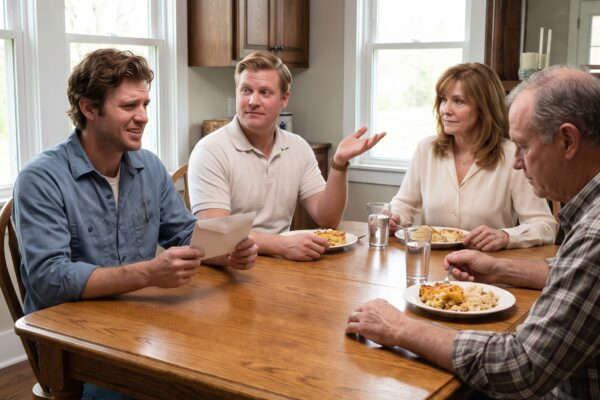
We ate pot roast, potatoes, and green beans.
Caroline asked how much sleep they were getting.
“Define sleep,” Kyle said.
Madison smiled.
For a little while, we talked like a family.
That mattered to me.
I did not want the only thing anyone remembered about that evening to be an accusation.
After dinner, Caroline helped clear the dishes. Kyle took Hudson to the living room for a diaper change and came back with him awake against his shoulder.
I brought the blanket to the table.
The seam ripper lay beside Frank’s note.
“I wanted to give Hudson his grandfather’s present with all of you here,” I said. “This was supposed to happen at the shower.”
Gail looked down at her cup.
Madison sat very straight.
I turned the blanket so the pocket faced upward.
“Frank asked me to put the papers with something I made. He wanted us to open it together, so the baby would have more than a dollar amount.”
I picked up the seam ripper.
For a moment, my fingers would not hold it comfortably.
Caroline moved as if to help, then stopped when I adjusted my grip.
I lifted the basting stitches, one by one.
No one spoke.
When the pocket opened, I removed the sleeve containing the bonds and set it on the table.
Then I took out the sealed letter.
Kyle reached toward the bond packet and stopped short of touching it.
“You can look,” I said.
He slid the first few papers apart.
There were his father’s name, my name, the purchase dates.
Years of small decisions, preserved in paper.
“Dad started these when I was ten?”
“Yes.”
He let out a breath.
“He never told me.”
“He wanted to give them to you when you had a child.”
Kyle looked down at Hudson, then back at the dates.
I placed the bank’s valuation summary beside the packet.
“The collection is worth a little over forty-seven thousand dollars. Different bonds were bought at different times. They didn’t all mature together.”
Gail lifted her eyes.
“Forty-seven thousand?”
“Yes.”
Madison stared at the sealed envelope.
“And that’s the letter?”
“Yes. He dictated it in the hospital. It’s for Hudson when he turns eighteen.”
She did not touch it.
The writing on the front was mine. Frank had been too tired to address the envelope neatly, but his signature was waiting inside.
Kyle looked at me.
“I remember you with the yellow pad.”
“You thought we were writing down bills.”
“I did.”
“We did some of those, too.”
He gave a small, broken smile.
Then I turned toward Madison.
“This was inside the blanket at the shower.”
“I know,” she said.
“I need you to hear the rest.”
She pressed her lips together.
“Those documents should have been handled more carefully. I’ve already said that. But I brought you a gift, and before I could explain it, you put it in a trash can.”
Her eyes moved toward Gail.
“I thought it would come across differently.”
“How?”
“Like a joke.”
“Who was supposed to enjoy it?”
She looked back at me.
I waited.
After a few seconds, she said, “My friends.”
“And me?”
“No.”
The answer was so quiet I almost missed it.
She swallowed.
“I didn’t think about that.”
Gail shifted in her chair.
“Darlene, nobody knew there was anything valuable—”
“The blanket was valuable.”
Caroline said it before I could.
Gail’s expression tightened.
“I meant money.”
“I know what you meant,” I said.
Madison looked down at the sailboats.
“I wouldn’t have done it if I’d known.”
Kyle adjusted Hudson against his chest.
“That’s what you keep saying.”
His voice was low, but it was steady.
Madison turned toward him.
“Because it’s true.”
“It doesn’t help.”
“Kyle—”
“Mom shouldn’t have needed to hide forty-seven thousand dollars in something to make us treat it decently.”
Hudson stirred.
Kyle paused to settle him, rubbing a hand gently down his back.
Then he looked at his wife again.
“And I shouldn’t have stood there.”
That was the first time he had said it in front of all of us.
“I saw what was happening,” he continued. “I could have stopped it. I decided not to.”
He turned toward me.
“I’m sorry.”
I nodded because I could not trust my voice yet.
Madison began to say something about the camera.
Kyle shook his head.
“Please don’t make Brooke the reason. You dropped it. I laughed. We both need to own that.”
She sat back.
Gail looked as if she wanted to interrupt, but Caroline held her gaze until she looked away.
I rested one hand on the blanket.
“I’m not asking any of you to argue over who feels worse. I’m asking that we stop pretending this happened because I didn’t attach a price tag.”
### What Would Happen to the Money
I took Patricia’s folder from the sideboard.
“There’s something else you need to know.”
Madison’s eyes moved to it immediately.
“Hudson is still getting the gift,” I said. “That was never in question.”
Kyle nodded.
“The money will go into an irrevocable trust for him, with an independent trustee. The documents are ready. Once the bonds are redeemed and everything is processed, I’ll fund it with forty-seven thousand dollars.”
Gail leaned forward.
“Why not put it in an account his parents can manage?”
“Because I’m choosing this arrangement.”
“Surely Kyle—”
“It includes Kyle.”
My son nodded again.
“I know.”
I explained the terms without reading the entire document aloud.
Educational expenses could be paid under the trust’s rules. The trustee would handle requests and keep records. Neither parent could withdraw money for household spending or use the fund as their own collateral.
Whatever remained would go to Hudson when he turned twenty-five.
“And you?” Madison asked.
“I don’t get to take it back.”
“So it’s not something you can hold over us.”
“No.”
Her face changed slightly.
I understood why she had asked.
Money can become another way for families to hurt one another. I had seen enough of that in my shop, hearing customers talk while I pinned their hems.
I did not want Frank’s gift turning into leverage.
“The money belongs to Hudson once I complete the gift,” I said. “Our relationship is a separate matter.”
Madison looked toward the blanket.
“What about that?”
“It’s staying here for now.”
“For how long?”
“Until we’re ready to talk about it without defending what happened.”
Gail made a small sound of disapproval.
I looked at her.
“I’m not withholding something Hudson needs. He has blankets. This one has been through enough.”
Kyle said, “That’s fair.”
Madison did not agree, but she did not argue.
I put the trust folder aside.
“His letter will stay sealed until eighteen. Caroline knows where it will be kept and how to get it to him if I’m not here.”
Caroline reached across and touched the envelope with one finger.
“I promised.”
I took out the smaller family note.
“This one Frank asked me to read when we gave the gift.”
Kyle lowered his head.
For a few seconds, all I could see was my husband in that hospital bed, asking whether a sentence sounded too much like something from a greeting card.
I opened the page.
### Frank’s Words
“If Darlene is reading this,” I began, “then we finally have a grandbaby, and I’m probably missing a very good afternoon.”
Caroline laughed once, through tears.
“I started saving for you before your dad had any idea how expensive children could be. I thought I’d get ahead of him.”
Kyle closed his eyes.
“I don’t have a lot of advice. Your grandmother has enough for both of us, and most of hers is better.”
I had forgotten that line.
For a moment, I had to lower the page.
Then I continued.
“I hope the money helps with something useful. School, learning a trade, whatever gives you a good start. I hope you get to be a kid before anyone asks you to be impressive.
“And I hope you know you were wanted before we met you.
“Your grandmother made the blanket because that’s what she does when she loves somebody. She makes sure they have something that fits, something warm, something that will hold up.
“If she tells you to be careful with it, listen. She knows more about keeping things together than I ever did.
“Tell Kyle to take you fishing. He’ll say I exaggerated how big the fish were. Don’t believe him.
“All my love, Frank.”
That was all.
No speech about designer labels.
No prediction about what Madison would do.
Just my husband, trying to make us laugh and leave something behind.
Caroline was wiping her face with her napkin.
Kyle had one hand spread across Hudson’s back and the other covering his mouth.
Gail stared at the table.
Madison looked at the blanket for a long time.
Then she said, “I didn’t know he’d asked you to make it.”
“He asked for something handmade. The sailboats were my idea.”
She touched the border.
Only the edge of one finger, as if she was uncertain whether she was allowed.
“These took you a long time?”
“Yes.”
She withdrew her hand.
I did not fill the silence for her.
Eventually, she said, “I shouldn’t have done it.”
It was not a complete apology.
There were no words about the roomful of guests, the laughter, or watching me retrieve my gift.
But she had finally said what she had done was wrong without adding a reason it was partly my fault.
I accepted that much.
“Yes,” I said. “You shouldn’t have.”
### The Rest of the Conversation
After Caroline put the letter back in its envelope, I told them what I needed going forward.
No more jokes about my work being cheap.
No more explaining that I had misunderstood something everyone else had understood perfectly.
No more inviting me to family occasions and treating my presence as an embarrassment.
“I want to know my grandson,” I said. “I know you’re his parents. You decide what works for his care and your home. But I won’t keep coming to places where I’m made fun of and expected to smile.”
Kyle looked at Madison.
Then he looked back at me.
“You won’t have to.”
I had heard promises before.
I hoped this one would become something I could see.
Gail finally spoke.
“I shouldn’t have laughed.”
It was the plainest sentence she had said to me in years.
“No,” I said.
She nodded and picked up her cup, though there was nothing left in it.
We did not end the evening with everyone embracing.
Madison helped Caroline carry the dessert plates into the kitchen. Gail asked for her bakery box back. Kyle changed Hudson once more before the drive home.
Ordinary things resumed around the difficult conversation.
At the door, Madison stopped beside me.
“I don’t know what else to say.”
“Then take some time.”
She nodded.
Kyle kissed my cheek.
“I’ll call tomorrow.”
“All right.”
After they left, Caroline stayed to wash the last dishes.
I wrapped the bonds and the sealed letter separately and placed them in the cigar box.
The blanket remained on the dining room table.
Caroline came back from the kitchen, drying her hands.
“How are you?”
“Tired.”
“I know.”
“And sad.”
She put the towel down.
“That, too.”
I looked at the empty chair where Kyle had sat.
“I wanted Frank here.”
Caroline pulled out the chair beside me.
“I did, too.”
We sat there until the dishwasher finished.
### What Changed, and What Didn’t
The money took more time than the dinner.
There were forms to complete, originals to submit, confirmations to wait for, and records to keep.
I did not hurry any of it.
Once the redemption was finished and the paperwork was in order, the trust received forty-seven thousand dollars. I paid the expenses I had agreed to handle from my own savings.
The trustee sent the first statement.
I put it in a folder beside a copy of Frank’s handwritten inventory.
The sealed letter went into protected storage with instructions for its delivery. Caroline kept a copy of those instructions.
The blanket stayed in my spare room.
Brooke’s video had been posted briefly after the shower, before she understood what had been inside it.
Caroline had seen the clip and saved it before it disappeared.
I asked her not to circulate it.
I did not want strangers judging Madison, and I especially did not want Hudson growing up with that clip as a family entertainment.
Enough people had seen the incident in person. A few relatives had seen the post. That was already more than I wished.
Madison removed what she could and asked Brooke to take down the rest.
It did not erase the afternoon.
But it stopped turning that afternoon into something people could watch again for amusement.
Gail and I did not become friends.
She began thanking me for things without adding a comment about how simple or old-fashioned they were. I returned the courtesy.
We could sit at the same table.
That was enough.
Madison and I were more complicated.
Some visits were comfortable. Others carried a stiffness neither of us knew how to remove.
I did not expect one dinner to change habits she had learned over a lifetime.
I also stopped making excuses for them.
If she interrupted me, I finished my sentence.
If she made a dismissive remark, I asked what she meant.
Sometimes she corrected herself.
Sometimes she got irritated.
Either way, I no longer did all the work of pretending.
Kyle began making changes that were easier to trust because they happened without an audience.
He called before plans were settled.
He told Madison when something bothered him instead of sending me a private apology later.
Once, when Gail suggested they should skip a visit to my house because there would be “nothing much to do,” Kyle said, “We’re visiting Mom. That is what we’re doing.”
He told me about it afterward without asking for praise.
I gave him some anyway.
A month after the dinner, he came over alone while Madison stayed home with Hudson.
He sat at the kitchen table, in the same chair he had occupied when the blanket was opened.
“I keep replaying the shower.”
“I wish you didn’t have to.”
“It wasn’t the first time.”
“No.”
He looked at his hands.
“I kept telling myself I was staying out of things.”
“You were choosing where to stand.”
“I know that now.”
For a while, we listened to a lawn mower running somewhere down the street.
Then he asked, “Why didn’t you tell me how much it hurt?”
“I did, sometimes.”
He nodded slowly.
“You said things like you felt left out.”
“Yes.”
“And I told you not to take it personally.”
“Yes.”
He leaned back and stared toward the ceiling.
“I’m sorry.”
“I know.”
“No, I mean for making you say it gently enough that I could ignore it.”
I looked down at the cup in my hands.
That was something I had not known how to explain to him.
“You don’t have to agree with me about everything,” I said. “You do have to believe I mean it when I tell you something hurts.”
“I will.”
He and Madison had started counseling.
I knew because he told me, not because I demanded it. He did not bring me reports from their sessions, and I did not ask for them.
Their marriage belonged to them.
My place in the family did not require a seat inside every argument.
Before he left, he paused beside the photograph of Frank on the hallway table.
“I found Dad’s old fishing box.”
“I wondered where that went.”
“In the garage. I’m cleaning it up.”
“For Hudson?”
“Eventually.”
He smiled a little.
“I might practice first. Apparently I’m terrible with a diaper. I should make sure I still know how to tie a hook.”
Frank would have liked that.
### The First Thing Madison Made
Madison asked me to teach her to knit in October.
She called on a Wednesday afternoon.
“Could I come over Saturday?”
“Of course.”
“Not just for a visit.”
I waited.
“I thought maybe you could show me how to make something. A hat, maybe.”
“For Hudson?”
“Yes.”
I glanced toward my yarn basket.
“All right.”
She arrived with a beginner’s set of needles, a skein of blue yarn, and three printed patterns that were much harder than she realized.
I put two of them aside.
“Let’s start with this.”
She frowned at the simple one.
“That doesn’t look like the picture I wanted.”
“The picture you wanted can be the second hat.”
She laughed.
Kyle stayed home with Hudson for the first hour. For once, Madison and I sat together without him hovering nearby, trying to keep everything pleasant.
I showed her how to hold the needles.
She gripped them too tightly.
I told her to relax her shoulders.
“I am relaxed.”
“Your shoulders are touching your earrings.”
She lowered them and smiled despite herself.
The first row was a struggle.
The second was worse.
She dropped stitches, pulled the yarn too hard, and somehow added three stitches without knowing where they came from.
At one point, she laid the work in her lap.
“How did you do a whole blanket?”
“A little at a time.”
She studied the crooked strip she had made.
“With your hands hurting?”
“On the days I could.”
She did not answer.
I let her sit with that.
We worked for another twenty minutes before she asked about undoing a mistake.
I showed her how to back up carefully.
“There’s no way to just hide it?”
“Sometimes. This one needs fixing.”
She gave me a look, and I could not tell whether she heard more in the answer than I had intended.
Neither of us turned it into a speech.
We fixed the stitch.
The hat took several visits.
It was slightly lopsided and too big at first. We adjusted the shape, and I helped her finish the top.
When she held it up, she smiled in a way I had not seen at the shower.
“Don’t look too closely.”
“I’ve already looked at every stitch.”
“It’s awful.”
“It’s your first hat.”
She ran a hand over it.
Then she said, “I’m keeping it.”
“I assumed you would.”
She looked at me.
For a second, I thought she might finally say everything I had been waiting to hear.
Instead, she folded the hat into her bag and said, “Thank you for helping me.”
“You’re welcome.”
It was not everything.
It was something.
### Bringing the Blanket Home
I brought the blanket to Kyle and Madison’s house later that month.
I called first.
“I have something for Hudson.”
Kyle knew what I meant.
“Come after lunch?”
“That works.”
Madison opened the door.
When she saw the cream blanket in my arms, she stepped aside without speaking.
The pocket was gone.
I had removed it completely after the dinner and finished the underside so there were no loose threads or rough seams.
The bonds were no longer folded inside.
The letter was protected elsewhere.
Now it was simply a blanket again.
Four months of work.
Blue sailboats.
Frank’s initials.
Hudson was awake on a play mat in the living room, waving his feet with great concentration.
Kyle picked him up, and I sat beside Madison on the couch.
I laid the blanket across my lap and let Hudson rest against me while she watched.
He caught the edge in his fist.
“That’s a strong grip,” I said.
“He gets it from her,” Kyle replied.
Madison touched one of the sailboats.
Then she found the initials.
“FM.”
“Frank Mercer.”
“I saw them at the dinner, but I didn’t really look.”
She traced the letters carefully.
“He would have liked him.”
“He already did.”
Her eyes filled, though she blinked the tears away.
There was a wooden blanket ladder near the bookcase, well away from the crib in the nursery. Madison showed me the place she had cleared for it.
“We’ll keep it here when we’re not using it,” she said.
“That’s good.”
Their pediatrician had told them to keep the crib empty except for its fitted sheet. The blanket was for holding Hudson while he was awake, for supervised time on the floor, and someday for when he was old enough to sleep with it safely.
It did not need to lie in his crib to belong to him.
Before I left, Madison took Hudson so I could put on my coat.
She settled him against her shoulder and looked at the blanket across the room.
“I’m glad you picked it up.”
I stopped with one arm in my sleeve.
“So am I.”
“I mean—”
She paused.
Then she shook her head slightly.
“I know.”
I let her finish putting Hudson down in his bassinet before I opened the door.
There would be other conversations.
I was no longer determined to have them all at once.
### Winter Work
My hands were worse by winter.
Some mornings I could not comfortably hold a needle. On those days, I read, worked on small repairs that required less grip, or left the sewing basket alone.
Hudson did not need a grandmother who hurt herself proving she loved him.
He needed one who could hold him when she was able and enjoy him while he was there.
Still, I began a sweater.
Nothing elaborate.
Soft blue yarn, wooden buttons, a pattern I had used often enough that I hardly needed to check it.
In the cuff, I worked Frank’s initials again.
Kyle came by one afternoon and saw it in my lap.
“You’re putting Dad in all his clothes?”
“Only the ones I make.”
“That could still be a lot.”
“Don’t get ahead of me. I’ve finished one sleeve.”
He sat down and handed me his phone.
There was a photograph of Hudson wearing Madison’s crooked hat.
The brim sat at a strange angle. One ear was almost covered and the other was not.
Madison was in the picture, too, smiling down at him.
No joke about how homemade it looked.
No apology for the uneven stitches.
I enlarged the image.
“That hat fits better now.”
“She says she wants to make another one.”
“Good.”
Kyle watched me looking at the photograph.
“You think we’re doing better?”
“I think you’re doing some things differently.”
He nodded.
That was the answer I could honestly give.
Frank’s money was where it belonged, managed for Hudson’s future.
His letter was waiting for a birthday none of us could yet picture.
The blanket had a place in my grandson’s home.
And my son had begun to understand that a private apology did not undo a public silence.
I could not ask Frank whether I had handled it the way he wanted.
Some nights, that still troubled me.
I had been angry. I had wanted them to understand exactly what they had done. I had needed to protect more than the papers inside that pocket.
But when I pictured Hudson someday opening his grandfather’s letter, I felt settled.
He would have the words.
He would have the gift.
He would know that someone had been thinking about him long before he arrived.
That Saturday, Kyle and Madison brought him over for lunch.
Madison took off the little hat and put it carefully beside her handbag.
Kyle carried Hudson into the living room while I found the blanket.
When I came back, my grandson reached toward the blue sailboats.
I sat down, spread the cream wool across my knees, and let him catch the edge.
This time, nobody laughed.