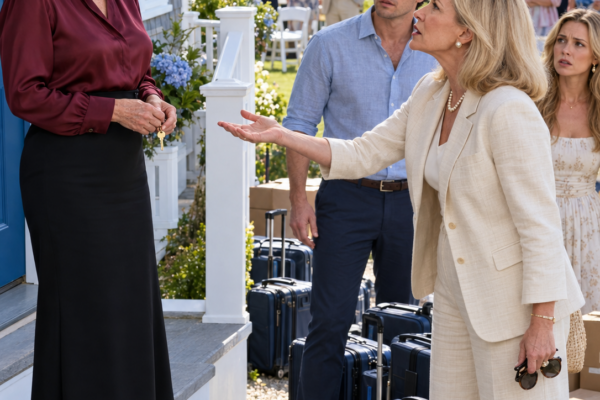
My son and daughter-in-law threw us a party for our 42nd wedding anniversary—but had the papers and a notary ready to pressure us into selling our home in front of 70 guests. They counted on us being too embarrassed to refuse. Before the toast, my husband touched my wrist and whispered…
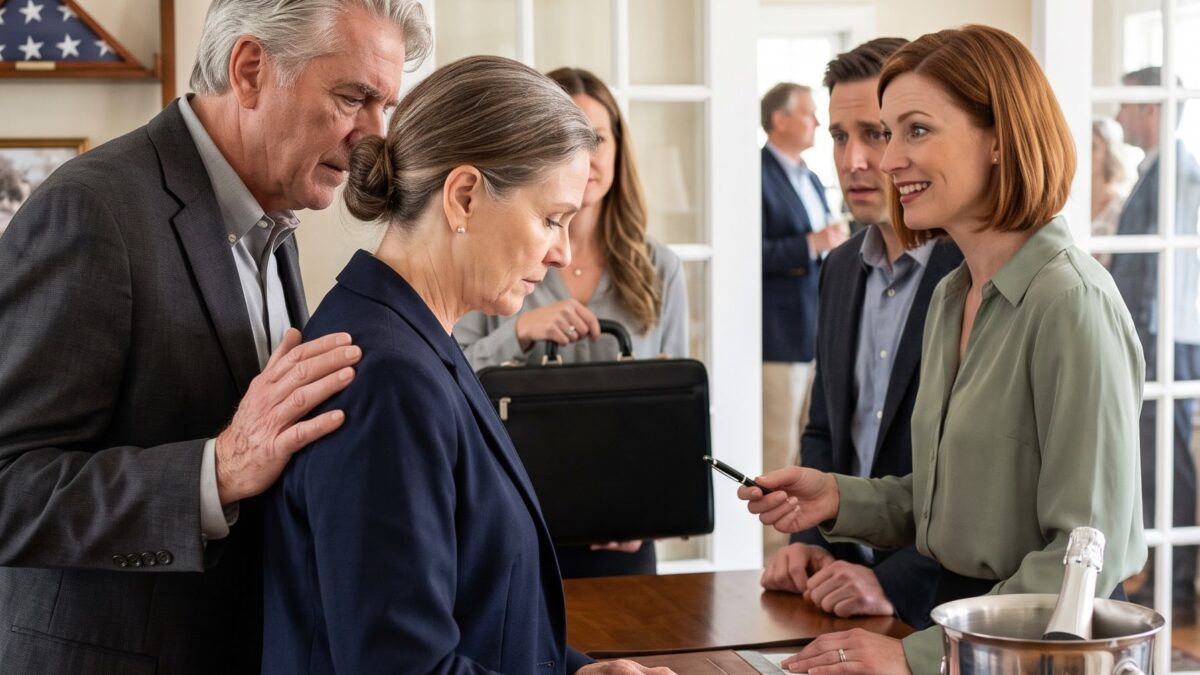
My husband tapped my wrist twice while his sister was telling a story about his hair.
I was laughing when he did it. Twyla had reached the part about the photograph from 1979, and Nells was supposed to object, the way he always did. Instead, he leaned close enough that nobody else could hear him.
“Say you’re not feeling well.”
I turned toward him.
“We need to leave, Abigail.”
His hand stayed against my wrist. Beyond his shoulder, our son was carrying a tray of empty glasses toward the kitchen. Seventy people had come to celebrate our marriage, and somebody had just turned the music down for a toast.
“Look under the champagne bucket,” Nells said.
That was when I stopped laughing.
Earlier that afternoon, I had thought our children were doing something kind.
It was Saturday, September 20, 2025. Our forty-second wedding anniversary was the following Wednesday, so when Miles texted that morning, I didn’t suspect anything.
Come by at 4:30. Ellie’s soccer celebration. Nothing fancy.
I put on a navy blazer over a white blouse. Nells looked at me from the bedroom doorway and said I looked as though I intended to close a loan.
“Maybe I’m celebrating soccer professionally.”
He grinned and went to find his good shoes.
Our oldest was forty, a regional sales manager for Culpepper Supply, the heating and cooling distributor out by the interstate. In June, he and Kirsten had moved into a five-bedroom house in Persimmon Ridge, a subdivision where the young maples still had stakes around them and every driveway seemed to hold two large vehicles.
They had paid $1,185,000.
I knew because Kirsten had mentioned the number twice at the Fourth of July cookout, once while showing me the kitchen and once while explaining why the property taxes were worth it.
When Nells turned onto their street, cars lined both curbs.
A banner across the garage read HAPPY 42ND, MOM AND DAD.
“Who throws a party for forty-two?” he asked. “Forty-two is a shoe size.”
I swatted his arm, but I was touched.
Inside, everyone shouted, “Surprise!”
There were friends from church, several men from Nells’s old crew at Sumac Valley Electric Co-op, Kirsten’s relatives, and our daughter, Tamara, who hugged me so tightly that my purse slipped off my shoulder.
“You look nice, Mom,” she said.
“So do you.”
She held on another second before stepping back.
Miles hugged his father and looked past him toward the driveway. Kirsten came out of the kitchen with a clipboard under her arm. She was thirty-eight, dressed in cream trousers and a pale green blouse, and already telling somebody where to put a casserole.
Our champagne bucket stood on the dining room sideboard.
It was sterling silver, with a dent near the bottom and an engraving that read N & A, September 24, 1983.
Twyla had given it to us for our wedding. Kirsten had borrowed it in late August for a dinner connected with work, and I had forgotten to ask for it back.
Now it sat on a silver tray, filled with ice and two bottles of champagne.
I remember being pleased that they had remembered it.
Through the front window, I could see a white SUV with an Applewhite Realty Group magnet on the door. It belonged to Kirsten’s older sister, Keely Gatlin.
At Easter, Keely had asked whether our house was paid off.
We had been standing beside the potato salad.
“That must be a good feeling,” she’d said when I told her it was.
At the time, I had taken it as ordinary conversation.
Kirsten found me before I finished my first glass of punch.
“Come see something,” she said. “Just for fun.”
She led me downstairs. Twyla followed us, carrying her purse as though we were going somewhere that might require identification.
The lower level was a separate suite. It had a small kitchen with a two-burner cooktop, a bedroom, a sitting area, and a walk-in shower with a grab bar. Sliding doors opened onto a patio beneath the deck.
A queen bed stood under a narrow window. The quilt still showed the square folds from its packaging.
On the dresser was a photograph of Nells and me from our thirtieth anniversary.
Ellie took my hand.
“Grandma, this is your room.”
She was seven. Her little brother, Bodie, was four and had already climbed onto the bed.
Kirsten lifted him down.
“No more gutters,” she said to me. “No more taking care of that big place. You could come in through the patio door and have everything on one level.”
Twyla squeezed my arm.
“Wouldn’t that be lovely?”
“It’s a nice room,” I said.
Ellie smiled.
I didn’t want to spoil that smile by asking why my photograph was beside a bed I had never agreed to sleep in.
On the way back upstairs, Kirsten pointed out where we could put Nells’s recliner.
I said nothing.
There were enough people in the kitchen that I could move away without seeming rude. I found Nells near the patio doors and told him about the room.
“Did anybody ask you?” he said.
“No.”
He looked toward Miles, who was talking to a man I didn’t know.
“Maybe it’s an invitation.”
“Maybe.”
But Miles kept moving away whenever his father approached him. Tamara checked her phone, turned it facedown, and checked it again. Kirsten touched Twyla’s shoulder in the hallway.
“Stay with Mom, okay?”
I heard it because I was standing close enough to reach the coat closet.
At 5:55, Nells glanced at the sideboard.
“That ice is about gone,” he said. “I’ll take care of it.”
Twyla started her story about the photograph.
Six minutes later, my husband came back and tapped my wrist.
I knew the signal. We had used it only a handful of times in forty-two years, and never casually.
I set my punch on a table and walked into the dining room.
Most of the guests had moved outside to watch the children. The bucket was heavy, so I shifted it onto the clear end of the tray rather than trying to carry it.
Water ran down its side.
Underneath, resting beside a leather folio, was a brass key tied with a white satin ribbon.
The tag read Welcome home, Mom and Dad.
The folio had a gold 42 stamped on its cover. An index card lay across it.
I recognized Kirsten’s handwriting.
6:15 — Miles toast.
6:20 — Mom lifts bucket. Key and folio.
6:25 — Sign. Eileen notarizes.
At the bottom, underlined, was another instruction.
If Mom balks, Dad follows. Keep Twyla next to her.
I read that line twice.
Then I opened the folio.
The first document was an unsigned listing agreement for 14 Catalpa Court.
Our house.
The proposed price was $598,000.
Behind it were an offer and a limited power of attorney naming Miles as the person authorized to act for us in the sale.
The front door opened.
Keely came in with a woman carrying a black document case.
I closed the folio, replaced the card, and slid the bucket back over the place where it had been.
My blouse was damp at the cuff.
Kirsten entered from the deck with clean glasses.
“Mom? What’s wrong?”
“I’m not feeling well.”
Nells was already standing beside me with my purse.
“We’re going home.”
“But we’re about to do the toast.”
Kirsten looked at the kitchen clock.
“It’ll only take a few minutes.”
Keely stepped closer.
“This is Eileen. She’s helping us with the surprise.”
Eileen gave me a polite nod. Her expression suggested she was still trying to understand what she had walked into.
“I’m sorry,” I told her. “We need to leave.”
Tamara caught up with us in the hall.
“Ten minutes, Mom. Please.”
“I can’t, sweetheart.”
Her hand tightened around my forearm before she let go.
Miles followed us onto the front walk.
“We had a whole thing planned.”
“I know you did, honey.”
He waited for the rest.
“That’s why I’m leaving.”
Ellie ran out before we reached the car. She was barefoot, holding a folded piece of paper.
“Don’t forget this.”
It was a drawing of a grandmother in a bed, with a yellow sun outside the window. Above the bed, Ellie had printed GRANDMA’S ROOM.
I kissed the top of her head.
“It’s beautiful.”
“Are you coming back?”
“I’ll see you soon.”
I couldn’t give her a date. That was the first thing that frightened me more than the paperwork.
We pulled away at 6:09.
Nells drove with both hands on the wheel.
For a while, neither of us spoke.
Then he said, “‘If Mom balks, Dad follows.’”
I kept looking at Ellie’s drawing.
“They think I’m somebody you can steer,” he said.
“Did you read everything?”
“Enough. I photographed the card and six pages before I put it back.”
He nodded toward his phone in the cup holder.
“You’re always telling me to make copies.”
At the stop sign leaving the subdivision, he added, “There’s already an offer, Abigail.”
“From whom?”
“A company.”
He looked both ways before pulling out.
“They didn’t leave much for us to decide.”
By 7:15, we were sitting at our own kitchen table.
Our house was a four-bedroom colonial we had bought in 1996 and paid off in 2016. The kitchen cabinets were older than Kirsten liked. One window needed a new screen. Nells had been meaning to replace a loose board on the deck since June.
It was ours.
I put on my reading glasses while he sent the photographs to my laptop.
I had spent about forty-one years in title and escrow. There were documents I could recognize before reading the heading, just from the spacing of the signature blocks.
The first two photographs showed the proposed listing agreement.
It would have run for 180 days. The asking price was $598,000, with a five-percent brokerage commission.
That was $29,900.
The third photograph was a cash offer at the same price from Brightwell Row Holdings, LLC, promising a closing within fourteen days of acceptance.
Someone had signed for the buyer as an authorized member. There was no readable printed name beside the signature.
The fourth photograph showed the limited power of attorney.
It would authorize Miles to sign sale documents and direct the distribution of the proceeds on our behalf.
That was not the same as giving him the house. But paired with the next agreement, it would give him exactly the authority they wanted.
The final two photographs were headed Family Residence Agreement.
Under that proposal, the net sale proceeds would go into what the documents called the Party Family Home Fund.
Despite its reassuring name, the fund was simply an account to be held by Miles and Kirsten.
There was no separate ownership share for us. No recorded interest in their property. No independent trustee protecting the money.
In exchange, we would be promised use of the lower-level suite.
Nells leaned over my shoulder.
“Where does it say we can get our money back?”
“It doesn’t.”
“What if we don’t like living there?”
I scrolled down.
“It doesn’t address that either.”
I opened the county auditor’s website.
The property record showed an estimated value of $615,000.
“That’s seventeen thousand more than the offer,” I said.
“Then they’re buying it cheap?”
“Possibly. The county number isn’t an appraisal. I’d need comparable sales to say that.”
He sat back.
“But nobody asked what we wanted for it.”
“Nobody asked if we wanted to sell.”
I read the residence agreement again.
It was short. That did not make it safe.
The phrase lifetime occupancy appeared in the middle of a paragraph, surrounded by vague promises about family support and shared expenses. There were no clear protections for us if their circumstances changed.
Nells rubbed his face.
“Say it plain.”
“We would sell our house, turn over the money, and become dependent on their promise.”
He stared toward the doorway.
His work boots were beside it. My gardening shoes were underneath the bench. We had spent almost thirty years putting things in those places.
At 9:14, my phone buzzed.
Kirsten had tagged me in a Facebook post.
The photograph showed the downstairs bedroom with silver balloons tied to the bedposts.
Mom wasn’t feeling well tonight, but we shared our big news with everyone. Mom and Dad are coming home to Persimmon Ridge. Three generations under one roof!
There was a red heart at the end.
People were already congratulating us.
Our pastor’s wife wrote that she was happy for the whole family. A woman I had sung beside for twenty years called me lucky. Someone I had never met said we were living the dream.
Nells picked up his phone.
“Give me a minute.”
“What are you doing?”
“Correcting it.”
I watched him type, then stop to look over his glasses.
“Let’s sleep before we answer anything publicly.”
“They’re telling people we said yes.”
“I know.”
“And we’re supposed to let that sit?”
“No. But I don’t want our first response to be something written while we’re this upset.”
He put the phone down.
Neither of us slept much.
At nine the next morning, Miles called.
“It’s already done, Mom.”
I stood beside the kitchen sink.
“What is?”
“Everybody knows about the arrangement.”
“Knowing about something doesn’t mean we agreed to it.”
“The paperwork is a formality. Keely explained it.”
“Miles, your father and I haven’t signed anything.”
He breathed into the phone. Behind him, I heard Bodie asking for waffles.
“You walked out in front of seventy people. Kirsten cried for an hour.”
“I’m sorry she was upset.”
“Then call her.”
“I will talk to her. I won’t apologize for refusing to sign documents I hadn’t seen.”
There was a pause.
“Keely has a buyer waiting.”
“That isn’t my responsibility.”
“Please don’t embarrass us again.”
I looked down at a small chip in the edge of the sink. Miles had made it years earlier, dropping a saucepan while trying to help with dinner.
“Again?”
“You know what I mean.”
“I don’t think I do.”
He ended the call.
Later, Nells showed me the reply he had drafted to Kirsten’s post. It began For the record and continued for four paragraphs.
I read it.
Then I asked him to save it rather than post it.
We agreed on two things at the kitchen counter.
We would sign nothing.
And whenever someone asked us about the move, we would say clearly that we had not agreed to it.
I also sent Miles and Kirsten a short message.
We are not selling our house or agreeing to move. Please correct the announcement and stop making arrangements on our behalf.
Miles did not reply.
Kirsten sent a heart reaction.
Nells looked toward the den.
The three envelopes were still in his desk.
“Leave them there,” I said.
He nodded.
We had planned a very different anniversary.
On Monday, September 22, I found a padded envelope tucked beside the flowerpot on our porch.
Inside was the brass key with its white ribbon.
Kirsten had wrapped a note around it.
For when you’re ready. Moving truck reserved for October 25. Love, K.
I stood beside the porch rail with the key in my hand.
Nobody had measured our furniture. Nobody had asked which belongings we would keep. The truck had been booked before I had even seen the proposed sale agreement.
I took the envelope inside and put it beside the laptop.
Kirsten called Tuesday.
“I just want to understand what happened.”
“I saw the documents.”
“Well, yes. That was the surprise.”
“A surprise would have been offering us the room.”
“We spent $6,400 on that party, Abigail.”
“I didn’t ask you to.”
“You could at least appreciate what we tried to do.”
I sat down.
“What did you tell Ellie?”
“That you and Dad would be close. That she could see you every morning.”
“You should have asked us before telling her.”
For a moment, Kirsten said nothing.
Then her voice changed.
“You’re sixty-seven. You have stairs and gutters and a big yard. You can’t just keep pretending nothing will ever change.”
“I don’t expect that.”
“You don’t have a plan.”
“You haven’t asked about our plan.”
“I start full-time at Yarrow Family Dental on January fifth. Office manager. Ellie and Bodie will need somebody there after school.”
There it was, tucked into the conversation as though we had already accepted that job.
“You need childcare,” I said.
“We need family.”
“I’m happy to help with the children when I can. That isn’t the same as moving.”
Her breathing grew uneven.
“My mother moved us four times before I finished middle school. Twice, there was a notice on the door. Do you know what that does to a kid?”
I did not answer quickly.
I had met her mother. I knew enough about Kirsten’s childhood to believe her.
“My children are staying in their schools,” she said. “They’re keeping their rooms.”
“I want that for them too.”
“Then why are you making this so hard?”
Because somewhere between wanting her children to feel secure and wanting us to help, she had decided our house was available.
I tried to say it without giving her something else to argue with.
“You can ask us for help. You can’t arrange a sale without our agreement.”
“You’ve said no to Miles his whole life.”
“That isn’t true.”
“In 2019, you—”
“I said no to cosigning a loan.”
Miles had wanted to borrow $310,000 for a heating and cooling franchise. He needed our guarantee.
I had read the disclosure documents. Four of the nine regional locations listed in them had closed within three years. The loan would have put our retirement at risk if the business failed.
I had offered to sit down with him and go through other ways to begin.
He stopped talking to me for six weeks.
“I didn’t reject my son,” I told her. “I declined a loan I couldn’t responsibly guarantee.”
“Fine.”
The word came out flat.
“Then don’t count on Friday.”
She hung up before I could ask what she meant.
I sat with the phone in my hand.
For two years, Friday afternoons had belonged to Ellie.
I picked her up at Halford Elementary at 3:15. Bodie rode with me in his car seat, and we stopped at the gas station on Mill Road for a soft pretzel.
Extra salt.
Ellie told me about recess, spelling tests, and children whose teeth had fallen out at lunch.
I hoped Kirsten meant something else.
Our real anniversary was Wednesday, September 24.
On Labor Day, I had invited all three children to dinner.
Wednesday the 24th. Six o’clock. Our house. We have something for you.
Chase, our youngest, lived in Denver. He and his wife, Talia, would join us by video.
I had planned pot roast for nine people: Nells and me, Miles’s family, and Tamara with her two children.
At 4:40, Miles texted.
We’re not coming until you apologize to Kirsten.
Nells read it over my shoulder.
Then he went to the garage and started sorting tools that had already been sorted.
Chase called at five.
“Happy anniversary, Mom.”
“Thank you, honey.”
“How’s Dad?”
“In the garage.”
“Is it weird over there?”
“A little.”
He hesitated.
“Tamara said the party didn’t go well.”
“The party was lovely until they tried to make it a signing appointment.”
“What?”
I told him about the folio.
He listened without interrupting.
“Did you agree to any of this?”
“No.”
“Okay. Then I’m confused about what everybody’s celebrating.”
“So am I.”
He stayed on the call while I put the rolls in the oven.
At six, the doorbell rang.
Tamara stood on the porch with a grocery-store sheet cake and her children, Lennox and Juno.
Lennox was ten and hugged me around the waist. Juno, eight, asked whether there were rolls.
“There are always rolls for you,” I said.
Tamara smiled without looking at me.
She had been divorced since spring. I knew money was tight. She had told me about school supplies, a new tire, and a dental bill. She had not told me about the house.
At dinner, she ate three bites and pushed the rest around her plate.
Her phone lit up several times.
Each time, Keely’s name appeared on the screen.
I noticed because it lay beside the serving spoon, where anybody passing the potatoes could see it.
After dinner, the children went to watch television. Chase stayed on the laptop while Nells cut the cake.
Tamara looked toward the den.
“Did Dad say anything?”
“About what?”
“Money.”
Nells put the knife down.
“What money, sweetheart?”
“Nothing. Never mind.”
“You can tell us.”
She took a small piece of cake.
“I’m just tired.”
At the door, she held her keys so tightly that the metal pressed against her palm.
“Mom,” she whispered, “please just sign it.”
I looked at her.
“I need it.”
“Need what?”
Her children were halfway down the walk.
“We’ll talk later.”
She followed them before I could stop her.
After they left, I covered the untouched food. Nells stood beside me, tearing pieces of foil from the roll.
“Did we miss something?” he asked.
“Yes.”
“Then we need to find out what.”
We put the food away.
We left the envelopes in the desk.
The first time Nells tapped my wrist, we were at our wedding reception.
We married on Saturday, September 24, 1983, in a small Christian church in southwestern Ohio.
I was twenty-five. He was twenty-eight, a lineman with the co-op, and the calmest person I knew.
The reception was in the church hall. Paper cloths covered the tables. Twyla had ordered a sheet cake, and somebody’s aunt had made enough chicken salad to feed a second wedding.
My father, Fritz, had died in 1977.
He was forty-nine, a tool-and-die maker who went to work one morning and never came home.
There had been a mortgage, overdue bills, and very little insurance. My mother, Ula, had signed papers during their marriage without understanding much beyond the place where her name belonged.
After he died, she tried to keep up.
By February 1978, she could not.
The house was lost through foreclosure. She moved into her brother Sonny’s spare room.
I was nineteen, working and trying to decide whether I could afford another semester of school.
At the wedding reception, Uncle Sonny stood to make a toast nobody had requested.
He had been adding something to his punch from a bottle in his car.
“To Abigail,” he said, raising his cup. “And to Ula, our boarder of five years.”
A few people laughed because they didn’t know what else to do.
My mother lowered her eyes.
Nells’s fingers touched my wrist.
Two taps.
“Get your purse,” he whispered.
I looked at my mother.
Before we left, we went to her table. Nells asked if she wanted to come with us.
“No, honey,” she said. “Go have your wedding night.”
He told Twyla to take her home rather than let Sonny drive her.
Then we left.
We drove toward Ripley, following the river to a small brick inn called the Lockridge House.
At first, I cried.
Then Nells missed the turn and had to circle a feed store, and somehow we started laughing.
He had brought the champagne bucket in the back seat.
In the gravel parking area behind the inn, he dropped it while trying to carry our bag, the bucket, and a bottle of inexpensive champagne at the same time.
That was where the dent came from.
For forty-two years, the two taps meant we would leave together if one of us needed to leave.
They were not an order.
They were a way to find each other without explaining ourselves to the room.
At Miles’s house, Nells had used them for the fourth time.
I knew why he had thought of our wedding.
Our children were planning to call me a boarder too.
They had simply found nicer wording.
We went to church on Sunday, September 28.
Before the first hymn, eleven people congratulated us on the move.
I counted because concentrating on a number was easier than listening to the same assumption again.
The pastor’s wife held my hands in the narthex.
“Such a lovely thing your children are doing.”
“We haven’t agreed to move,” I said.
“Oh. Well, it’s a big adjustment.”
“We’re staying in our house.”
She let go of my hands.
That time, she heard me.
The choir director asked when she should expect a change in my schedule.
“There won’t be one.”
One of Nells’s old coworkers asked whether he planned to sell the riding mower.
“No,” Nells told him. “I still have grass.”
After the service, Twyla found me near the coffee table.
“Kirsten says you agreed in August.”
“I didn’t.”
“She says you got nervous when it became real.”
“Twi, did you ever hear me say we were moving?”
She studied the sugar on her doughnut.
“No.”
“Then please believe me now.”
Her eyes lifted.
“I do. I just don’t understand why she’d say it.”
Neither did I. Not fully.
Twyla had spent the party beside me because she thought she was helping me enjoy something I had requested. That mattered. I was angry with her for pressing, but I did not think she had seen the documents.
“She told me you wanted someone close,” Twyla said. “That Nells worried about the stairs.”
“He doesn’t.”
“You’ve both always kept so much to yourselves.”
“That doesn’t make somebody else’s story true.”
She nodded.
As I turned to leave, she caught my sleeve.
“Keely’s been talking about your house. She says she already has interest.”
“What kind of interest?”
“I don’t know.”
That answer was better than pretending.
Keely called Monday morning.
“Abigail, I’ll keep this short. My buyer’s first offer deadline is October tenth.”
“Your buyer?”
“The cash buyer. We don’t want to lose him.”
“I haven’t engaged you to sell anything.”
“I know there’s paperwork to finish.”
“There is no agreement to finish.”
She moved past that.
“The market’s getting softer. Five ninety-eight is a good number for a house with an original kitchen.”
“You’ve been in my kitchen once.”
“I know the neighborhood.”
“Then send me your comparable sales.”
“I can do that.”
“And tell me who controls Brightwell Row Holdings.”
“A local investor.”
“That’s a description.”
“He prefers to stay private.”
“He can remain private from my neighbors. He can’t expect me to sign a contract without knowing who I’m dealing with.”
She gave a quick laugh.
“I know you used to handle paperwork at the title company. But we do these transactions all the time.”
“So did I.”
“This is family.”
“Then it should be easy to answer a question.”
I could hear a turn signal in the background.
She said she had a showing and would call back.
She didn’t.
I wrote October 10 on the calendar.
On the next line, I wrote Moving truck, October 25.
The offer could be revised. The truck could be canceled.
Neither date explained why our daughter needed me to sign.
There was another deadline somewhere.
Tuesday morning, I enlarged Nells’s photograph of the offer.
Near the bottom was a disclosure section about the real estate licensee’s interest in the transaction.
It had not been completed.
That alone did not prove wrongdoing. The papers were still drafts. But an agent who expected us to sign in front of a crowd should have been ready to explain any personal or family interest in the buyer.
The signature did not help.
The printed company name was clear. The person signing for it was not.
Nells came in carrying the newspaper.
“You find something?”
“Something missing.”
He pulled out the chair beside me.
“Who throws a party for forty-two?”
“You’ve asked that three times.”
“Because I still don’t like the answer.”
We looked at the calendar.
A party on September 20. A buyer pressing for an answer. A truck already reserved.
I remembered Tamara’s hand on my arm.
I need it.
On Wednesday, October 1, an email arrived from Juanita Coffey.
Juanita had worked with me at Trowbridge Title and Escrow for twenty-one years. She was still there three days a week.
The subject line said Abigail, is this yours?
She had forwarded a marketing email from Keely.
There was a photograph of our house taken from the street. The maple in front had started turning, and Nells’s pickup was visible at the edge of the driveway.
Off-market opportunity. Seller-direct transaction. Cash buyer in place. Fourteen-day close.
Our address was underneath.
Juanita had written, Are you selling? Why am I hearing it this way?
I called her.
“We’re not selling.”
“I thought something was wrong.”
“Has anybody opened a title order with your office?”
“Not here. I can’t tell you about other companies.”
That was the kind of answer I trusted.
She told me the advertisement had gone to a broad list of local real estate contacts. It wasn’t confidential. She had received it in the ordinary course of her work.
“Save the email,” I said.
“Already did.”
I saved it too.
That evening, after Nells fell asleep in his recliner, I searched the Ohio Secretary of State’s business records for Brightwell Row Holdings.
The company had been formed on August 18, 2025.
Its statutory agent was Holden Gatlin.
The address was 88 Fernbrook Drive, Halford.
I recognized it.
In 2021, when Keely had her son, I had mailed a quilt with blue sailboats to that address. She had sent a photograph of the baby lying on it.
Holden was her husband.
I sat back from the laptop.
A statutory agent receives official papers for a company. That person does not have to own it. I knew enough not to turn a connection into a conclusion.
But Keely had called the buyer a discreet local investor.
She had not mentioned her husband.
I downloaded the filing and printed it.
Then I put it beside the offer and compared the signatures.
There were similarities, but I was not a handwriting expert. I wrote only what I could support.
Buyer company formed August 18.
Agent: Holden Gatlin.
Address: Keely and Holden’s home.
No relationship disclosed in proposed offer.
In the morning, Nells read the page.
“Is she buying our house?”
“I think that’s possible.”
“Does Kirsten know?”
“I don’t know.”
“Does Miles?”
“I don’t know that either.”
He took off his glasses.
For once, neither of us tried to fill the silence.
On Thursday, October 2, I wrote to Lamont Hightower, the managing broker at Applewhite Realty Group.
The letter was one page.
Nells and I owned 14 Catalpa Court. We had not signed a listing agreement, authorized an offer process, or permitted the property to be advertised. We required the marketing to stop.
I attached the email Juanita had received.
We both signed.
I emailed the letter and mailed a copy by certified mail.
I did not yet attach the LLC filing. I wanted to give Miles a chance to hear the connection directly from us before I made a fuller complaint about his sister-in-law.
That decision did not mean letting Keely continue to advertise our house.
By late afternoon, Juanita forwarded a correction.
14 Catalpa Court withdrawn. Prior notice sent in error.
It was the first acknowledgment that anything about this had been wrong.
Lamont called the following morning.
He said the property had been removed from the brokerage’s marketing and asked whether we had ever given Keely verbal authorization.
“No.”
He asked Nells the same question.
“No,” my husband said.
Lamont told us to send any further documents we wanted reviewed. He did not promise a particular outcome.
That was appropriate too.
Kirsten’s messages began that evening.
You went to Keely’s broker?
Then:
Do you know what you’ve done to her?
Then:
Ellie asked why Grandma doesn’t want to live with us. What am I supposed to tell her?
I read that one twice.
I wanted to call Ellie. I wanted to explain that none of this was about her room, her drawing, or whether I loved her.
But she was seven. She did not need the documents described to her by another upset adult.
I answered Kirsten.
Please tell her Grandma loves her and is staying in her own home. Those two things can both be true.
At 7:30 Friday morning, another message arrived.
Friday pickups are canceled until you can act like family.
I put the phone on the counter.
Nells saw my face.
“What?”
I showed him.
He read it and handed it back carefully.
“Do you want me to call Miles?”
“Not yet.”
At 3:15 that afternoon, I was sitting in the living room with my purse on my lap.
My keys were in my hand.
I had picked them up without thinking.
Outside, a school bus stopped down the street. A neighbor’s child climbed off, dragging a backpack by one strap.
I stayed where I was until the bus had gone.
Then I put the keys on the table.
I texted Kirsten once more.
I love the children. I’m available when you’re ready to arrange visits without conditions about the house.
She did not answer.
Nells came home from the hardware store at four. He found me looking at Ellie’s drawing.
He sat beside me.
For a long time, we listened to the refrigerator switch on and off.
Chase called early Saturday morning.
It was barely five in Denver.
“Mom, is Dad there?”
I put him on speaker.
“Tamara called me last night,” he said. “I think you need to know what’s going on.”
He sounded tired.
“She told me because she couldn’t sleep. I asked if she had told you, and she said no.”
Nells pulled out a chair.
In June, Miles and Kirsten had bought the house at Persimmon Ridge before their townhouse on Sassafras Lane sold.
They had used a $240,000 bridge loan from Ravenscroft Lending to cover part of the purchase.
The rate was 11.5 percent.
The original balance had been due October 31.
They expected to repay it from the townhouse sale.
But on August 14, that buyer withdrew after the homeowners association announced a $38,000 special assessment for new roofs.
The assessment had changed the buyer’s numbers. Miles and Kirsten had already moved and were carrying costs on both properties.
Two days later, Keely came over for a swim.
Tamara was there.
According to what Tamara told Chase, Keely sat beside the pool and said our house was paid off and too large for us anyway.
She said a multigenerational arrangement could solve several problems at once.
Miles’s loan.
Kirsten’s childcare.
Our supposed need to downsize.
“And Tamara?” I asked.
Chase exhaled.
“Her divorce settlement gives her until December first to buy out Damon’s share of their house. Eighty-eight thousand five hundred. Otherwise, they have to list it.”
I closed my eyes.
“Keely promised her ninety thousand from the family fund.”
Nells pushed his coffee away.
“From our money.”
“Yes.”
“Did Tamara hear us agree to that?”
“No. Keely told her it was what you would want.”
I found an envelope and wrote the dates on the back.
August 14: townhouse buyer withdraws.
August 16: pool conversation.
August 18: Brightwell Row formed.
August 20: party invitations sent.
Chase had received an invitation too.
“It only said surprise anniversary party,” he told us. “I thought it was early because people had plans later in the month.”
“We believe you,” Nells said.
Chase went on.
“The townhouse finally closed in late September. But at a lower price, and they had to account for the assessment. Miles put the net proceeds toward the bridge loan. Tamara says there’s still a big balance.”
“How much?”
“She didn’t know exactly. He showed her a statement, but she was worried about her own part.”
That made more sense than the missing townhouse had.
There had been a sale. It simply had not solved the problem.
“The loan date is still October thirty-first,” Chase said. “Keely keeps telling them your house can close in time.”
I looked at the folio photographs.
Fourteen days could be possible for a straightforward cash purchase after title review and other work. It was not possible to promise that schedule before the owners had even consented.
“Does Miles know who Brightwell Row is?” I asked.
“Tamara thinks it’s somebody Keely knows.”
I told Chase about Holden’s name and the address.
“Mom.”
“I haven’t proved who owns it.”
“But she should have explained the connection.”
“Yes.”
We talked for another twenty minutes.
Before hanging up, Chase said Miles planned to come Monday night.
“With the papers.”
Nells looked at the calendar.
“He can bring them,” he said. “We can read them.”
Miles arrived Monday, October 6, at 6:30.
He was alone.
The leather folio was under his arm. His tie was loose, and he looked as though he had driven over rehearsing what to say.
I opened the door.
“Come in.”
He stopped on the mat.
“Keely’s buyer is ready. We just need your signatures.”
“You’ve needed them since the party.”
“The dates changed. We have time.”
“For what?”
“For the closing.”
Nells came in from the kitchen.
Miles looked from him to me.
“Can we just sit down?”
We did.
I offered coffee. Miles said no.
He opened the folio and took out the proposed residence agreement.
“We made changes.”
“Who made them?”
“Keely helped.”
“She isn’t your attorney.”
“It’s a family agreement, Mom.”
“That doesn’t make it simple.”
He pushed the pages toward me.
I read the new clause.
The promised occupancy would terminate upon sale or refinancing of the Persimmon Ridge property, unless a replacement arrangement was agreed to in writing.
Nells leaned forward.
“What does that mean?”
“It means if they sell or refinance, this promise can end.”
Miles frowned.
“We wouldn’t put you out.”
“Then why does the agreement allow it?” I asked.
“That’s boilerplate.”
“It’s a sentence with consequences.”
He looked at the paper for the first time since setting it down.
I waited.
“The lender might need flexibility,” he said.
“Your lender,” Nells answered. “Not ours.”
Miles rubbed the back of his neck.
“You don’t understand what we’re trying to do.”
“Then explain the bridge loan,” I said.
He stopped moving.
“Chase told you.”
“He told us what Tamara told him.”
“That’s private.”
“So is our house.”
He looked toward the pantry doorway.
His height marks were still there, including the crooked line he had added himself when he thought I wasn’t looking.
“We’re trying to keep everybody together,” he said.
“Did you tell Tamara she would receive ninety thousand?”
“Keely said there would be enough.”
“Did you ask us?”
“We thought—”
“You thought we would sign in front of the guests.”
His face reddened.
“Kirsten wanted it to be special.”
“She wrote instructions for handling our objections.”
He stared at me.
I showed him Nells’s photograph of the card.
He read the bottom line, then looked away.
“That’s just how she organizes things.”
Nells set his palms on the table.
“I’m not an item on her clipboard.”
Miles said nothing.
I asked him who owned Brightwell Row.
“An investor.”
“Have you spoken to him?”
“No. Keely handles that.”
“Ask her whether she or Holden has a financial interest in the company.”
Miles looked up.
“Why?”
“Because Holden is its statutory agent, at their home address.”
He glanced at the folio.
“That doesn’t mean he owns it.”
“No,” I said. “It means you need to ask.”
“Keely’s family.”
“So are we.”
His chair scraped the floor.
“You always find a reason to say no.”
“The reason is written on the page.”
“In 2019, you wouldn’t help me build anything. Now we finally have something, and you’re doing it again.”
I let him finish.
Then I said, “I will not sell my home to pay for a purchase you made without speaking to me.”
He looked at his father.
Nells did not soften it for him.
We had a vow renewal planned at the Lockridge House on Saturday, October 11. We had booked the date in March and sent invitations in July, long before the surprise party.
Miles, Kirsten, and Tamara had not replied.
“You’re still welcome Saturday,” Nells said. “Come as our children. Leave the business at home.”
Miles closed the folio.
“Can we talk about this there?”
“We can talk,” I said. “The answer about signing is still no.”
He nodded, but I could see him choosing which part to hear.
At the door, he set the folio on the hall table.
“Keep it. Read the whole thing.”
“I have.”
“Read it again.”
After he left, I did.
That night, I put the amended agreement beside the photograph of Ellie’s room.
The picture on the dresser.
The quilt.
The patio door.
Everything had been arranged to make dependence look like comfort.
I started at Trowbridge Title and Escrow in February 1978, a week after my mother lost her house.
My first job was answering phones and sorting mail.
I didn’t know what escrow meant.
I knew what it felt like to watch people carry your mother’s belongings out of a place she had believed would always be hers.
By 1979, I was an escrow assistant. In 1981, a young lineman came in to ask about buying a quarter-acre lot.
He apologized for asking questions.
I told him questions were cheaper than mistakes.
That was Nells.
I became an escrow officer in 1984. I finished my business degree in 1986, taking evening classes while Miles was little. Nells worked around my schedule when he could, and Twyla watched Miles when neither of us could.
In 1994, I became an escrow manager.
In 2008, I was promoted to regional vice president of escrow operations.
I retired in 2019 at sixty-one.
Over those years, I handled or supervised thousands of transactions. I had seen people sell willingly, reluctantly, joyfully, and under pressure. I had seen families help one another, and families use the word help when they meant control.
My children called it Mom’s paperwork job.
I never bothered to correct them.
That was partly modesty.
It was also easier to keep certain things private.
My mother remained in Sonny’s house for nineteen years, until she died.
I had asked her to live with us more than once. She said our house was busy, that she liked being near her friends, that moving again would be too much.
There were practical reasons. There were also reasons she never named.
She had become accustomed to asking permission.
At Sonny’s, she stood in the kitchen doorway with a saucepan in her hands.
“Is anyone using that burner?”
Even when nobody was cooking, she asked.
I used to get angry with her.
“Just use it, Mom.”
She would give me a look that meant I didn’t understand the cost of being unwelcome.
I understood more as I got older.
I helped with bills when she would let me. I drove her to appointments. I invited her to every holiday. None of that gave her back the feeling that a kitchen could belong to her.
I had not told my children the whole story.
They knew their grandfather died young. They knew Grandma Ula lived with Uncle Sonny.
They did not know about the foreclosure, the papers she had signed, or the way she checked a room before entering it.
I thought leaving those things unsaid protected her dignity.
It also left my children unable to recognize why their proposal frightened me.
That was something I could explain.
It was not something I needed to sign away to prove.
Nells and I had lived comfortably without looking especially comfortable.
He drove the same pickup for nineteen years. We took modest vacations. We bought furniture when the old furniture wore out.
His pension covered much of our ordinary spending. My salary and later profit sharing had gone into retirement accounts and savings for decades.
By September 2025, our savings and investments totaled about $1.38 million.
That was not all available cash, and it was not money we intended to exhaust. We had allowed for future care, taxes, market changes, and the possibility that one of us would live many years without the other.
Our children knew we were secure.
They did not know the amount.
Before the party, we had decided to give each of them $120,000.
We had talked it through for months.
Nells wanted to help while we could watch something good come from it. I wanted the gifts to be equal, without conditions about how often the children visited or which choices they made.
We had reviewed the plan with the person who prepared our taxes and made sure we were leaving enough for ourselves.
On Monday, September 15, we went to Lineworkers Federal Credit Union to arrange for the necessary funds to be available in our joint savings account.
We collected the transfer instructions we would need once the children provided their account details.
No gift transfer was submitted.
At home, Nells wrote each child a letter.
He put the letter and a copy of the planned transfer instructions in a white envelope.
Miles.
Tamara.
Chase.
We intended to hand them out at the September 24 dinner.
That was the something I had promised in the family text.
Our children did not know it.
Miles stayed away from dinner because we would not apologize.
Tamara sat at our table asking us to surrender our house because she needed money.
There had been money available to discuss.
They had chosen a plan that required our signatures before they ever asked us a question.
On Tuesday, October 7, I took the envelopes from the desk and laid them in a row.
Nells sat across from me.
“What do you want to do?”
I touched Tamara’s name.
“I don’t want to make a decision just because I’m hurt.”
“Then don’t.”
“But I can’t give them this while they’re trying to force the other thing.”
He nodded.
We had not delivered the letters or transferred the money. The gifts remained plans we could change.
Chase’s gift would go ahead.
Miles’s and Tamara’s would wait while we decided what helping them should look like now.
We were not rewriting our wills in a rage. We were not canceling their children’s birthdays.
We were stopping a transfer until we could trust the conversation around it.
Nells returned two envelopes to the drawer.
I kept Chase’s on the table.
“What about Saturday?” he asked.
“We go.”
“And if they bring the papers?”
“I say no where everybody can hear it.”
He reached across and held my hand.
“That’s what I wanted to know.”
Twyla called Wednesday evening.
“I probably shouldn’t be in the middle of this.”
“You don’t have to be.”
“Kirsten’s bringing Eileen on Saturday.”
“The notary?”
“Yes. She says you’ll be more comfortable once everybody’s together.”
“Twi, I’ve told her no.”
“I know.”
“Please don’t help them pretend otherwise.”
Her voice became small.
“I won’t.”
After the call, I contacted Cena Tisdale at the Lockridge House.
She had run the inn for twenty years and had already worked out the chairs, cake table, and rooms with me.
“My son may arrive with people who aren’t coming for the ceremony,” I said. “There could be paperwork.”
“What kind?”
“Paperwork I won’t be signing.”
“Do you want me to keep them out?”
“No. If my children come, let them come. But I may need help ending a business conversation.”
“You only have to tell me.”
That was enough.
Chase and Talia arrived Thursday afternoon.
Chase hugged me in the driveway, then stepped back to look at me.
“You okay?”
“I’m angry.”
“Good. I was worried you’d say fine.”
Talia carried their bag inside while Nells showed Chase the loose deck board.
By supper, they had fixed it.
There was something comforting about watching a problem become smaller because somebody actually worked on it.
Friday morning, Chase drove to Persimmon Ridge.
He told me afterward.
“I went for your bucket.”
“You could have asked me.”
“I figured you’d tell me not to bother.”
Kirsten had opened the door in her robe.
He told her he wanted the champagne bucket for our ceremony.
She went to the dining room and brought it out.
While he waited, he heard Keely speaking from the kitchen.
“She’ll sign in front of everybody. She doesn’t want another scene.”
Chase said he did not go inside.
He took the bucket, thanked Kirsten, and left.
I held it under the kitchen light.
The dent was still there.
The engraving needed polishing.
I spent half an hour cleaning it while Talia dried the good champagne glasses.
“Do you want to cancel?” she asked.
“No.”
“Okay.”
She did not ask whether I was sure three more times.
I appreciated that.
At 10:50 Friday night, Tamara called.
I could hear her car’s turn signal.
“Where are you?”
“In my driveway. The kids are asleep.”
She told me about the letter from Damon’s attorney. It referred to the buyout date in their divorce settlement and the requirement to list the house if she could not pay.
“I thought I’d refinance,” she said. “I couldn’t qualify for enough on my own.”
“What about selling and staying nearby?”
“I’ve looked. Everything decent is smaller.”
“Smaller isn’t the same as unsafe.”
“They’ve already had to adjust to so much.”
“I know.”
“Keely said the fund would cover it. She said you’d want the children to keep their rooms.”
“Did you ask whether I had agreed?”
Tamara began crying.
“I knew you’d help if I could explain it.”
“Then why didn’t you explain it?”
“Because you’d ask questions.”
I rested my forehead against my hand.
“Yes,” I said. “I would.”
For a while, there was only the turn signal.
I told her what I had told Miles about Holden and the company.
She did not know anything beyond Keely’s claim that an investor was ready.
“Come tomorrow as my daughter,” I said. “Bring the children if you want. Leave the papers with them.”
“I’m riding with Miles.”
“You can drive yourself.”
“Mom.”
“You have a choice.”
“I need this to work.”
“It can’t work by treating my house as money you already have.”
She cried harder.
I stayed on the line.
Before we ended the call, she said, “I’m sorry.”
I wanted that to mean she would come alone.
It did not.
We left Catalpa Court at 2:15 Saturday afternoon.
Nells drove along the river.
The Ohio was broad and brown beneath a pale October sky. Across the water, the Kentucky hills were beginning to turn.
Chase and Talia followed in their rental car with the champagne bucket secured behind the passenger seat.
The Lockridge House was a brick inn facing Front Street. Beyond its porch, a garden sloped toward the river, with a gazebo and an iron gate at the upper path.
We had asked for a small ceremony.
Thirty-four guests had accepted.
Our friends from church. Juanita. Twyla. Several of Nells’s former coworkers and their wives. Chase and Talia.
Miles, Kirsten, and Tamara still had not said whether they would come.
Marty Jessup, Nells’s old foreman, would lead the renewal. He had printed his remarks in large type because he refused to buy stronger reading glasses.
“You’re not marrying us again,” I reminded him while he arranged his pages.
“Good,” he said. “I wasn’t sure how much authority I had.”
I wore the same navy blazer and white blouse I had worn to the party.
Nells noticed.
“Same outfit?”
“It fits.”
He smiled.
In my purse were our house key, Kirsten’s brass key, the printed LLC filing, and copies of the documents.
Nells carried the three envelopes inside his jacket.
We had discussed whether to bring all three.
I wanted the children to understand what had actually been planned before they decided we were refusing to help.
I did not want to wave the envelopes around.
Nells said he would keep them in his pocket unless the conversation made them relevant.
Our bucket stood on the cake table, filled with ice.
There was nothing underneath it.
Cena came down from the porch.
“Your son called this morning,” she said quietly. “He asked when the toast would be.”
“What did you tell him?”
“That the ceremony began at four.”
She looked toward the gate.
“I’ll be nearby.”
At four, Marty cleared his throat.
He talked about storm calls, long marriages, and the way Nells always checked that the younger men had eaten before taking his own lunch.
Then he looked at me.
“And Abigail checked that we understood what we were buying before any of us signed.”
A few of the men laughed.
Nells took an index card from his pocket.
“I wrote something down,” he said. “So I wouldn’t wander.”
He looked at me rather than the card.
“We’ve had a good life. Some hard parts. A lot of ordinary days I wouldn’t trade.”
His voice caught briefly.
“When you need to go, I go with you. When you need to stay, I stay.”
I wiped under one eye before he finished.
My vows were shorter.
“I still trust you with the things I can’t say quickly.”
He nodded.
Marty pronounced us still married.
We laughed.
Chase opened the champagne. Twyla passed glasses along the row. Somebody asked Marty for a photograph before he put away his pages.
For half an hour, the afternoon was what we had wanted.
Juanita raised her glass at 4:35.
“To Abigail,” she said, “who taught me that a question is not an inconvenience.”
She glanced at Nells.
“And to Nells, who always brings the car around when it’s raining.”
We drank.
A barge passed beyond the garden. Several people turned to watch it.
Then the gate clicked.
Miles came in first.
Kirsten followed with Tamara.
Behind them were Keely and Eileen.
Eileen carried the black document case.
I set my glass down.
Miles walked directly toward the cake table.
“Hi, everybody. Sorry we’re late.”
People greeted him, but he did not stop to speak with them.
He picked up a fork and tapped it against an empty champagne glass.
The conversation ended unevenly, one group at a time.
“We wanted to do this while you were all here,” he said. “Mom and Dad are coming home with us.”
Twyla looked at me.
I shook my head once.
Kirsten placed the leather folio beside the bucket.
Yellow tabs marked the pages.
Keely removed her sunglasses.
“This won’t take long.”
Eileen stopped near a small table by the gazebo. She opened her case but did not take out her seal.
“Have you had a chance to review the documents?” she asked me.
“Yes.”
Kirsten turned a page.
“We’ve put the important parts right here.”
She held out a pen.
I did not take it.
“Miles, I told you Monday that we weren’t signing.”
He looked toward the guests.
“We’re all family here.”
“I know. That’s why I’m saying it clearly.”
Nells moved beside me.
Somebody in the second row whispered that they thought the move had already been agreed to.
I heard it.
So did Kirsten.
I turned toward our guests.
“There’s been a misunderstanding, and it hasn’t been corrected. Nells and I have never agreed to sell our house or move into theirs.”
Miles tried to interrupt.
“Mom—”
“Let me finish.”
I did not raise my voice.
“The papers brought to our anniversary party were new to us. They included a listing agreement, an offer to buy our house, authority for Miles to act in the sale, and an agreement transferring the net proceeds to an account controlled by Miles and Kirsten.”
A chair moved on the grass.
I continued.
“In return, we were promised use of their downstairs suite. The latest draft allows that promise to end if they sell or refinance.”
Kirsten looked down at the folio.
“We wouldn’t do that to you.”
“Then you shouldn’t have brought me an agreement that permits it.”
Miles reached for the pages.
“The point is to keep you close.”
“You could have asked us to visit more.”
“You make everything sound ugly.”
“I’m describing the documents.”
I took the proposed offer from my purse.
“The price is five hundred ninety-eight thousand dollars. The proposed brokerage commission is twenty-nine thousand nine hundred. We haven’t had an independent appraisal, and we haven’t discussed terms with a buyer.”
Keely stepped forward.
“The offer is reasonable for the condition.”
“Then it should survive questions.”
Kirsten put the pen on the table.
“We spent six thousand four hundred dollars on that party.”
I looked at her.
“You left before the toast. Everybody asked what happened.”
“I’m sorry your evening was spoiled.”
“You pretended to be sick.”
“I felt sick when I read the plan for getting me to sign.”
She glanced toward Twyla.
I did not yet read the card aloud.
There was enough before us without using every piece at once.
Keely rested her hand on the folio.
“This is a family matter. We shouldn’t be doing it in front of people.”
“You brought the signing here.”
“We thought you’d be comfortable.”
“I’ve said no at home, on the phone, and in writing. I’m saying it here because you announced the opposite here.”
Eileen closed the lid of her case halfway.
She was watching us now.
I turned to Keely.
“Who owns Brightwell Row Holdings?”
“A client.”
“Does anyone in your household have a financial interest in it?”
She adjusted the strap of her purse.
“This isn’t the time.”
“It was the time before you asked us to sign.”
Miles looked at her.
“Keely?”
I took out the state filing.
“It was formed August eighteenth. Holden is its statutory agent, at your home address.”
Kirsten’s eyes moved to her sister.
“That’s your address.”
Keely tried to speak.
I held up a hand.
“This record doesn’t establish ownership. I know that. I’m asking you to tell us who owns the company.”
“Holden handles paperwork for people.”
“Does he have an ownership interest?”
She looked toward the gate.
Kirsten stepped closer.
“Answer her.”
For a few seconds, Keely said nothing.
Then she said, “Holden and I were putting the purchase together.”
Miles lowered the papers.
“You told me it was an outside investor.”
“There was financing behind it.”
“Were you buying their house?”
Kirsten’s voice was quiet enough that the question carried.
Keely looked at her.
“Yes. Through the company.”
Twyla put her glass on the ground.
Nobody mistook the admission for something on the printout.
We had asked.
Keely had answered.
“You were going to earn the commission too?” Miles asked.
“The brokerage gets the commission,” Keely said. “I get my split. That’s how real estate works.”
“And you didn’t think to tell us?”
“I was trying to solve a problem.”
“By buying my parents’ house.”
“At a fair price.”
I said, “You were asking to represent us in a sale to a company you and your husband had an interest in. That needed to be disclosed before we signed.”
“There wasn’t a signed contract yet.”
“No. Because we left.”
Kirsten’s eyes filled.
“You said someone else was ready.”
“Someone was ready.”
“You let me tell them it was a gift.”
Keely looked tired for the first time.
“You knew where the money was going.”
Kirsten recoiled.
There was no honest way for her to deny that.
She had seen the fund agreement. She had arranged the room. She had booked the truck.
Learning that her sister intended to profit did not make Kirsten innocent of pressing us.
It did make her understand that the plan had another layer she had never questioned.
“You’d still have had the bridge loan covered,” Keely said. “That was the point.”
Miles’s face changed.
Several guests looked at him.
He had not wanted that part said aloud.
Nells kept his eyes on our son.
“What’s the balance now?”
Miles didn’t answer.
“You sold the townhouse,” Nells said. “How much is still due?”
“That’s not everybody’s business.”
“You made our answer everybody’s business.”
I touched Nells’s sleeve.
We did not need to make Miles read his bank statement to the garden.
I said, “Your debt is yours to work out. Our house isn’t part of the repayment plan.”
Eileen came forward.
“Mrs. Party, may I ask you directly: do you wish to sign any of these documents today?”
“No.”
She turned to Nells.
“Mr. Party?”
“No, ma’am.”
She nodded.
“Then there’s nothing for me to notarize.”
Keely moved toward her.
“They’re upset. Give us a minute.”
“They’ve answered.”
“You were hired for the appointment.”
“I was told the signers wanted the appointment.”
Eileen put her notebook back in the case.
“I won’t proceed where the people involved are refusing.”
She did not rule on the agreements. She did not declare anybody guilty of a crime.
She simply packed her tools.
Before leaving, she looked at me.
“I’m sorry for the misunderstanding.”
“Thank you for listening.”
The gate clicked behind her.
Cena came down the path.
“This is a private celebration,” she said. “We’re not holding a real estate appointment. The papers need to be put away.”
Kirsten looked toward Miles.
He was still holding the offer.
Tamara had remained near the upper path.
Now she came down slowly, wiping her cheeks with the heel of one hand.
“She promised me ninety thousand,” she said.
I turned.
“Keely said that was my part.”
Her voice broke on the last word.
“I needed to buy Damon out. If I can’t, we have to sell.”
She looked at the guests and seemed to realize how much she had said.
“I wanted the kids to keep their rooms.”
I believed her.
I had believed her on the phone too.
“Tamara,” I said, “you should have come to us.”
“I knew you’d ask about the settlement. About work. About everything.”
“Yes.”
“I couldn’t stand another conversation about what I should have done.”
I took a breath.
“Then we could have talked about what you could do next.”
She looked down.
Her need was real.
So was the fact that she had agreed to use money that did not belong to her.
Miles put the offer back in the folio.
“So you’re just going to let us lose the house.”
“We didn’t buy it,” Nells said.
“You know what I mean.”
“I know you’re scared.”
That stopped him briefly.
Nells stepped away from the cake table.
“There was a card under our bucket,” he said. “It told everybody when the toast would happen and when Abigail was supposed to sign.”
Kirsten covered her face.
“Nells, please.”
“There was also a line about me.”
I could see Twyla watching his mouth.
“‘If Mom balks, Dad follows. Keep Twyla next to her.’”
Twyla stood.
“You told me they’d agreed.”
Kirsten did not look at her.
“You sat in my kitchen and told me they wanted this.”
“I thought they’d see—”
“That isn’t what you told me.”
Twyla sat back down. She held her purse on her knees with both hands.
Nells looked at Miles.
“I found that card because I went to fix the ice. I took photographs because I knew Abigail would need to read the papers.”
He paused.
“I brought her home because she hadn’t agreed to any of it.”
Miles lowered his head.
Kirsten wiped her face.
“You’re choosing that house over being with the children.”
I felt Nells shift beside me.
I reached over and tapped his wrist.
Twice.
He looked at me.
I kept my hand against his arm.
“I can answer.”
He nodded.
The taps had always meant we would go together.
This time, I needed him to stay beside me while I said something I should have said years earlier.
“My mother lost her home after my father died,” I told them. “She lived in her brother’s spare room for nineteen years.”
Tamara looked up.
“You knew where she lived. You didn’t know how hard it was for her to ask permission to cook, to have somebody over, to put a chair where she wanted it.”
My voice grew unsteady.
“I worked in title and escrow because I wanted to understand what had happened to her. Nells and I paid for our house over twenty years. It’s where we intend to live while we can.”
I looked at Kirsten.
“I love Ellie and Bodie. I won’t prove it by surrendering the money I may need to care for myself.”
She pressed a tissue under her eyes.
There was no answer she could make without returning to the same demand.
Nells reached inside his jacket.
“Before any of this,” he said, “we had something planned for our anniversary dinner.”
He took out the envelopes.
Miles saw his name.
Tamara saw hers.
Chase, standing beside Talia near the back row, went still.
“We prepared these September fifteenth,” Nells said. “We intended to give each of you one hundred twenty thousand dollars.”
Miles stared at him.
“What?”
“The money hasn’t been transferred,” I said. “The envelopes contain letters and the plan. We were going to get your account information at dinner.”
Tamara put a hand over her mouth.
“You said you had something for us.”
“Yes.”
Miles looked at Kirsten.
Then he looked at the folio.
One hundred twenty thousand dollars would not have erased every problem. It would have made a substantial difference.
It was more than enough for Tamara’s buyout, if she had been ready to discuss whether keeping that house was sustainable afterward.
It was help we had chosen freely.
They had never given us the chance to offer it.
Kirsten’s voice became thin.
“You’re keeping it now?”
“For the moment,” I said.
“Because we asked you to live with us?”
“Because you tried to make us sign away our home and used the children when we refused.”
Miles shook his head.
“We were counting on this.”
“You didn’t know about these gifts.”
“The sale.”
“That’s the problem.”
Nells handed Chase his envelope.
Chase took it carefully.
“Dad.”
“We’ll finish the transfer next week,” Nells said.
Chase looked at me.
I nodded.
He put the envelope inside his jacket without opening it.
The other two went back into Nells’s pocket.
I took the brass key from my purse.
The ribbon was creased from being folded for almost three weeks.
I held it out to Kirsten.
“This belongs to your house.”
She took it.
“Our key is staying with us.”
Miles stared at the table.
“Please go home,” I said. “Call the lender. Talk about what you can actually afford. There are twenty days until the loan date.”
He looked as though he wanted to say one more thing.
Then he closed the folio.
Keely left first.
Kirsten refused to leave with her.
Miles held the gate while Kirsten and Tamara walked through. Tamara turned once at the top of the path.
I looked back at her.
I did not wave her away.
Then they were gone.
Nobody applauded.
I was grateful for that.
These were our children, not strangers who had lost an argument for everybody’s entertainment.
For a moment, people stayed where they were.
Marty picked up his pages.
“Well,” he said, “there’s still cake.”
A few people laughed softly.
Cena moved the folio-shaped space on the table back into order, straightening the cake knife and collecting the abandoned glass.
Juanita came over and asked whether I wanted to sit.
“Yes.”
She brought me a chair.
Nells sat beside me.
Twyla approached with tears on her face.
“I should have asked you.”
“Yes,” I said.
“I thought I was helping.”
“I know.”
She looked toward the gate.
“I’ll never take somebody else’s word about what you want again.”
I reached for her hand.
“That would help.”
Chase and Talia stayed close without crowding us. One of Nells’s old coworkers began talking about a storm call from the eighties, and gradually ordinary conversation returned.
Someone cut the cake.
Someone asked for coffee.
The afternoon did not become perfect again.
It became ours again.
Later, as the last guests left, Cena showed us upstairs.
Nells and I had room four, the room we had stayed in on our wedding night. Chase and Talia were across the hall.
Nells placed the champagne bucket on the dresser.
“No dropping it this time,” I said.
“I’ve had practice.”
I took off my blazer.
My shoulders ached as though I had carried something heavy all day.
Nells sat on the edge of the bed.
“Are you sorry we brought the envelopes?”
I thought about it.
“No. I’m sorry we had to explain them that way.”
“Me too.”
“I don’t want Tamara thinking I’m waiting for her to suffer enough.”
“Then tell her.”
“I will. When we can talk without the house sale between us.”
He nodded.
Outside the window, a truck moved along Front Street.
I sat beside him.
“I wish they’d asked.”
He took my hand.
“I know.”
We stayed like that until it was dark.
On Monday, October 13, I sent Lamont Hightower the LLC filing, the proposed offer, the unsigned listing agreement, and Nells’s photographs.
I described Keely’s statement in the garden as accurately as I could.
I did not call the printout proof of ownership.
I said she had acknowledged that she and Holden were arranging the purchase through the company.
Lamont thanked me and said the brokerage would review the matter.
He did not tell me which disciplinary steps it might take, and I did not ask him to invent a punishment for my satisfaction.
That afternoon, Kirsten texted one word.
Canceled.
A second message followed.
The truck.
I replied, Thank you for letting us know.
On October 20, Lamont sent a careful letter saying Applewhite had ended Keely’s affiliation with the brokerage after its review.
That did not mean I had revoked her license. I had no authority to do that.
It meant her brokerage had made a decision about whether she would continue working under it.
In November, the public business record showed Brightwell Row Holdings had filed to dissolve.
I checked because the company had been named in an offer for my house.
I did not know everything behind the filing.
I did not need to.
Miles and Kirsten had to deal with the loan.
Weeks later, Miles told Nells the townhouse proceeds had reduced the balance, but not enough. They missed the October 31 payoff date.
Ravenscroft agreed to a 120-day extension.
The extension fee was $14,400, and interest continued under the revised terms.
That was an agreement between them and their lender. We did not negotiate it, guarantee it, or pay it.
They listed the Persimmon Ridge house in November.
Kirsten’s sister did not handle the sale.
It closed on February 20, 2026, for $1,124,000.
Miles told his father the number.
It was $61,000 less than their purchase price, before commissions and other costs.
I did not know their complete settlement statement. I knew enough to understand the house had been more than they could carry once the expected townhouse proceeds changed.
They moved into a rented three-bedroom house in Halford in March.
Ellie and Bodie stayed in their schools.
There was no downstairs suite.
Kirsten and Keely were not speaking. Kirsten told me that herself during a later conversation, without asking me to repair it.
I said I was sorry the sisters were estranged.
That was true.
It did not change what Keely had done.
Tamara could not complete the buyout by December 1.
Under the divorce settlement, the house had to be listed.
Damon did not arrive that morning and take her keys. The sale took time. There were appointments, offers, and another conversation with their attorneys about distributing the proceeds.
Tamara found a two-bedroom apartment within the children’s school attendance area.
Lennox and Juno shared a room.
It was not what she had wanted.
It was also not the end of their childhood.
In January, she called from the parking lot outside the apartment building.
“I’m sorry I went with them.”
I stood at the kitchen counter, peeling an orange.
“I knew you weren’t going to sign,” she said. “I think I wanted you to see how desperate I was.”
“I did see it.”
“I still went.”
“Yes.”
She cried quietly.
I let her.
Then she said, “I’m not calling to ask about the money.”
“Okay.”
“I just needed you to know I’m sorry.”
“Thank you for saying it.”
She asked whether she could bring the children Sunday.
“Yes.”
“They want your rolls.”
“I can manage rolls.”
When she came, she stayed to wash dishes.
For once, she left her phone in her purse.
After the children went into the living room, I told her the envelope had not been thrown away.
She looked at me quickly.
“I don’t want to use it to make you perform for me,” I said. “But we need to talk about help honestly. What you owe. What you earn. What would actually make things stable.”
“I know.”
“And you’re allowed to ask. Even when you think I might say no.”
She dried a plate.
“I don’t like being the one who needs it.”
“I know that too.”
We did not resolve her future in one conversation.
We agreed to have another.
That was progress.
Chase used his gift toward a down payment on a modest house in Denver.
He sent us a photograph of himself and Talia standing beside a crooked fence.
Nells immediately wanted to fly out and fix it.
Talia said the fence could wait until spring.
We completed Chase’s transfer after the vow renewal, through the credit union, using the account information he provided.
The letter in his envelope was the one Nells had written before the party.
We did not rewrite it to praise him for taking our side.
The gift had begun as a gift to our son.
It stayed that way.
We changed our plan for the amount intended for Miles.
After discussing the contributions and reporting with our tax preparer, I opened two education savings accounts, one for Ellie and one for Bodie.
I retained control of the accounts.
The purpose was to support the children’s future education, rather than rescue the purchase that had caused the immediate trouble.
I told Miles before funding them.
He was quiet.
“So that’s my envelope.”
“That’s what we’ve decided to do with the money we had set aside.”
He did not thank me that day.
He did not argue either.
On Friday, January 9, he called.
“Can you pick Ellie up again?”
I closed the book I was reading.
“Today?”
“If you can. Kirsten’s started at the dental office. We’ve worked out the other days, but Fridays are hard.”
There was a long pause.
“Mom?”
“I can.”
He cleared his throat.
“Okay. I’ll let the school know you’re on the pickup list again.”
“Miles, visits can’t depend on whether we agree about money.”
“I know.”
I waited.
“I know,” he repeated.
It was not a full apology.
It was the beginning of a conversation we had avoided for too long.
At 3:15, Ellie climbed into the back seat.
She buckled herself while Bodie announced that he knew the alphabet now.
“Can we get pretzels?” she asked.
“Of course.”
“Extra salt.”
“I remember.”
At the gas station, she showed me a spelling test.
I asked about school.
I did not ask what her mother had said about me.
By the time we reached Catalpa Court, Bodie was asleep.
Nells carried him inside.
Ellie went straight to the kitchen and asked whether she could help make dinner.
“Yes,” I said.
She did not have to ask whether she belonged there.
That spring, our tax preparer handled the gift-tax returns required for the transfers we had actually made.
Nells and I filed separately as required. The reporting took account of the applicable exclusions and our prior gift history.
For our circumstances, no federal gift tax payment was due.
The untransferred amounts sitting in our account were still ours. Letters in a drawer had not made them someone else’s property.
I was glad we had understood that before emotion entered the room.
Tamara’s envelope remained in Nells’s desk, although we eventually replaced the old transfer instructions with a note to discuss the plan again.
We were not preserving it as a prize.
We were keeping the possibility of help open.
Miles began coming by without a folder.
Sometimes he stayed only fifteen minutes. Sometimes he helped Nells with something in the garage.
Kirsten’s visits were more awkward.
The first time she came for dinner after the move, she stood in the kitchen doorway and said the apartment downstairs at Persimmon Ridge had looked so nice when she finished it.
“I know you worked hard on it,” I said.
She nodded.
Then, after a moment, “I should have asked.”
“Yes.”
She looked at the floor.
I did not make the answer easier for her.
I also did not keep talking until she had nowhere to stand.
We ate dinner.
She helped put the leftovers away.
That was enough for one evening.
Our silver bucket sits on the sideboard at Catalpa Court now.
The dent is still there.
When the grandchildren come, Ellie sometimes lifts it to check underneath.
The first time she did it, I asked what she was looking for.
“The key,” she said.
“There isn’t a key there anymore.”
“Oh.”
She set it down on its cork coaster.
Then she went to find Nells.
I watched her cross the room without worrying about who owned it.
On September 24, 2026, our forty-third anniversary, Nells and I ate pot roast at our kitchen table.
Just the two of us.
Tamara had called that morning. Chase sent a photograph of the repaired fence. Miles dropped off a card before work and stayed long enough for coffee.
The meal was quiet.
Halfway through, Nells reached across the table and tapped my wrist twice.
I looked at him.
“Do we need to leave?”
“No.”
“What, then?”
He smiled.
“Who throws a party for forty-three?”
“We do.”
He picked up his fork again.
After dinner, I rinsed the plates while he dried them.
Our keys lay in the dish by the back door.
Tomorrow, there would be grass to cut, a window screen to replace, and grandchildren asking what was for supper.
Nells put the last plate in the cupboard.
“Coffee?”
“Yes.”
He filled the kettle, and I took down our cups.