Mom called me her “angel” when I spent two years and over $40,000 rebuilding my parents’ house. But when I asked about adding my name to the deed, my brother said, “I have three kids. You live alone and play video games. Be realistic.” Mom nodded in agreement. All I could manage was a bitter smile. At a family dinner sometime later…
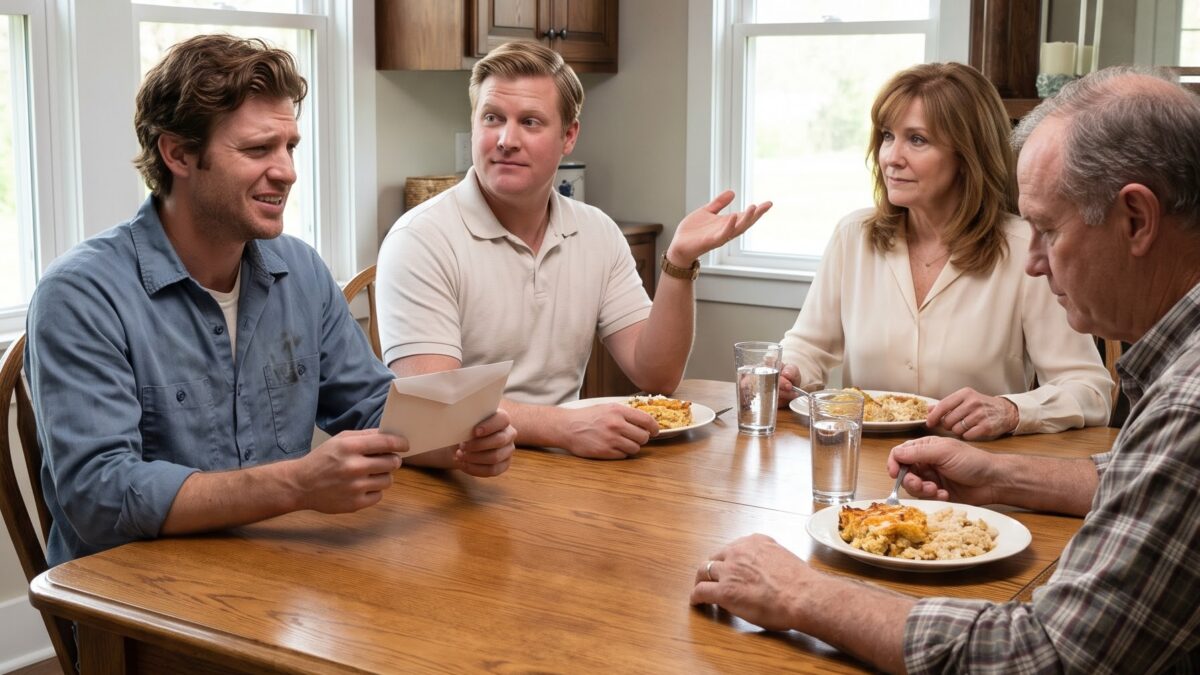
I spent two years rebuilding my parents’ house, put more than forty thousand dollars of my own money into it, and did the work after finishing other people’s jobs.
When I finally brought up the deed, my brother leaned back in his chair.
“Bro, I have three kids. You live alone and play video games. Be realistic.”
My mother nodded.
I laughed once. I couldn’t help it.
Then I walked to my truck and came back with a folder listing what I had spent.
It wasn’t a magic piece of paper. It didn’t make me the owner of anything.
But it was the first thing I had ever put in front of my family that they couldn’t reduce to a favor.
My name is Nolan. I was thirty-two when that dinner happened.
My brother, Connor, was thirty-five, married to Paige, and the father of three children under seven. Our parents, Rick and Donna, still lived in the house where we grew up, in a small town in eastern Tennessee.
Connor had always been easy for people to admire.
He was a good athlete, confident in front of strangers, and comfortable asking for what he wanted. Dad still kept a photograph of his high school football team in the hall, even though Connor’s oldest child was nearly old enough to play himself.
I was the kid who took apart the lawn mower and got it running again.
When something broke, someone called my name.
I went to trade school, worked under an experienced contractor, and eventually got licensed and insured to run my own renovation business. By my late twenties, I owned a small house, had a reliable truck, and could pay my bills without asking my parents for anything.
I was proud of that.
At family dinners, though, Connor’s sales job sounded like a career. Mine sounded like something I did because I was handy.
“Your brother’s always been good with tools,” Mom would say.
She meant it affectionately. Most of the time.
I played video games when I had a free evening. Sometimes I met friends online for an hour after dinner. Connor watched sports and played golf.
Only one of those hobbies ever became evidence that a person didn’t have a serious life.
The trouble started a little over three years before that dinner.
Dad called about a stain on the upstairs ceiling.
“Probably needs a little caulk,” he said.
I drove over after work and went into the attic.
The roof needed more than caulk. Water had been getting in around a chimney and along an old section of flashing. Insulation was wet. Some roof decking was soft enough to crumble when I pressed it.
Downstairs, a bathroom floor had begun to sag around the toilet. There were plumbing leaks beneath the house, several damaged joists, and electrical problems that needed a proper inspection.
The foundation had cracks too.
I brought in someone qualified to look at them before making promises. Fortunately, the house did not need to be lifted or have its entire foundation replaced. It needed drainage corrections and repairs to specific damaged areas.
That distinction mattered.
What looked like a disaster could be managed, but it would still be expensive.
Dad had retired from the plant. Mom worked part-time at a dentist’s office. They had paid off the mortgage years earlier, but their cash savings wouldn’t cover a large renovation.
A local investor offered around a hundred and forty thousand dollars for the house as it stood.
Dad showed me the letter.
Forty years in that house, reduced to a number on one page.
“We might have to take it,” he said.
Mom was standing by the sink.
“Where would we go?”
I looked at the warped cabinet beneath her hands and began making a list.
That was my first mistake.
Not the list itself.
The way I started solving the problem before asking who else was going to help.
Connor came over that Sunday.
He listened while I explained what I had found.
“Man,” he said. “That’s rough.”
“Could you contribute toward the repairs?”
He rubbed the back of his neck.
“Paige and I just finished our kitchen. We’re tapped out right now.”
Their remodel had cost sixty-five thousand dollars. Connor had told us the number himself while showing off the quartz countertops and the faucet mounted above the stove.
I didn’t begrudge them a kitchen they could afford.
What bothered me was the way their expenses became fixed facts, while mine remained available for rearranging.
Dad said, “We don’t expect either of you to take this on.”
He was looking at Connor when he said it.
Later, after my brother left, I stayed.
“I can do a lot of the work,” I told my parents. “We’ll have to bring in an electrician and a plumber for parts of it. I’m not going to pretend I can do everything.”
Mom sat down.
“How much?”
“I can keep the labor costs down. I won’t charge for my own time. But materials and outside work still have to be paid for.”
Dad nodded slowly.
“I can float those costs as we go,” I said. “You’ll need to reimburse me. We can work out a schedule once we know the final amount.”
“We’ll pay you back,” Dad said.
Mom reached across the table and squeezed my wrist.
“You’re our angel.”
I wish I could say that didn’t affect me.
It did.
I was used to being thanked after something was repaired. Being told I mattered before the work began felt different.
That evening, I emailed a rough scope and an initial budget. I wrote that my labor would be a gift, while purchases and outside trades would be reimbursed.
Dad replied the next morning.
Looks right. Keep track of what we owe.
It wasn’t the contract I would have used with a customer.
At the time, it seemed unnecessary to ask my father to sign one.
The work took two years because I couldn’t afford to stop earning a living.
This was not a mansion, and I did not tear every wall out at once. It was an older, roughly sixteen-hundred-square-foot house that had accumulated problems faster than my parents could address them.
We worked in stages.
The first priority was keeping it dry and safe. I repaired damaged framing where the inspection called for it, improved the drainage, and replaced the roof with help from two men I paid for the heavy work.
The electrician corrected unsafe circuits and replaced the panel. A plumber helped with the failing supply lines and the bathroom repairs.
I did the demolition, carpentry, insulation, drywall, painting, flooring, cabinet installation, and a long list of jobs too small to sound impressive until you added them together.
Some existing hardwood could be refinished. Some cabinets could be saved.
I watched clearance sales, bought discontinued tile, and drove to pick up unopened boxes of flooring left over from another project.
Mom wanted a particular front door she had seen in a magazine.
I found a similar one at a building-supply outlet.
It wasn’t cheap enough to be an impulse purchase, so I sent her the price.
She replied, Get it. We’ll include it in what we owe you.
I saved that message with the receipt.
That was how I ran jobs.
Every purchase had a place. Every change had a note.
I never imagined that one day I would be reading those notes to a lawyer.
My parents remained in the house for most of the work.
They stayed with an aunt for a week while the electrical work was finished, and with me for several nights when both bathrooms were inconvenient to use.
Dad complained about sleeping in my guest room.
“The mattress is softer than ours.”
“The one at your house is currently beside a stack of drywall.”
He conceded the point.
Mom packed lunches while I worked on Saturdays. Dad cleaned up when his knees allowed it.
They weren’t absent from the renovation.
That made what happened later harder to understand.
They saw me arrive after a full day of work. They saw me take off my muddy boots in the garage, eat something standing at the counter, and keep going until it was too late to make noise.
They knew what those two years looked like.
On my thirtieth birthday, I spent the morning repairing roof flashing before a forecast of several days of rain.
I finished while the roof was dry.
Then I helped Dad carry a tarp over a stack of lumber, washed my hands, and ate a piece of grocery-store cake in the kitchen.
Mom took a photograph.
There was drywall dust in my hair.
Later, she posted it online with a caption about how lucky she was to have such a hardworking son.
Connor commented with a thumbs-up.
I asked Connor to help more than once.
Not to rebuild a wall. Not to put down his job and become a carpenter.
“Can you give me two hours Saturday? I need to move drywall upstairs.”
He had promised the kids a trip to the zoo.
“What about Sunday morning?”
“Paige has something.”
I stopped pressing and paid a helper.
A few weeks later, I asked whether Connor could take Dad to pick up a rented floor sander so I wouldn’t lose half a workday.
He said he was in meetings.
Maybe he was.
One missed Saturday doesn’t make a bad brother. Neither does choosing your children over a construction project.
The problem was that there was never another Saturday.
There was always something else.
He came by once while I was installing the kitchen cabinets.
“Looking good, bro.”
He opened the refrigerator, took a beer, and talked to Dad about a football game.
When he left, I was still holding a cabinet against the wall, waiting for Dad to bring me the screws.
I remember thinking that I should say something.
Then the cabinet shifted, and I had work to do.
Cassie and I were dating when the project began.
At first, she understood.
Her own father had needed help after surgery, and she knew families sometimes rearranged their lives for one another.
Six months in, she began asking when we could have a weekend.
“One more big push,” I kept saying.
There was always another.
I missed her sister’s birthday dinner. I canceled a short trip we had planned because a plumbing problem had to be resolved before the floor went down.
Once, she came over to my parents’ house with takeout.
I told her I needed fifteen minutes.
Forty minutes later, she was sitting at the table with two cold containers in front of her.
“I don’t mind that you help them,” she said.
“I know.”
“I mind that helping them means I can never count on you.”
I started explaining the problem with the bathroom.
She closed the containers.
“That’s exactly what I mean.”
We broke up near the end of the project.
She didn’t scream or give me a dramatic choice.
She told me she was tired of making plans around promises that changed as soon as someone else needed something.
I wanted to argue.
Instead, I watched her carry a box of her things to her car.
For a long time afterward, I blamed the renovation.
Eventually, I admitted that the house hadn’t decided where I spent my evenings.
I had.
By the following December, the main work was finished.
The roof didn’t leak. The bathrooms were solid. The electrical inspection was signed off. My mother could open her kitchen drawers without lifting one corner first.
We converted an existing upstairs office into a proper fourth bedroom. There was no grand addition, just a room finally usable the way it should have been.
The house looked good.
More than that, it worked.
The final out-of-pocket total was $41,614.37.
That included materials, permit costs, rentals, and the outside help I had paid for. I had deducted returned purchases, supplier credits, and materials left over for my own business.
My labor log came to 1,112 hours.
I rounded that to eleven hundred whenever anyone asked.
Dad shook my hand after the final walkthrough.
He held it for a while.
Mom cried in the kitchen.
I sent them the expense summary and asked when we could discuss reimbursement.
Dad said he would look at their finances after the holidays.
In January, Mom said there were a few things they needed to sort out first.
In February, I asked again.
“We haven’t forgotten,” she said.
I believed her.
I didn’t yet understand that remembering and intending to pay were two different things.
The first conversation about the deed happened in March.
I had gone over to install a mailbox.
It should have taken half an hour. It took longer because the old post had rotted beneath the ground, and I had to remove the broken section before setting the new one.
Mom had chicken casserole in the oven.
Connor and Paige arrived with the kids.
After dinner, the children went into the living room, and the five adults remained at the oak table I had built from reclaimed boards.
I hadn’t planned to demand ownership.
I wanted to settle what I had spent. If cash was difficult, perhaps an ownership interest or a written arrangement tied to a future sale would work.
“I wanted to talk about the renovation money,” I said.
Mom reached for a serving dish.
“Let me get this out of the way.”
“It can wait.”
She left it where it was.
“I sent the final total,” I said. “We’ve put off discussing it a few times. If paying me back now isn’t possible, could we talk about adding my name to the deed for a fair share?”
Dad looked at Mom.
Connor stopped turning his glass between his hands.
“Well,” Mom said. “We were going to talk to you about the house.”
I sat back.
“Okay.”
“Your father and I have been thinking about what happens when we’re gone.”
She folded her napkin.
“We think it makes sense to leave it to Connor and Paige.”
I looked toward the living room.
One of the children was laughing at the television.
“Leave the whole house to them?”
“They have three children,” Mom said. “You have your own place.”
“So does Connor.”
“Their family needs more room.”
I looked at Dad.
He stared at a knot in the tabletop.
“What about the money you said you’d pay back?”
Mom’s expression tightened.
“We’re grateful for everything you did.”
“That wasn’t what I asked.”
Connor leaned back.
“Bro, I have three kids. You live alone and play video games. Be realistic.”
Mom nodded.
It was a small movement.
I watched it happen.
For two years, they had called me responsible whenever they needed me to take care of something. Now that I was asking to have my contribution recognized, my life had become evidence that I didn’t need anything.
I laughed.
“What?” Connor asked.
“I’m trying to understand how the video games got into this.”
“You know what I mean.”
“No. I don’t.”
Paige spoke.
“Connor works hard for his family. You have more flexibility.”
“I used that flexibility to work here.”
“Nobody forced you.”
That one landed.
Because it was true.
Nobody had forced me. They had simply made promises while I was doing it.
I pushed back my chair.
“I’ll be right back.”
Mom asked where I was going.
“To the truck.”
The expense folder was in a document box behind the seat. I had brought it earlier that week to show Dad a warranty card and left it there.
I stood in the driveway for a minute before returning.
Inside the folder were the summary and copies of the largest receipts. The complete records were at home.
I put it on the table.
Dad opened it.
“Forty-one thousand,” he said.
“And six hundred fourteen dollars. Thirty-seven cents.”
Connor looked at me.
“You’re billing Mom and Dad?”
“I’m showing them what they agreed to reimburse.”
Mom touched the edge of the folder.
“We thought you were helping.”
“I was. My time was the help. I told you that before I started.”
Her eyes moved toward Dad.
He didn’t say anything.
I could have stayed and argued over every sentence.
Instead, I left the folder.
“Please read it,” I said. “Then tell me what you think we agreed to.”
I drove home with the radio off.
I called Travis the next morning.
He was a lawyer I knew through local business work. He handled property and contract matters, and he had once reviewed a subcontract for me.
I told him what had happened.
“Did they agree to repay the expenses?” he asked.
“Yes.”
“Do you have that in writing?”
“Some emails. Texts.”
“And the labor?”
“I said I wouldn’t charge.”
He paused.
“All right. Bring everything. Including anything that doesn’t help you.”
At his office, I placed a thumb drive, bank statements, and the printed correspondence on his desk.
He read for nearly an hour.
When he finished, he didn’t announce that I was about to win.
“The reimbursement messages matter,” he said. “They give us something more useful than a pile of receipts by itself.”
“What about the labor?”
“You can document its value. But you offered it without charge. Being hurt now doesn’t automatically turn it into a debt.”
I didn’t like hearing that.
He could tell.
“You want me to tell you what holds up,” he said, “or what feels good?”
“What holds up.”
“Then we keep those two things separate.”
Travis explained that there were different ways to argue about money spent improving someone else’s property.
He could evaluate a claim based on the repayment agreement and consider other theories if necessary. But he wanted to understand the promises, the family context, and the records before choosing a course.
I asked about a mechanic’s lien.
He shook his head.
“Don’t assume a lien is available just because you’re a contractor. We would have to examine the agreement, notices, deadlines, and the work involved. I’m not filing something questionable to scare your parents.”
“So they can sell the house?”
“They own it. A reimbursement dispute doesn’t make you the owner.”
I rubbed my hands over my face.
“But they can’t just pretend they never promised to pay me.”
“That,” he said, tapping Dad’s email, “is the part we address.”
We sent a written request for repayment and proposed discussing a payment plan or another documented arrangement.
It was not an angry letter.
I almost wished it were.
My mother could dismiss an angry letter as me being upset.
A polite letter with dates and attachments required an answer.
Mom called when she received it.
“You got a lawyer involved?”
“Yes.”
“We’re your parents.”
“I know.”
“You could have talked to us.”
“I did.”
She was quiet for a moment.
Then she said, “We don’t have forty thousand dollars sitting around.”
“I asked about a payment plan. Or securing it against a future sale. You didn’t discuss either one.”
“We’re trying to do what’s best for everyone.”
“Then I need to be included in everyone.”
She began crying.
I sat at my kitchen table with the telephone against my ear and let her finish.
It was one of the hardest conversations I had ever had.
I didn’t accuse her of pretending.
She was upset.
That still didn’t answer the question.
When she said she needed time, I agreed.
But I told her the conversation would continue through Travis until we had something in writing.
For a few weeks, I wanted to do nothing but work.
That was familiar ground. A crooked wall could be measured. A leaking pipe could be found. A customer who owed money had an invoice with terms.
My parents had a whole childhood they could bring into any discussion.
I found myself remembering every time Mom packed my lunch, every time Dad helped fix my first truck.
Then I remembered the evenings I had skipped meals to finish their house.
It was exhausting, trying to balance love against a spreadsheet.
Eventually, I stopped trying to prove which one mattered more.
They both mattered.
I could love my parents and still need repayment.
I could appreciate what they had done for me as a child without agreeing that my savings belonged to them indefinitely.
Travis continued the correspondence.
Their responses were vague.
They were reviewing their finances. They wanted to keep the family together. They hoped we could find a solution.
No payment arrived.
No proposal arrived.
My business had suffered while I worked on the house.
I had turned down jobs and stretched smaller ones around my parents’ schedule. Now I called old customers, followed up on estimates, and took work I had been too busy to accept.
Bathroom repairs. Decks. Doors that wouldn’t close.
I started leaving Saturday afternoons open.
At first, I didn’t know what to do with them.
I cleaned my garage. I watched a movie in the middle of the day. I went fishing with a friend and spent most of the morning checking my telephone out of habit.
Nobody needed me to come fix something.
That felt strange before it felt good.
I met Claire at the hardware store in April.
She was holding two packages of wall anchors and reading the backs as if one of them might eventually apologize for being unclear.
“What are you hanging?” I asked.
“A television.”
“Into studs?”
“I was hoping you wouldn’t ask a second question.”
I helped her find what she actually needed.
She had recently moved to town for a physical therapy job. We talked in the aisle for longer than either of us needed to.
Before leaving, she asked whether I wanted coffee.
I said yes.
For once, I didn’t offer to install something first.
I told Claire about the house after we had been seeing each other for several weeks.
We were eating on my back steps because the weather was finally warm enough.
She listened without interrupting.
Then she asked, “Did you tell your parents the labor was free?”
“Yes.”
“And that they had to pay back what you bought?”
“Yes.”
“So why are they treating both as the same thing?”
“I don’t know.”
She set her plate beside her.
“Have you asked them?”
“Several times.”
“What do they say?”
“That we’re family.”
Claire looked at the yard.
“That’s an answer to a different question.”
I laughed.
She smiled, but she didn’t turn it into a speech about my worth or tell me to cut everybody off.
Later that evening, when I said I might just let it go, she asked what letting it go would mean.
“Not arguing anymore.”
“Would you actually stop feeling it?”
I knew the answer.
“No.”
“Then make sure you’re choosing peace,” she said, “and not just being quiet again.”
That summer, I got steadier work from a small local builder who needed help finishing houses.
I hired Jake, a young man fresh out of trade school.
He was eager, careful, and afraid of disappointing anyone.
I recognized the combination.
One Friday, he offered to stay late without pay to finish something that wasn’t urgent.
“No,” I told him. “We’ll finish Monday.”
“I don’t mind.”
“I know. Put it on your time sheet anyway.”
He looked at me.
“That’s how this works.”
I could hear how simple it sounded when I said it to someone else.
By August, the business was booked ahead. I had replenished some savings. Claire and I spent weekends together without my phone deciding where we went.
The dispute with my parents was still there.
It just wasn’t occupying every room in my life anymore.
Then Travis called.
“Your parents have listed the house.”
I pulled over before answering him.
“For sale?”
“Yes.”
“How much?”
“Four hundred thirty-five thousand.”
I sat looking through the windshield.
They had found a way to turn the house into cash.
They still hadn’t found a way to discuss paying me back.
Travis had seen the public listing while reviewing the property records for our file.
That evening, I looked at the photographs myself.
The kitchen. The upstairs hallway. The front door Mom had chosen.
There was a photograph of the dining room with my table in the center.
The description called the house lovingly renovated.
I closed the page.
Then I called Dad.
“Are you selling?”
He hesitated.
“We were going to tell you.”
“When?”
“We only just listed it.”
“What happened to leaving it to Connor?”
He breathed into the phone.
“Your mother thinks a smaller place would be easier on us. Connor’s been looking at houses with more room. We thought we could help.”
“How much help?”
“We haven’t settled that.”
“But you listed this one.”
“Nolan—”
“What about reimbursing me?”
“That’s part of what we need to work out.”
It was the first time he had acknowledged that selling the house and paying me should belong in the same conversation.
I should have felt relieved.
Instead, I wondered why I had needed to find the listing to hear it.
I met with Travis again.
We went through the records carefully.
There were 412 expense entries, supported by receipts, invoices, or matching payment records. We removed one duplicate and corrected two purchases partly returned to a supplier.
The final cash total remained $41,614.37.
Then we reviewed the labor log.
My usual labor rate for comparable renovation work was sixty-five dollars an hour. At 1,112 hours, that came to $72,280.
Combined, the documented expense and labor value was $113,894.37.
Travis drew a line beneath the figures.
“This is the value of what you contributed,” he said. “It is not automatically the amount they legally owe.”
“I understand.”
“Then the document needs to say so.”
We prepared an expense invoice for reimbursement and attached a separate labor-value schedule.
The cover sheet showed both amounts.
The labor section clearly stated that I had originally waived payment for my time. I was presenting it as part of a proposal to recognize my overall contribution in a negotiated settlement.
Nobody could accuse me honestly of hiding that distinction.
More importantly, I wouldn’t be hiding it from myself.
Before the next Sunday dinner, Travis sent a formal proposal through the lawyer my parents had now retained.
We asked them to address reimbursement before distributing sale proceeds to anyone else.
Their lawyer agreed to discuss a temporary arrangement that would preserve the disputed money at closing if the house sold before the dispute was resolved.
That would require written agreement.
It wasn’t something I could impose by announcing that I had an invoice.
Travis also told me not to negotiate percentages over casserole.
“Show them the records if you want,” he said. “But don’t make promises, and don’t threaten to damage the house or take fixtures.”
“I’m not taking a toilet hostage.”
“Good. You’d be surprised what people do.”
I told Claire what I planned.
She asked whether I wanted her to come.
“No. I need to do this myself.”
“All right.”
She looked at the folder.
“Are you asking them to understand, or asking them to pay?”
“Both.”
“And if they only do one?”
I didn’t have an answer yet.
Mom sounded delighted when I called to say I would come for dinner.
“I’ll make the chicken casserole.”
“Okay.”
“Should I set a place for Claire?”
“Just me this time.”
There was a brief pause.
Then her voice became bright again.
“Your brother will be here. It’ll be nice to have everybody together.”
It hurt how easily she could say that.
On Sunday, I parked behind Connor’s SUV.
The front yard looked good. Dad had kept the grass cut, and Mom had planted flowers beside the walkway.
I sat for a minute with the folder on the passenger seat.
Then I got out.
Mom hugged me at the door.
Dad asked about work.
Connor lifted a hand from the couch. His youngest climbed down and ran over to show me a drawing.
I crouched to look at it.
“Is that a dinosaur?”
“It’s you.”
“I’m going to need a little explanation.”
He laughed and pointed out the truck.
That part, at least, looked like mine.
Dinner was awkward, but not every minute of it.
The kids argued about who had gotten more potatoes. Dad asked Jake’s age. Mom told us a story about a patient at the dentist’s office who had arrived on the wrong day.
For a little while, I could see how tempting it would be to eat, smile, and go home without opening the folder.
Then Connor mentioned that he and Paige had found a place with a finished basement.
Mom asked whether the school district was good.
I set down my fork.
“Is that what the house sale is helping pay for?”
Connor looked at Paige.
“We’re still figuring things out,” he said.
“Right.”
After dinner, Paige took the children into the living room and settled them with a movie. When she returned, I got the folder from beside my chair.
Mom watched me place it on the table.
“I brought the complete renovation figures.”
“Nolan,” she said. “Can’t we just have dinner?”
“We did.”
I slid the cover sheet toward her.
She read the expense total, then the labor schedule.
At the combined value, she looked up.
“A hundred and thirteen thousand?”
“Eight hundred ninety-four dollars and thirty-seven cents. That’s the documented total value. The money you agreed to reimburse is listed separately.”
Connor leaned over.
“You said you weren’t charging for labor.”
“I’m not pretending I didn’t. Read the note.”
He read it.
Paige reached for the page after him.
“So why put it there?”
“Because we’re discussing what I contributed to this house. You’ve been talking about it as if I bought some paint and helped on a few weekends.”
Mom pressed a hand against the table.
“We know you worked hard.”
“Then why was my asking about repayment treated like I was taking something from Connor?”
Nobody answered.
I opened the folder to the expense schedule.
“These are the purchases. These are the credits. These are the outside invoices. There’s no markup.”
Dad began turning pages.
He recognized some receipts because he had gone with me to collect the materials.
That recognition mattered more than the total.
Connor sat back.
“Mom and Dad don’t have that kind of money.”
“They’re selling the house.”
“They need somewhere to live.”
“Yes. They do.”
“And you’re trying to take a third of it.”
“I asked for a conversation about a fair arrangement. They promised to reimburse what I spent.”
Paige said, “It feels like you’re punishing them because they wanted to help the kids.”
I looked at her.
“Your children didn’t make this decision.”
“That’s not what I said.”
“They didn’t ask me to work for two years. They didn’t promise to repay expenses. Leave them out of it.”
She lowered the paper.
Mom’s eyes were wet.
“You make it sound like we used you.”
I waited.
She looked toward Dad.
He had stopped turning pages.
“I don’t want to tell you what you meant,” I said. “I want you to look at what happened.”
Dad nodded once.
It was the first time that evening he had moved toward me instead of toward silence.
“Son,” he said. “We should have worked this out sooner.”
“Yes.”
“I thought we had time.”
“You had time to discuss what Connor would get.”
Dad rubbed his forehead.
Mom said, “We were thinking about the grandchildren.”
“I know.”
There wasn’t any point pretending that explanation surprised me anymore.
“I’m not asking you to choose between me and them,” I said. “I’m asking you to stop treating my money as something you can promise elsewhere.”
Connor started to speak.
I looked at him.
“You told me to be realistic. This is the realistic part. I can’t keep financing family plans without an agreement.”
He looked down.
I stood.
“Your lawyer has Travis’s proposal. Please answer it.”
Mom asked whether I was leaving already.
“Yes.”
I put a copy of the records in front of Dad and kept my own folder.
At the door, my oldest niece caught my sleeve.
“Are you coming next week?”
“I’ll call your dad,” I said.
I hated that I couldn’t give her a simpler answer.
Claire was at my house when I got home.
She had brought dinner, then remembered where I had been and put it in the refrigerator.
“How did it go?”
“I didn’t say everything I thought I would.”
“Was that good or bad?”
“I’m not sure.”
I sat beside her.
She didn’t ask whether Mom had cried or whether Connor looked embarrassed.
She asked whether I had kept the promises I made to myself before going in.
“I didn’t pretend the labor was a debt,” I said. “I didn’t take a smaller number just to stop the conversation.”
“Then that’s something.”
I leaned back and closed my eyes.
After a minute, she rested her hand on mine.
I was tired in a way a shower couldn’t fix.
But I hadn’t left the house wondering whether I had explained myself clearly.
They understood the question now.
What they chose to do with it was theirs.
The following week, my parents’ lawyer contacted Travis.
Their first response was that the labor had been a gift and that they disputed some of the expenses.
Travis agreed about the first point and asked them to identify the disputed entries.
They listed several.
We provided the receipts, bank records, and messages approving those purchases. One rental charge had been entered under a confusing description, so we clarified it.
There were no theatrical courtroom moments.
Mostly, there were emails, attachments, and people checking dates.
Then Dad asked for a meeting with both lawyers.
Mom attended too.
Connor and Paige weren’t clients in that dispute because they didn’t own the property. They could help my parents obtain advice, but they didn’t get to negotiate my parents’ obligations as if the sale proceeds already belonged to them.
That distinction changed the tone.
For the first time, Connor’s wishes weren’t seated at the center of every discussion.
The meeting lasted nearly three hours.
We talked about repayment, about the anticipated sale, and about my parents’ plans for a smaller house.
Dad admitted they had promised to repay the cash expenses.
Mom said she had assumed I would eventually stop asking because I had offered so much other help.
Hearing that was worse than hearing she had forgotten.
“You thought I wouldn’t insist,” I said.
She looked at me.
“Yes.”
Her lawyer spoke quietly with her.
Then Mom said, “That doesn’t make it right.”
Nobody congratulated her for saying it.
We still had numbers to settle.
My parents did not want a drawn-out dispute. I did not want to spend a year arguing about them with strangers.
We negotiated a broader settlement that recognized the expense claim and the larger contribution I had made, without pretending a court had already ordered payment for gifted labor.
That was a choice they made.
I wanted that choice stated clearly.
The agreement gave me a thirty-percent ownership interest in the property, documented through a deed prepared and recorded as part of the settlement.
It also specified how the house would be sold, which costs would be deducted, and how the remaining proceeds would be distributed.
There was no outstanding mortgage.
My thirty percent would come from the net proceeds after the agreed selling expenses.
In exchange, I released the renovation reimbursement dispute, including any further claim arising from the work.
My parents kept seventy percent.
What they chose to give Connor after securing their own housing was up to them.
I didn’t receive a veto over their lives.
They didn’t receive another open-ended promise from me.
Before signing, I read every page.
Dad noticed.
He said nothing, but when his lawyer pointed out a provision, he asked her to explain it again.
I was glad he did.
The house sold for four hundred twenty thousand dollars.
That price reflected the renovations, the land, and the market. I hadn’t personally created every dollar of its value, and nobody needed that fiction to acknowledge what I had done.
Agreed commissions and other closing costs totaled $25,200.
The net proceeds were $394,800.
My thirty percent came to $118,440.
After three thousand dollars in legal fees, I kept $115,440.
I looked at the closing statement for a long time.
It was more than the cash I had put into the house. It also represented a negotiated recognition of the labor and time my parents had been willing to overlook.
It did not give me those two years back.
It did let me stop carrying their cost alone.
My parents bought a smaller ranch house with fewer stairs and manageable upkeep.
They still gave Connor and Paige money toward their next home.
It was less than my brother had expected.
That was not a debt I owed him.
Dad called first.
It was a Sunday evening several weeks after the sale.
I was washing a pan when the telephone rang.
“Got a minute?”
“Yeah.”
He cleared his throat.
“I should have spoken up at that dinner.”
I waited.
“I heard what your brother said. I knew it wasn’t fair.”
“Then why didn’t you?”
“Because I didn’t want an argument.”
I turned off the faucet.
“So I got one by myself.”
“Yes.”
He didn’t explain how Mom had felt or what Connor needed. He didn’t ask me to consider his position.
“I’m sorry, son.”
“Thank you.”
We spoke for a few more minutes about work.
Before hanging up, he said, “There’s a loose handrail at the new place.”
I closed my eyes.
“I found somebody local to fix it,” he added. “Just thought you’d want to know.”
I laughed.
He did too, a little.
That was how we started again.
Mom took longer.
For a while, she sent birthday reminders and photographs of the grandchildren without addressing anything else.
I answered the messages about the kids.
I didn’t treat that as a reconciliation.
Eventually, she asked whether we could have lunch.
We met at a restaurant instead of one of our houses.
She kept moving her iced tea glass around its coaster.
“I thought because you were doing well, it didn’t matter as much.”
“It mattered.”
“I know that now.”
“And being single didn’t make my time free.”
She nodded.
“I kept thinking about what Connor’s children needed. I didn’t think enough about what you had already given.”
I looked at her.
She wasn’t asking me to reassure her.
That helped.
“I appreciate you saying it.”
“Will you come for dinner sometime?”
“Yes. But things are going to be different.”
She waited.
“I’m not coming over every time something needs fixing.”
“All right.”
“And if you hire me for something, we handle it like a job.”
She looked embarrassed.
Then she said, “I understand.”
I hoped she did.
This time, I would wait for her actions before deciding.
Connor didn’t speak to me for several months.
I missed the children more than I missed him.
Around the holidays, he sent a long message.
At first, I thought it would be another explanation about money and responsibility.
It wasn’t.
He said he had been angry because he had counted on help that wasn’t his to count on. He said the kids kept asking about Uncle Nolan and he hadn’t known how to explain why I wasn’t coming around.
Then he wrote that he had thought about the video-game comment.
I made your life sound smaller so mine could come first.
I read that sentence twice.
Then I called him.
The conversation was awkward.
He apologized. I told him I had been tired of being useful only when he needed something.
He said he hadn’t thought of it that way.
“I know,” I said. “That was part of the problem.”
We didn’t become different brothers in an hour.
But we stayed on the telephone long enough to say things we usually avoided.
Paige later apologized for saying nobody had forced me.
She said it had been true in the narrowest sense and unfair in every way that mattered.
I accepted the apology.
I didn’t erase the conversation.
By the next spring, Claire and I were living together.
My business had four employees, including Jake, who had become an excellent framer and still needed occasional reminders to record all his hours.
I used part of the settlement money to strengthen the business and kept the rest in savings.
I didn’t buy a boat or a bigger truck to prove a point.
The one I had worked fine.
One evening, Claire mentioned that the bathroom needed better lighting.
I looked at her across the kitchen.
“How extensive is this proposal?”
“Two lights and a mirror.”
“That’s how they all start.”
She smiled.
“I’m prepared to negotiate.”
We made a list and a budget.
It felt almost ridiculous how easy that could be when both people intended to listen.
I still go to family dinners.
Not every week.
Sometimes I have work. Sometimes Claire and I have plans. Sometimes I want a quiet Sunday at home, and I no longer invent an appointment to make that sound acceptable.
At my parents’ new house, Dad keeps a list of local repair companies in a kitchen drawer.
Mom calls them when she needs something done.
She called me once to ask whether an estimate looked reasonable.
I reviewed it, told her what questions to ask, and went back to my evening.
She thanked me without adding another request.
Connor’s kids still run toward me when I arrive.
They don’t care whose name was on the deed. They want to know whether I’ll look at a drawing, throw a ball, or help build something out of the pieces scattered on the floor.
I say yes when I can.
And when it’s time to leave, I leave.
The old spreadsheet is still saved on my computer. I don’t open it much anymore.
A few months ago, Jake asked whether I had a contract template he could use for a small job his cousin wanted done.
I sent him one.
Then I added a note.
Write down what’s free. Write down what isn’t. Have the conversation before you start.
He replied, Even with family?
I looked toward the kitchen, where Claire was making dinner and asking whether I wanted rice or potatoes.
Then I typed back.
Especially with family.