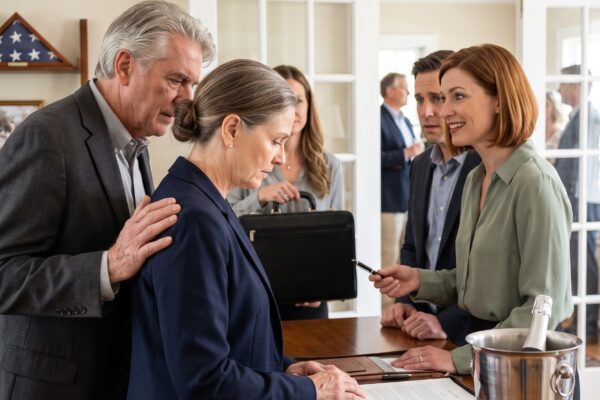
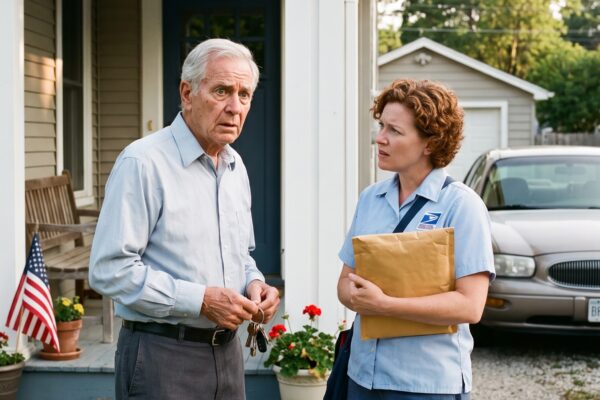
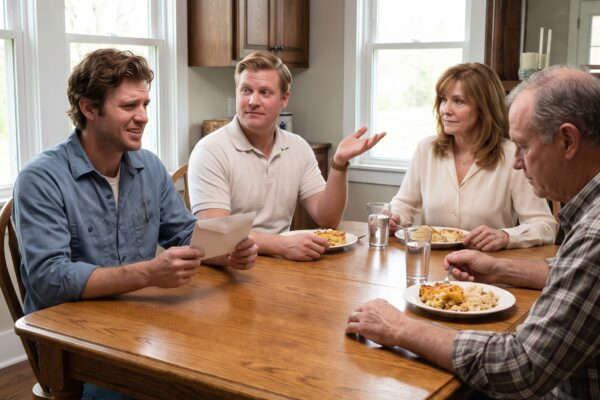
I was drinking coffee outside my Florida home when a moving truck pulled up in my driveway. My son-in-law stood there smiling. “The nursing home can take you Thursday, Dad. We want to help you get settled.” My daughter stood beside him, refusing to look at me. I was only 64, still living independently in my own home. When he handed me the doctor’s letter, I calmly asked him one question. The smile vanished from his face.

The morning my son-in-law arrived with a moving truck, I was on my back deck drinking coffee.
A pelican stood in the shallow water beyond my dock. I had a sanding block beside my chair and a short list of things to finish on the sailboat before lunch.
Then a diesel engine interrupted the quiet.
An eighteen-foot rental truck turned into my driveway. Derek got out of the passenger seat carrying a manila folder. My daughter, Melissa, followed in their SUV and parked behind it.
I had not called a moving company. I had not packed anything.
Derek looked toward the deck.
“Morning, Frank. We figured we’d make this easy on you.”
I set my cup down.
“The place in Bradenton has an opening,” he continued. “Thursday, if we get everything moving.”
“What place?”
“Sunrise Manor. We talked about you needing more support.”
“No,” I said. “You talked. I told you I was fine.”
Melissa stood beside the SUV with her phone in her hand. She looked up briefly, then back at the screen.
The driver opened his door.
“Where do you want us to start?”
“You don’t,” I said.
Derek turned toward him with an apologetic smile, as if I were being difficult about a delivery.
“Give us a minute.”
My name is Frank Callaway. I was sixty-four that morning, and I had spent thirty-one years working as a forensic accountant for the FBI.
I followed money. I examined records. I helped investigators distinguish a business failure from a business built to deceive.
I had retired two years earlier and moved to a small waterfront house in Sarasota. Eight hundred square feet, a screened porch, and a dock that needed more work than the seller had admitted.
My wife, Carol, had died four years before. Melissa was our only child.
That was why, when she brought paperwork to my kitchen table, I had treated her like my daughter instead of someone whose work needed checking.
I came down the deck steps.
The driver was watching us now. A second mover sat inside the truck, holding a clipboard.
“Who hired you?” I asked.
“Mr. Holt.”
“Then Mr. Holt can pay your cancellation charge. Nothing leaves this house.”
Derek shifted the folder against his chest.
“Frank, nobody’s trying to upset you.”
“Tell him to move the truck out of my driveway. Then come inside and show me what you think gives you authority to do this.”
“Dad,” Melissa said.
I waited.
She looked at Derek.
He took the driver aside. Their conversation was short and unpleasant. A few minutes later, the truck backed onto the street.
I held the front door open for my daughter and her husband.
Neither thanked me.
What I Had Signed
Derek put the folder on my kitchen table, beside the bowl where I kept my boat keys.
Melissa took the chair she always used.
There were two documents.
The first was a designation of health care surrogate naming Melissa to make medical decisions if I became unable to make them myself. It carried my signature, dated seven months earlier.
The second was a letter bearing the name of Dr. Raymond Cho, a psychiatrist in Tampa.
According to the letter, he had evaluated me six weeks before and found symptoms consistent with early vascular dementia. It recommended supervised living and further assessment of my ability to manage my affairs.
I read it twice.
I had never met Dr. Cho.
I had not attended a psychiatric appointment in Tampa. On the date listed, I had taken my truck in for brake work and spent most of the morning waiting at the garage.
“This appointment didn’t happen,” I said.
Derek leaned back.
“Sometimes people don’t remember the evaluations.”
Melissa rubbed her thumb along the edge of her phone.
I looked at her.
“Did you take me to this doctor?”
“No.”
“Did you arrange for him to come here?”
She shook her head.
“Then how did he evaluate me?”
Derek answered before she could.
“It may have been based on the information we provided.”
“That isn’t what the letter says.”
Outside, the truck engine shut off.
I could hear the refrigerator cycling behind me and the little scrape of Melissa’s wedding ring against her phone case.
She had married Derek six years earlier. He worked in commercial real estate, though his description of that work changed depending on who was listening.
One month he was developing properties. Another month he was putting together investment partnerships.
Carol had disliked how often he asked what things were worth.
After her death, Melissa called more frequently. I was grateful for it.
Eight months before the truck arrived, she began bringing folders when she visited. Insurance forms. Beneficiary information. Emergency contacts.
I had read some of those pages. Others I had skimmed while she talked about dinner or her drive down from Tampa.
I remembered signing the health care document.
She had said, “If you’re ever unconscious after an accident, somebody needs to be able to talk to the doctors.”
That had sounded sensible.
Now Derek tapped the document.
“Melissa is responsible for these decisions.”
“If I can’t make them,” I said. “I’m making one now. I’m staying here.”
Melissa finally looked at me.
“You’ve been forgetting things.”
“What things?”
“You missed my call last Sunday.”
“I was under the boat.”
“And the insurance notice—”
“What insurance notice?”
She stopped.
Derek closed the folder.
“We’re getting nowhere.”
“No,” I said. “You’re not getting what you came for.”
I picked up the two documents.
“I’m keeping these copies. You can leave.”
Melissa stood slowly. She reached for her handbag but did not put it over her shoulder.
For a moment I thought she might tell me something that would make the morning less ugly.
Instead, she said, “You’re making this harder than it needs to be.”
I opened the door.
The truck left empty.
The First Calls
After they drove away, I sat at the kitchen table.
My coffee was cold. The sanding block was still outside beside my chair.
I photographed both documents and wrote down what had happened while the words were fresh.
Then I called Patricia Osgood.
Pat had supervised financial investigations in Tampa before retiring. She now did consulting work, including cases involving disputed financial authority.
“My daughter tried to move me into a care facility this morning,” I said. “She brought a medical letter from someone I’ve never met.”
Pat let me finish.
“Did anyone get inside your accounts?”
“I don’t know.”
“Then that’s the next thing you find out. But get a lawyer first.”
She gave me Douglas Freed’s number.
Doug’s office found room for me the following morning. Before then, I changed the passwords on my email and financial accounts, turned on additional verification, and called the institutions holding my savings.
I did not move the money. I asked them to note that no one else was authorized to give instructions.
That afternoon, I called Sunrise Manor.
The admissions coordinator sounded surprised when I gave my name.
My daughter had asked about availability and submitted preliminary information. There had been no assessment, no completed admission agreement, and no approval to move me in.
“We certainly didn’t send movers,” she said.
“Would you make a note that I’m not requesting admission?”
“Of course.”
The opening Derek had described was a room they could discuss after their normal review. He had turned that into a Thursday deadline and brought a truck to make it feel settled.
When I hung up, I looked at the empty chair across from me.
Melissa knew I disliked scenes. She knew I would rather inconvenience myself than embarrass her in front of strangers.
They had counted on that.
Doug read the papers without interrupting me.
Then he said, “This health care designation does not give your daughter ownership of your house. It doesn’t give her general control of your finances, either.”
“Could they use that letter to get a guardian appointed?”
“They could try to start a proceeding. A letter doesn’t complete one. You would have rights, and there are procedures they cannot simply skip.”
He asked whether I had signed a separate financial power of attorney.
“I don’t remember one.”
“We’ll obtain the complete set of documents. Today, we revoke the health care designation and give notice. We’ll also address any financial authority we find.”
He prepared the revocation while his assistant copied my identification.
I signed it after reading every line.
The Paper Trail
Doug recommended Sandra Beach, a financial investigator who had previously worked criminal tax cases.
When I met her, she handed me a written authorization.
“This lets me speak with the institutions you identify,” she said. “Please don’t send me your passwords.”
I liked her immediately.
We began with statements I downloaded myself, policy records, and the folder of papers Melissa had left in my desk.
There was no financial power of attorney in that folder.
There was a copy of the health care designation, some legitimate insurance updates, and a contact form adding Derek to my homeowner’s policy.
I had signed that form.
Melissa had described it as a way for someone local to help if a storm damaged the house while I was away.
Derek lived in Tampa. I had not asked why that made him the obvious choice.
The insurer confirmed that he could receive certain communications. He could not sell the property or collect money merely because he was listed.
We removed him.
The retirement account produced a more troubling answer.
Three months earlier, an online request had attempted to replace the charitable foundation named as beneficiary of my IRA with Melissa Holt.
The request had not been completed. Additional verification had been required, and a notice had been sent to me.
I had never seen it.
The account’s security staff confirmed an unfamiliar login associated with the attempt. They would preserve the records, but Sandra was careful about what that meant.
“It tells us the account was accessed,” she said. “It doesn’t prove who was sitting at the device.”
I remembered letting Melissa use my laptop to scan insurance paperwork. I had left accounts open more than once.
That afternoon, I went to the post office.
For several weeks, less mail had been arriving. I had assumed the usual companies were switching to email. My utility bills were already paperless, and friends generally called.
With identification and a conversation with a supervisor, I learned that a change-of-address request had redirected mail to a Tampa post office box.
I had not submitted it.
I canceled the forwarding and made a written report.
The box number appeared on a business form Derek had emailed me months earlier. At the time, he had wanted me to introduce him to someone I knew in commercial banking.
I had declined the introduction. I had kept the email.
Sandra put the two records beside each other.
“That’s a connection,” she said. “We still document it properly.”
It was slower than television makes this work look.
There were callbacks, written requests, and records that took days to arrive. Some information would require legal process.
By Friday, however, I understood enough.
Someone had tried to change what would happen to my retirement money.
Someone had diverted the mail that might have warned me.
And my daughter had arrived with a document describing me as unable to recognize what was happening.
The Doctor Who Had Never Seen Me
Doug contacted Dr. Cho’s office with my signed permission to discuss the supposed evaluation.
The doctor confirmed that I had never been his patient.
He reviewed the letter and identified a signature that was not his. The practice address was correct, but parts of the letterhead were outdated.
He supplied a written statement and agreed to cooperate with investigators.
Doug also arranged an appointment with Dr. Angela Voss.
I disliked needing to prove that I could manage my own life. Nevertheless, I went.
Dr. Voss asked about my health, medications, daily routine, finances, and the events leading to the appointment. She conducted testing and reviewed records I authorized my regular physician to provide.
She did not promise a particular conclusion.
When I became irritated by one exercise, she put her pen down.
“Mr. Callaway, you spent a career expecting people to support their claims. Let me do the same.”
That settled me.
Her report found no evidence supporting the diagnosis in the forged letter and no basis, from her examination, to conclude that I lacked the ability to make the decisions at issue.
It did not say I could never become ill. It said what she had actually assessed.
Doug sent the revocation notices, the doctor’s denial, and my written refusal of admission to Sunrise Manor.
Then we reported the suspected fraud.
A detective took my statement. I gave him copies, not a speech about my former job.
My experience helped me organize the material. It did not entitle me to search anyone’s phone or borrow access to government databases.
Meanwhile, Doug began the civil work needed to stop Melissa and Derek from presenting themselves as authorized representatives.
I changed the house locks, too.
Melissa had a spare key. She had once used it to bring soup when I had the flu.
I held the old key cylinder in my palm after the locksmith finished.
That small piece of metal bothered me more than I expected.
What the House Was Worth
Sandra found Holt Coastal Holdings in Florida business records.
It was a recently formed company controlled by Derek. Other records connected him to three commercial projects, some through separate entities.
Two lenders had filed collection actions. The public complaints included loan documents, guarantees, and figures that suggested approximately $840,000 in outstanding obligations.
Those figures were claims, not final judgments. Sandra made that distinction every time we discussed them.
One filing included a demand for roughly $310,000 and referred to a deadline Derek had missed.
Melissa’s signature appeared on a guarantee associated with the bridge loan.
I stared at the page.
She had not simply been listening to her husband complain about business. Her own finances were exposed.
The brokerage inquiry took longer to trace.
Derek had once mentioned an agent who specialized in waterfront properties. Sandra contacted that office with my authorization and asked whether anyone had requested a valuation of my house.
The broker’s attorney eventually provided correspondence.
Derek had described himself as helping an older relative prepare for a move. He had asked about an as-is sale and how quickly a cash buyer might close.
The brokerage had requested proof of ownership and authority before doing more.
None had been supplied.
The preliminary estimate placed my property between $1.1 million and $1.4 million, depending on its condition and the waterfront access.
The house itself was small. The land was what Derek had been studying.
I remembered him standing at the porch door during a visit.
“You could put something twice this size here,” he had said.
I had answered, “I don’t need something twice this size.”
Now the figures sat together on my table: the debt, the demand, and the estimated sale price.
There was no signed sales contract. No deed had changed hands.
They had not completed their plan.
But they had brought the truck.
That evening, I worked on the Catalina until my hands began to ache.
Carol and I had bought the 1974 Catalina 27 when Melissa started college. We had sailed it for years before repairs and Carol’s illness put it on land.
After retiring, I brought it to Sarasota on a transporter.
Restoring it had given me something to do after breakfast besides look at an empty chair.
I sanded one narrow section of hull three times before realizing I was no longer paying attention.
Then I put the tools away.
My Daughter at the Door
Melissa came alone the following week.
She rang the bell.
That was how she discovered her key no longer worked.
I stepped onto the porch and closed the door behind me.
“Can we talk inside?” she asked.
“Here is fine.”
She wore the blue blouse I had bought her for her birthday. There was a crease down one sleeve, as if it had been folded in a bag.
“Derek handled the arrangements,” she said.
“You came with him.”
“I thought you might listen if everything was ready.”
“Listen to what?”
“That living alone isn’t always the best thing.”
I waited.
She looked toward the street.
“Dad, the house is a lot to maintain.”
“I know. I maintain it.”
“You could have people around you. Meals. Help.”
“Did you know the doctor’s letter was false?”
She pressed her lips together.
“Derek said it was what we needed to get the process started.”
“What process?”
“Getting you somewhere safe.”
“And then?”
She did not answer.
“The house,” I said.
“It’s too much money tied up in one place.”
I felt something give way quietly.
She had finally said it in her own voice.
“You could have asked me for help,” I said.
“We knew what you’d say.”
“You never gave me the chance.”
She wiped under one eye, angry at the tear.
“You helped people your whole life.”
“I did.”
“But when it’s your own family—”
“Don’t finish that.”
She looked at me.
“You stood in my kitchen and told me I was forgetting things while holding a letter about an appointment you knew I hadn’t attended.”
“I was scared.”
“So was I.”
She seemed surprised by that.
I had been frightened after they left. Frightened by the possibility that one morning I might wake up to a hearing notice or discover that another piece of my life had been altered.
She had not expected to hear it.
“I need you to leave,” I said.
“Are you going to let them charge me?”
“That decision isn’t mine.”
She walked to her car without hugging me.
I stayed on the porch until she drove away.
The Months Between
The legal work did not finish in three weeks.
Doug obtained temporary protection while the civil dispute proceeded. Melissa and Derek received notice and had an opportunity to respond.
Their attorney, Gareth Simmons, argued that they had misunderstood the limits of the health care document and acted out of concern.
Doug answered with the letter from Dr. Cho.
There were deadlines, continuances, and requests for records.
My accounts remained under my control. I still bought groceries, paid bills, and drove to the marine supply store.
Some mornings I managed to forget the case for twenty minutes.
Then the phone would ring.
Derek left a voicemail offering to “straighten everything out privately.”
Melissa sent messages asking whether we could stop involving strangers.
I saved both.
Pat came by on Sundays sometimes. She brought sandwiches and did not insist that I discuss my daughter.
One afternoon, I told her I kept remembering Melissa at twelve, sitting on the garage floor sorting washers while I repaired the lawn mower.
Pat unwrapped her sandwich.
“She was that girl,” she said. “You don’t have to pretend those years didn’t happen.”
“I don’t know how to put them beside this.”
“Give yourself time.”
The records accumulated.
The moving company confirmed Derek’s booking. The admission inquiry showed that Melissa had represented herself as the person arranging my care.
Postal investigators examined the forwarding request. The financial institution preserved its access records.
Eventually, through the legal proceedings and Melissa’s cooperation with investigators, messages between her and Derek became available.
Doug asked me to read them in his office.
He stayed at his desk while I worked through the pages.
At first, they discussed debt.
Then Derek asked what I would do if Melissa told me she might lose everything.
Her answer was short.
“He’ll ask to see the numbers.”
A few pages later:
“He won’t sell. Not while he can say no.”
I stopped there for a while.
Further down, they discussed a care facility, the medical letter, and the possibility of seeking guardianship after getting me moved.
One message from Melissa said:
“Once he’s settled, we can deal with the house.”
Another included a link to Sunrise Manor.
“It’s the cheapest opening I found. Looks fine. He won’t know the difference once he’s settled.”
I put the pages down.
Doug asked whether I wanted water.
“Yes,” I said.
He left me alone while he went to get it.
In Court
The later civil hearing took place on a Tuesday morning.
I wore a charcoal suit that still fit, though Carol would have told me to have the sleeves adjusted.
Doug met me outside the courtroom.
Across the hall, Melissa sat beside Derek. He was looking at his phone. She was looking at the floor.
Simmons approached Doug about a possible agreement.
I stayed out of the discussion until Doug came back.
“They’ll acknowledge the revocation and agree not to act for you,” he said. “They want the remaining civil claims dismissed.”
“What happens to the evidence?”
“The criminal investigation is separate. They cannot settle that through me.”
“Then I want the court to hear what we came to establish.”
Doug nodded.
Judge Carolyn Marsh heard testimony and reviewed the records relevant to the requests before her.
Simmons emphasized that no house had been sold and no money had left my retirement account.
Those things were true.
He also described Melissa as a worried daughter who had relied on her husband’s arrangements.
Then Doug showed her messages.
Dr. Cho’s statement established that the medical letter was false. Dr. Voss testified about her own examination, staying within what she had evaluated.
When I took the witness stand, Doug asked what had happened on the morning of the truck.
I told him.
“Had you agreed to move?”
“No.”
“Had you authorized either defendant to sell your home?”
“No.”
“Did you attend the evaluation described in the letter?”
“No.”
Simmons asked whether I had ever misplaced my keys.
“Yes.”
“Forgotten an appointment?”
“Probably, at some point.”
“Would you agree those things concerned your daughter?”
“I would agree she used them after I challenged a document about an appointment that never happened.”
He moved on.
The judge confirmed that Melissa had no continuing authority under the revoked health care designation. The order prohibited both of them from representing that they controlled my care or property and from using the false letter to support that claim.
The house remained mine, as it had been throughout.
The court left the remaining civil claims for further proceedings. Criminal responsibility would be decided elsewhere.
Outside, Melissa rose when she saw me.
“Dad.”
I stopped.
She looked at Doug, then back at me.
“I didn’t think it would get this far.”
“You brought a truck to my house.”
Derek called her name from near the elevator.
She turned toward him.
I walked the other way.
Consequences
The criminal case took more than a year from the morning in my driveway.
There were interviews I did not attend, records I did not obtain myself, and decisions made by prosecutors rather than Doug or me.
They pursued charges involving forged documents and the plan to obtain control of my property through deception.
The postal evidence was handled by the appropriate investigators. It was not simply folded into a state charge because everyone wanted a tidy list.
Derek’s business debts were examined separately.
The $840,000 did not become money he owed me. I had never lent it to him, and the failed attempt to take my house had not erased his obligations to the lenders.
Melissa cooperated.
She provided messages, explained how the letter had been obtained, and admitted that she knew I had not attended the claimed examination.
Her account did not make her innocent.
It made the sequence clearer.
Derek eventually entered a negotiated plea to the charges resolved in his agreement. At sentencing, the court imposed four years in state prison.
I attended that hearing.
He wore a suit I had seen at Christmas. He looked smaller without a roomful of people listening to him describe his next deal.
He apologized for the “distress” he had caused.
The word irritated me, but I did not stand up to correct him.
The prosecutor had already described the plan plainly.
Melissa’s case ended with a separate plea agreement. She received eighteen months of supervised probation and three hundred hours of community service, along with the other conditions the court imposed.
Her cooperation mattered. So did the fact that the scheme had been stopped before my assets were transferred.
Any restitution arising from my case was tied to documented losses, not Derek’s entire business balance sheet. My civil claims were resolved separately.
I chose not to attend Melissa’s sentencing.
Doug called afterward and told me the result.
I thanked him.
Then I went outside and tightened a fitting on the boat that had been loose for weeks.
What Remained
Pat came over that evening with two containers of takeout.
We ate on the dock.
A mullet jumped near the pilings. Somewhere across the water, someone was rinsing dishes, and I could hear the faint clink through an open window.
“Do you wish you’d gone?” Pat asked.
“No.”
“Do you think you’ll see her?”
“I don’t know.”
She accepted that.
After dinner, we talked about an old colleague who had finally retired and bought a camper he could barely reverse.
I laughed for the first time that day.
Three weeks later, Melissa’s letter arrived.
Four pages, handwritten.
She described the debt and the guarantees. She wrote about overdue notices and arguments she had hidden from me.
Then she wrote about the choices she had made.
She admitted that she had helped select the facility. She had let herself believe that moving me first would make everything else easier.
She had known the evaluation was false.
For once, she did not call it confusion or concern.
“I wanted your house to solve something we had done,” she wrote. “I kept finding nicer words for that.”
I read the letter twice.
There was no request for money. No demand that I answer.
She said she understood why I had changed the locks.
I folded the pages and put them in my desk.
Carol’s last letter was in another envelope in the same drawer. I kept them separate.
I did not call Melissa that night.
A few days later, I sent a brief reply.
“I received your letter. I’m not ready for visits. If that changes, I’ll tell you.”
Before mailing it, I read it once more.
There was nothing else I could honestly promise.
Back on the Water
Six weeks after the sentencing hearings were finished, the Catalina was ready.
I had completed the teak trim and replaced the running lights. A marine mechanic had checked the engine, and a rigger had inspected what I had repaired.
The boat went back to the yard for launching. Nobody tried to slide a twenty-seven-foot keelboat into the cove from my backyard with a rope and optimism.
My neighbor drove me there early on Thursday.
He took photographs while the yard crew lowered her into the water.
I climbed aboard, checked the bilge, and started the engine.
For a few minutes, I stayed tied to the dock.
Carol would have been checking the lockers. She never trusted me to remember enough drinking water.
I reached into the cabin and touched the bag holding two bottles and a sandwich.
Then I cast off.
The first trip was short.
I stayed in familiar water and watched the weather. When I raised the sail, the boat leaned gently and the engine noise gave way to water moving along the hull.
There were still small things to fix.
A latch rattled. One cushion needed replacing. I had spent so long restoring her that I had nearly forgotten what it felt like to use her.
By early afternoon, I was back at my dock.
I secured the lines, put away the gear, and sat in the cockpit with my shoes off.
Inside the house, the mail was on my kitchen table, delivered to the right address. The keys in my pocket opened locks I controlled.
Melissa’s letter was in the drawer.
I missed my daughter. I was still angry with her. Both feelings came aboard with me that morning, and both were there when I returned.
But I had gone where I wanted to go.
The next morning, I made coffee and carried it onto the deck.
I checked the forecast.
Then I took out the boat keys.