I came home early from walking the dog and saw my husband slip a pill into my evening tea. I poured it out when he wasn’t looking and pretended to fall asleep. Once he thought I was asleep, he left. I quietly followed him in my car. When a woman opened the door to let him in, I recognized her immediately…
The Tea He Made Me
I came home early from walking our dog and saw my husband put something into my tea.
The kitchen door hadn’t caught behind me. Through the narrow opening, I watched Walter stand beside my blue mug, his shoulders bent over the counter. He tipped a small tablet from his palm, dropped it into the tea, and stirred.
Then he looked toward the door.
I stepped back before he could see me. Cooper’s leash pulled tight in my hand.
For several seconds, I stood on the back step, listening to the spoon touch the side of the mug.
The night before, Walter had made me the same tea. I remembered setting it beside the bed. After that, there were gaps: the lamp still burning when I woke, my alarm sounding somewhere beneath the covers, the awful effort of getting my feet onto the floor.
I had blamed a long day.
Now I watched my husband rinse the spoon.
I was thirty-seven years old. I managed Lux Gems, a jewelry store in downtown Detroit, and had spent ten years married to a man I thought I understood.
Until that evening, the worst thing I suspected was an affair.
It was early June. The maple trees along our Birmingham street had filled out, and most evenings Cooper wanted to investigate every fresh patch of grass between our house and the corner.
Usually, the walk took half an hour.
That night, I had turned back after three houses because I’d forgotten my headphones.
Walter knew my routine. He knew how long I would be gone, which mug I used, and that I liked chamomile before bed.
Lately, he had become unusually attentive about making it.
“You work too hard,” he would say, setting it beside me.
I had wanted to hear affection in that.
For months, something between us had felt slightly out of reach. He kept his phone facedown. Conversations stopped when I entered a room. He laughed at messages, then claimed they were insurance-office jokes too dull to explain.
When I suggested we finally take the Hawaii trip we had postponed after our wedding, he barely looked up.
“Not this year. We can’t afford it.”
We had about twenty-seven thousand dollars in our joint savings account. That didn’t mean every dollar was available for a vacation, but I had expected a conversation.
Instead, he had changed the subject.
Standing outside the kitchen, I thought of asking him what he had put in my mug.
The words formed in my mouth.
Then he picked up the cup and looked at it with such calm familiarity that I couldn’t make myself open the door.
I walked Cooper another block. At the corner, I stopped beside a hedge and took out my phone.
Lily answered on the fourth ring.
“Can I call you back? I’m cleaning paint out of—”
“I saw Walter put a pill in my tea.”
She went quiet.
“What?”
I told her again, slowly.
“Don’t drink it,” she said. “Come here.”
“He’s still home.”
“Kimberly, you don’t have to explain anything to him.”
I knew she was right. I also knew that if I left immediately, he would know I had seen something.
That mattered to me then more than it should have.
I was frightened, embarrassed, and still trying to find an explanation that would let me remain married to him.
“I’ll call you when he leaves,” I said.
“Send me your location. And keep your phone with you.”
I did both.
When I returned, Walter was on the couch, scrolling through his phone.
“Everything okay?”
“Cooper found something interesting.”
He smiled toward the kitchen.
“Your tea’s ready.”
I unclipped the leash and filled Cooper’s water bowl. My hands were unsteady enough that I spilled some on the floor.
Walter didn’t notice.
I carried the mug upstairs without drinking from it.
In our bathroom, I poured the tea down the sink. I rinsed the mug, set it on the nightstand, and sat on the edge of the bed.
Only later would I understand that I had thrown away something investigators might have wanted.
At the time, I simply wanted it gone.
I changed into pajamas, pulled the quilt over myself, and left my phone beneath the pillow.
Walter came upstairs about twenty minutes later.
“Kim?”
I kept my eyes closed.
He stood in the doorway, then approached the bed.
For a moment, I thought he might touch my face, and I wasn’t sure I could stay still if he did.
Instead, he checked the empty mug.
Then he went into the closet.
I heard a hanger scrape, a drawer close, the soft pull of a zipper. He was changing clothes.
A few minutes later, the front door shut.
I went to the bedroom window and watched him sit in his Toyota. He remained there, looking down, long enough for me to pull on jeans and a sweater.
I texted Lily.
He’s leaving. I’m going to see where he goes.
Her reply came immediately.
Please don’t confront him. Call me.
I should have gone straight to her apartment.
Instead, I went downstairs.
Cooper lifted his head from his bed. I checked his water, locked the back door, and took my keys.
Walter’s car was still near the end of our street when I pulled out.
I kept several cars between us whenever traffic allowed it.
At one light, a delivery van blocked my view, and I nearly lost him. I told myself that would be my signal to stop.
Then the van turned, and his Toyota was ahead again.
We drove south toward Detroit. The radio in my car was still tuned to the station we listened to on Saturday mornings. I turned it off.
Walter stopped outside Madison Lofts.
I knew the building.
Six months earlier, I had helped Jessica carry boxes through its entrance.
My cousin was thirty-two, five years younger than me. When her parents died twenty years earlier, she had moved into our house. My parents handled the difficult decisions. I handled the smaller ones: school pickups when I could, rides to friends’ houses, helping her choose something to wear on picture day.
I had never been her mother.
But somewhere along the way, being her cousin had stopped feeling like enough of a description.
She called me her sister.
I parked across the street and half a block down.
Walter stepped out carrying a small paper bag. Before he reached the entrance, the door opened.
Jessica came outside barefoot, holding it with one hand.
He said something. She laughed.
Then she put her arms around his neck and kissed him.
I knew them both too well to mistake it.
My phone was already in my hand. I recorded a short, shaking video through the windshield: Walter’s car, the building entrance, Jessica drawing him toward her.
They went inside.
I stopped recording.
For several seconds, I couldn’t remember how to put the car in drive.
Lily called.
“Where are you?”
“Outside Jessica’s building.”
“Oh, Kim.”
Those two words nearly undid me.
“I saw them.”
“Come to my place.”
“Cooper’s home.”
“Then get Cooper. I’ll stay on the phone.”
I didn’t go upstairs. I didn’t wait for another glimpse through a window. I drove home, stopping once in a well-lit pharmacy parking lot because I couldn’t see clearly enough through my tears.
Lily stayed with me until I could drive again.
Back at the house, I put Cooper’s food, leash, and medication into a grocery bag.
I packed a change of clothes, my work things, my wallet, and the silver heart necklace my mother had given me before she died.
Then I sat at the kitchen table.
The blue mug was upstairs.
Walter’s place at the table still held the mail he had sorted after dinner.
Everything looked available for tomorrow.
That was what made it so difficult to leave. Nothing in the house acknowledged what had happened.
As I reached for the tablet we used for recipes, its screen lit up.
Walter had left his messaging account connected to it months earlier. Sometimes notifications appeared while I was checking a recipe, and I would call out that someone from work had texted him.
This notification was from Jessica.
Did she drink it?
A second message appeared beneath it.
You said she was asleep.
I took a photograph of the screen with my phone.
Then I put the tablet down.
I didn’t scroll through old messages. I didn’t need to know what else they had called me while I was sleeping.
I called Lily.
“I’m coming.”
“Good. I’m downstairs.”
Before I left, I sent Walter one message.
I’m staying with Lily. Do not come there.
Then I locked the door and walked Cooper to my car.
Lily lived in a second-floor apartment above an elderly couple who grew tomatoes in buckets beside the back steps.
She came down in socks when she saw my headlights.
She took Cooper’s bag first.
Then she took my hand.
Inside, she gave me water and sat beside me while I explained the previous morning’s dizziness, the tea, the tablet notification, everything.
When I finished, she asked, “Have you called anyone medical?”
“No.”
“Let’s do that now.”
We contacted Poison Control and explained what I knew and what I didn’t. I had not drunk that evening’s tea. I didn’t know what the tablet was. I had felt unusually groggy after the previous night’s cup.
Following the guidance we received, Lily drove me for an evaluation.
The clinician asked clear, ordinary questions: what symptoms I’d had, when they started, whether I took any medications, whether I had been drinking.
I kept apologizing for not knowing the name of the pill.
“You can only tell us what you know,” she said.
No one promised that a test could reconstruct the previous night. They examined me, documented my account, and discussed what to do if symptoms returned.
The discharge papers felt strangely heavy in my hands.
Walter had called eleven times.
I silenced my phone.
Lily took the papers from me while I put on my jacket.
“You can cry,” she said.
“I’m afraid if I start, I won’t stop.”
“Then we’ll sit here awhile.”
So we did.
The next morning, I called the store owner and said I needed a few days away.
He didn’t ask for details.
“Take what you need. We’ll cover.”
I had spent years arranging other people’s schedules. Hearing someone make room for mine brought tears to my eyes again.
Lily helped me write down the sequence while I could still remember it clearly.
The first cup of tea. The next morning. The early return from the walk. The drive. The messages.
We reported what had happened to the police in Birmingham. I provided the original video and photographs and explained that I had poured out the tea.
The officer taking the report didn’t scold me.
He asked whether I had somewhere safe to stay.
I said yes.
He asked whether Walter had access to my accounts.
That answer took longer.
We had joint checking and savings. Separate credit cards. Shared household passwords we had accumulated over ten years without much thought.
My house documents were in a filing cabinet at home.
My identification had been copied for mortgage paperwork years earlier.
Walter knew almost everything someone might use to pretend to be me.
I hadn’t considered that before.
By noon, I had changed the passwords on my own email and financial accounts. I checked recovery addresses, signed out other sessions, and called my card issuers.
I didn’t empty the joint account.
I downloaded the statements and left the money where it was until I could get legal advice.
That afternoon, I met Sarah Carter.
Sarah’s office was above a row of businesses in Oakland County, with a copier that seemed to be running the entire time I was there.
She was in her fifties, wore reading glasses on a chain, and let me finish before she asked her first question.
“Are there children?”
“No.”
“How long have you owned the house?”
“Eleven years. We’ve been married ten.”
“Mortgage?”
“Still a small one.”
“Paid from what account?”
“Our joint account.”
She made a note.
I pushed a copy of the deed toward her.
“His name isn’t on it.”
“That matters,” she said. “But it doesn’t answer every question.”
She explained that buying the house before the marriage gave us an important starting point. We would still need records showing the original purchase, the down payment, mortgage payments, improvements, and any contributions during the marriage.
I had bought it with years of savings and help my parents had given me while they were alive. It wasn’t a mansion. It was a three-bedroom house with an aging furnace and a kitchen we kept postponing renovating.
It was also the first thing I had ever owned that made me feel secure.
“Can I make him leave?” I asked.
“We can ask for temporary possession through the divorce case. Don’t change the locks while he’s still living there without an agreement or an order.”
“What if he sells something?”
“We’ll address preservation of assets promptly.”
She looked at my list.
“And the medication concern belongs with the investigators. I can coordinate where necessary, but this office isn’t going to investigate it by guessing.”
I liked her for that.
She didn’t tell me I would win everything.
She told me which documents to bring.
Walter’s messages changed as the day went on.
First, concern.
Where are you? Lily won’t answer me.
Then irritation.
You can’t just leave without talking.
Finally:
Whatever you think you saw, you’ve got it wrong.
I read that one twice.
He hadn’t asked what I thought I had seen.
Jessica sent a heart emoji and a message asking whether I wanted to meet for coffee.
I didn’t answer either of them.
For three nights, I slept on Lily’s pullout couch with Cooper pressed against my legs.
At work, I could explain the difference between two diamond settings without thinking. At Lily’s apartment, I stood in front of the refrigerator and couldn’t choose between soup and leftovers.
She didn’t treat that as a character flaw.
She heated both.
On the fourth day, Walter agreed in writing to let me collect more belongings from the house while Lily came with me. He also kept insisting we needed to talk.
I wanted to say the words once, where he couldn’t interrupt them with unanswered calls.
Sarah advised me to keep the visit brief and leave if he became agitated.
I told Walter I would come early that evening.
Then I sent Jessica a separate message.
Come to the house at six. We need to discuss the money you borrowed.
She answered within a minute.
Of course, sis.
I found Walter in the kitchen when Lily and I arrived.
He had set out three plates.
“Thought we could eat,” he said. “Talk like adults.”
There were takeout containers on the counter from the Italian restaurant we used for anniversaries when neither of us wanted to cook.
I wondered how long he had spent choosing it.
Lily stayed in the living room with Cooper while I went upstairs for clothes. I packed quickly, keeping the bedroom door open.
Downstairs, the doorbell rang.
Jessica was wearing a beige dress and carrying the bag I had given her for her thirtieth birthday.
She stopped when she saw Lily.
“Is this a family thing?”
“I’m here with Kimberly,” Lily said.
Jessica looked toward Walter.
It was a quick glance, but I saw it.
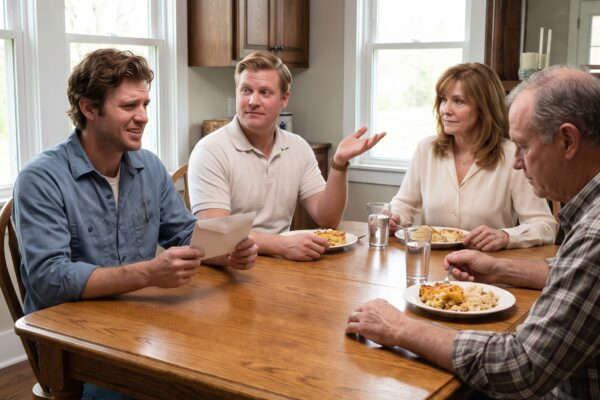
We sat at the kitchen table. Nobody touched the food.
Walter began.
“I know you’re upset, but disappearing for days—”
“I told you where I was.”
“You wouldn’t answer.”
“I’m answering now.”
I put my phone on the table and played the video.
It lasted less than half a minute.
Jessica watched her own hand reach around his neck.
Walter stared at the edge of the phone.
When it ended, he said, “It wasn’t supposed to happen.”
“How many times?”
Neither answered.
Jessica pulled her bag closer.
“Kim, you’ve been distant for a long time.”
I looked at her.
“You could have talked to me.”
“You’re always working.”
“So you talked to my husband.”
Walter leaned forward.
“Leave her out of this.”
For ten years, I had heard him defend me in arguments about late fees, bad service, a mechanic’s mistake.
Now he used the same voice for her.
I took out the photograph of the tablet notifications.
“Tell me about the tea.”
Jessica stopped moving.
Walter glanced at the photograph, then away.
“You weren’t sleeping.”
“What did you put in it?”
“Something to help.”
“Without asking me?”
“I wasn’t trying to hurt you.”
Lily stood.
“That’s enough for tonight.”
I held up one hand. There was one more thing I had brought.
Jessica’s loan agreement was three pages long.
We had signed it at this table six months earlier, back when she was excited about a new series of brand contracts and needed money to get established.
The thirty-five thousand dollars had covered moving costs, rent and a deposit, camera equipment, furniture for a small work area, and business expenses while she waited for invoices to be paid.
I had transferred it from savings I kept separately.
She had made the first two monthly payments.
Then there had been reasons.
A late-paying client. An unexpected tax bill. A contract that would make everything right next month.
I laid the agreement in front of her.
“You’re behind.”
She didn’t look at it.
“Seriously? Right now?”
“Yes.”
“After everything, you’re worried about money?”
“I’m worried about several things.”
Jessica gave a small, disbelieving laugh.
“I thought you wanted to help me.”
“I did.”
“You said we were family.”
“We are. You also signed an agreement to repay me.”
Walter pushed his chair back.
“You’re making this ugly.”
I looked at the plates he had set out, the food getting cold, the woman sitting in my kitchen wearing a gift from me.
“I’ve hired a lawyer,” I said. “I’m filing for divorce.”
Walter’s expression changed.
“You don’t mean that.”
“I do.”
“Kimberly, ten years. You don’t throw away ten years over—”
He stopped.
I waited.
He couldn’t finish the sentence without saying what he had done.
Jessica stood first.
“Come on, Walter.”
He looked at her, then at me.
That was the answer to something I hadn’t asked.
Lily picked up my suitcase.
I took Cooper’s leash, and we left before either of them could turn it into another argument.
The next week was mostly paperwork.
I signed the divorce filing. Sarah requested temporary arrangements to protect the accounts and address who would remain in the house while the case proceeded.
I gathered old bank statements and mortgage records.
At the store, I counted inventory twice because I no longer trusted my concentration.
Walter’s attorney contacted Sarah.
Jessica stopped calling.
Then, on a Wednesday afternoon, my work phone rang.
“May I speak with Kimberly Collins? This is a closing coordinator calling about the property in Birmingham.”
I thought it was a mistake.
“I’m Kimberly. What property transaction?”
The woman paused.
“A proposed sale. Before we send the seller documents, we need to verify some information directly with you.”
“I’m not selling my house.”
She asked me to repeat that.
I did.
Then I asked for her name, company, and file reference. I ended the call and found the company’s published number myself.
When I called back, I was transferred to the same woman.
She had already notified her supervisor.
A purchase agreement bearing my name had been submitted to their office. The person coordinating the sale had supplied contact information and a copy of identification.
One detail in the file hadn’t matched cleanly with their verification process, so they had used an independently located telephone number.
Mine.
I asked them not to proceed and called Sarah.
She answered while I was still standing in the stockroom.
“Tell me exactly what they said.”
The company sent the disputed agreement through a secure channel after verifying my identity.
My address was on the first page.
My name was on the last.
The signature looked like something assembled from a memory of mine.
The agreed price was roughly eighty thousand dollars below what a recent market comparison suggested the house might bring.
There was also a supposed authorization allowing Walter to handle communications while I was unavailable.
I had never signed it.
Sarah contacted the company and the buyer’s representatives. The closing file was placed on hold while the suspected impersonation was investigated.
No sale proceeds had been released. No deed had been recorded transferring my ownership.
It was serious enough without imagining we had stopped a completed sale by seconds.
I sat beside Sarah while she asked for copies of the supporting documents.
One of them used an email address almost like mine.
One letter was different.
I kept looking at that letter.
Walter had slept beside me while someone created it.
The sale discussions had started before I left the house. Appointments had been arranged for times when I was at the store. He had explained that I worked long hours and preferred him to handle details.
The buyer had been told we needed a quiet, quick sale because we were relocating.
Hawaii had been unaffordable.
Apparently, leaving with Jessica had been worth planning.
The buyer’s name was Nina Brooks.
I learned about her children from her, not from the contract.
Her agent asked whether I would be willing to speak with her after the transaction had been stopped. Sarah said I could, as long as I didn’t make promises about money or try to investigate anyone myself.
Nina called that evening.
“I didn’t know,” she said before I could speak.
“I believe you.”
“I saw the house twice. Your husband showed me the backyard. He said you loved it but wanted somewhere smaller.”
I closed my eyes.
“He said the price was low because you didn’t want the hassle of listing.”
“Did you pay anything?”
“Earnest money. It’s with the escrow company.”
“Your agent and attorney need to work with them on that.”
“I’m already doing that. I just wanted you to know I wasn’t part of it.”
In the background, a child asked whether they were still moving.
Nina covered the phone, but I heard enough.
When she came back, her voice had changed.
“My lease is ending this summer.”
“I’m sorry.”
“You don’t owe me an apology.”
We stayed on the line another minute, two women trying to be polite around damage neither had caused.
Afterward, I wrote her name in the notebook I had begun carrying.
Not under evidence.
On a clean page.
The house documents gave the investigation something concrete beyond my account of the tea.
Detective Harris, who was handling the Birmingham complaint, asked me to bring the records I had received through the closing company.
She reviewed the original video and the notification photograph too.
“Did you alter these?”
“No.”
“Did you go through his accounts?”
“No. That appeared on the tablet. I photographed it.”
She asked where the tablet was.
“At the house, last I knew.”
She wrote that down.
I wanted her to tell me they would have answers by Friday.
Instead, she explained that obtaining records and any devices would require the appropriate legal process.
“Keep everything,” she said. “Even messages that don’t seem important. And don’t contact them to get admissions.”
I nodded.
Then I asked the question that had followed me everywhere.
“What if I can’t prove what he put in the tea?”
“We investigate what we can establish,” she said. “You don’t have to solve the whole case before you report it.”
I cried in the parking lot after that.
Until then, some part of me had believed the burden was mine: to remember perfectly, preserve everything, stay calm, make the right decision at every moment.
I had already failed at several of those.
The report still existed.
The investigation still moved.
Over the following weeks, Harris contacted the people involved in the attempted sale.
The closing company preserved its file. The buyer and her agent provided communications. Records connected Walter to the messages sent under my name.
Eventually, investigators obtained authorization to examine relevant devices and accounts.
I learned the results in pieces, through Harris and Sarah when they were permitted to tell me.
There was a copy of my identification.
There were drafts of the disputed documents.
There were messages discussing money from the house and how soon Walter and Jessica could leave Michigan.
The earlier talk of changing the paperwork “next year” had become a more immediate plan after Jessica’s income dropped and I began asking questions.
That was the part I struggled with most.
They hadn’t merely imagined a future without me.
They had priced it.
Messages also supported my account of the tea. Walter had referred to giving me something so I would sleep while he went out. Jessica had asked whether it worked.
Those messages could not tell a doctor exactly what had been in my body on a particular night.
They did tell me that neither of them had misunderstood what was happening.
I asked Sarah whether I had to read the entire exchange.
“No.”
“Will I eventually?”
“Only if there’s a reason. I’ll tell you if there is.”
I let her keep the copies.
By then, I had begun renting a small apartment near Midtown.
Lily helped me carry boxes up the stairs, complaining that friendship should come with an elevator requirement.
Cooper inspected each room, drank from his bowl, and fell asleep on the rug as though we had always lived there.
I envied him.
My first grocery trip took almost an hour.
I kept reaching for things Walter liked. His cereal. His coffee. The mustard he insisted tasted different from every other brand.
At checkout, I had one bag of groceries and felt exhausted.
Some days were easier.
I could open the windows without hearing that the air-conditioning was on. I could eat scrambled eggs for dinner. I could leave a book facedown on the couch and find it there when I returned.
Other days, I missed him so abruptly that it made me angry.
I missed the man who used to warm my car on winter mornings.
Then I remembered him checking the empty mug.
Both memories belonged to him.
That was harder to accept than the simple version in which every good year had been a lie.
I started seeing a counselor. I kept working. I walked Cooper before dinner because the old evening routine unsettled me.
Lily came over on Thursdays, and sometimes we talked about paint colors or her students instead of my marriage.
I needed that more than advice.
The first public report appeared after charges were filed.
It was a short local article about an attempted property sale involving alleged impersonation and forged documents.
Walter’s name was in it.
So was Jessica’s.
I had been dreading that moment, yet reading it didn’t feel the way I expected.
The article contained none of the kitchen, none of the years Jessica spent at our family table, none of Walter’s hand resting on my back at my parents’ funerals.
It reduced everything to dates, allegations, and a statement that the defendants were entitled to contest the charges.
That was appropriate.
It was also startling.
A few weeks later, Harris told me warrants had been issued. Walter and Jessica were taken into custody at her apartment without the televised spectacle I had imagined after too many sleepless nights.
I wasn’t there.
I heard about it afterward.
They were subsequently released under conditions set by the court.
Walter’s employer placed him on leave while reviewing the situation. I learned that from correspondence his attorney provided about his income, not an anonymous newsroom source.
Jessica lost a brand contract. Later, another company stopped using her promotional work.
Her social media became quieter.
I stopped checking it.
Nothing on her page could answer why she had done this.
The temporary house issue took its own course.
Walter had remained there for much of the separation, even while spending nights at Jessica’s apartment. Through counsel, he resisted leaving and argued about expenses.
Sarah kept the disagreement in the court file.
When an order gave me temporary possession and set a deadline for him to move, she sent written arrangements for collecting his belongings and returning keys.
The deadline passed.
There were excuses about a truck.
Then storage.
Then a claim that I had taken things belonging to him.
I felt the old temptation to drive over and settle it myself.
Sarah told me what the next procedural step would be.
We followed it.
By the time a court officer attended the scheduled turnover, I had been away from the house for more than two months.
Sarah came with me. A locksmith waited in a van at the curb.
Walter opened the door.
Behind him, the living room looked wrong.
At first, I couldn’t understand why.
Then I saw the broken lamp.
The television screen had a long crack through it. Framed photographs lay facedown beside a box. One wall had writing across it in red lipstick.
GOLD DIGGER.
I stared at those words.
The house had been mine before we married.
It was such a foolish accusation that, for a second, it hurt more than something clever would have.
Jessica was in the kitchen.
She had apparently come to help Walter pack. Her suitcase stood beside his bags, though I didn’t know how many nights she had stayed there.
Nobody needed to explain that to me.
The officer explained the purpose of the attendance and the terms of the turnover.
Walter looked at Sarah.
“This is unnecessary.”
“The deadline was in the order,” she said.
He turned to me.
“You could have handled this privately.”
I looked at the wall.
“I tried talking to you at this table.”
Jessica pulled on her coat.
“We’re leaving.”
While the officer supervised the remaining collection, Sarah asked me to stay near the entry. She photographed the visible damage with my permission, and I took additional pictures for the records.
I didn’t delete them.
We would need estimates, receipts, and a clear account of what had changed.
Walter carried out two boxes, returned for a bag, and stood in front of me with the house key in his palm.
“You happy now?”
“No.”
He waited.
I didn’t give him anything else.
He placed the key on the narrow entry table.
Jessica walked past me without speaking.
No one handcuffed them for moving out. They left in separate cars, and the locksmith began changing the locks once the turnover was complete.
I went into the kitchen.
One blue mug remained beside the sink.
I asked Sarah for a bag.
I wrapped it, placed it in a box, and took it out of the house.
I couldn’t decide what to do with it yet.
I only knew I didn’t want to find it unexpectedly again.
Restoring the house took longer than I expected.
The contractor gave me an estimate, then discovered water damage under a section of flooring that had nothing to do with Walter or Jessica.
For a day, that ordinary inconvenience nearly broke me.
I sat in my car outside the house and laughed until I cried.
Even the repairs couldn’t stay neatly inside the story I wanted to tell.
We separated the older maintenance issues from the new damage. I paid for what needed doing and kept the invoices.
The lipstick took primer and several coats of paint.
The broken fixtures were replaced.
I donated things I no longer wanted and kept some things I had thought I would throw away.
My mother’s mixing bowl stayed.
So did the dining table.
It had belonged to my life before it belonged to that evening.
Jessica’s loan became a separate civil matter. Sarah referred that work appropriately, and the signed agreement, transfer records, and missed payments supplied the basis for pursuing it.
The criminal case did not magically turn every dollar Jessica owed me into restitution.
Some losses belonged in one proceeding. Some belonged in another.
I learned more about that distinction than I ever wanted to know.
I also learned that a judgment and money in a bank account were different things.
Recovery would take time.
I could accept that.
What I couldn’t accept anymore was pretending a debt disappeared because someone called me “sis.”
The divorce was finalized during the winter.
It took negotiations, records, and a property valuation.
I provided the documents from my purchase before the marriage. Walter’s attorney raised the payments and improvements made during it.
There were discussions I found infuriating.
Sarah reminded me that being furious did not make a financial question vanish.
In the final settlement, I retained the house. Other assets and obligations were divided, and the accounting addressed the claims and documented losses the parties resolved in that case.
I did not walk away with every dollar we had ever earned.
Walter did not receive ownership of the home he had tried to sell without me.
The judgment gave us an ending we could enforce.
At the courthouse, Sarah handed me my copy.
“Keep this somewhere you can find it.”
I put it in a folder labeled HOUSE, then changed the label later.
FINAL DOCUMENTS.
That felt more accurate.
Outside, snow had settled along the curb. I called Lily from my car.
“It’s done.”
“How do you feel?”
I looked at the folder on the passenger seat.
“Tired.”
“Good. Come over. I made chili.”
There was no speech I could have wanted more.
The criminal case continued into the following spring.
There were adjournments. There were discussions between attorneys that I wasn’t part of. There were days when no news made me wonder whether anything would happen.
The victim advocate explained the process when she could.
Eventually, Walter and Jessica accepted negotiated resolutions addressing the conduct prosecutors believed the evidence could establish.
Before the hearing, I was told what the agreements covered, what they didn’t, and what recommendations would be presented to the judge.
I did not get to select the punishment.
I did get to speak.
I wrote my statement at the kitchen counter in my apartment while Cooper slept under my stool.
The first draft was six pages.
The final one was less than two.
At the hearing, Walter looked older. Jessica kept folding and unfolding a tissue.
Walter apologized.
He said he had handled things badly.
When it was my turn, I held the paper with both hands.
“For weeks,” I read, “I thought the hardest thing was that my husband and my cousin wanted to be together. It wasn’t. They could have told me that. They made decisions about my body, my money, and my home because telling me the truth would have been inconvenient.”
I paused until I could continue.
“I don’t need either of them to agree with my account of what this cost me. I need the orders followed, the losses addressed, and the contact to stop.”
That was all I said.
The judge imposed five years of probation, community service, financial obligations based on documented losses, and other conditions explained in court.
The consequences were serious.
They also weren’t a promise that I would receive a large check the next morning.
Payments would be monitored under the orders. Separate civil obligations remained separate, and amounts already resolved elsewhere weren’t counted twice.
I listened carefully.
When the judge finished, I folded my statement and put it in my purse.
Outside the courtroom, Jessica said my name.
I turned.
She was standing beside her attorney.
For a moment, I saw the twelve-year-old who used to wait outside my bedroom when she couldn’t sleep.
That memory still existed.
So did everything since.
“I know you won’t believe me,” she began.
Her attorney touched her arm, reminding her of the boundaries around contact.
I looked at her for another second.
Then I left.
In the hallway, Lily took my elbow.
“Do you need to sit?”
“No. I need to get outside.”
The spring air was cold enough that we both zipped our coats.
We walked to the parking garage without discussing them.
I had kept Nina’s number.
Her earnest money had been returned months earlier after the canceled transaction was properly resolved. She had found a short extension on her lease and was still looking for a house.
I knew because she had sent a brief message thanking me for speaking with her, and we had exchanged occasional updates since.
Once the divorce was complete and Sarah confirmed I could proceed, I called her.
“I’m going to sell,” I said.
There was a pause.
“The house?”
“Yes.”
“Are you sure?”
“I am. Would you still be interested in seeing it?”
She didn’t answer immediately.
“I don’t want you to feel obligated.”
“I don’t.”
We used agents and a title company. Nina had her own inspections and financing. I signed my own documents, in my own name, after reading them.
The fresh appraisal came in above the amount in the original fraudulent agreement.
I reviewed the numbers carefully.
I could have listed publicly and tried for more.
Instead, after considering the repairs, the carrying costs, and what I wanted from the next few months, I chose to offer Nina the earlier price.
It was a real concession.
I could afford it without jeopardizing my plans, and I preferred a straightforward sale to beginning another round of showings.
I didn’t call it fate.
It was a choice.
For once, everyone involved knew whose choice it was.
Nina brought her children on their final walk-through.
Her son ran straight to the back window.
“There’s room for a dog.”
“We’ve discussed this,” Nina said.
“A small dog.”
Her daughter opened a closet and announced that she had found the perfect place for board games.
I stood in the hallway and listened.
The house sounded different with people making ordinary plans in it.
Nina came beside me.
“You okay?”
“Yes.”
It surprised me that I meant it.
At closing, she checked every page and asked questions when she needed to.
I liked that about her.
Afterward, I handed over the keys I had received from the locksmith.
She hugged me.
“Thank you for giving us another chance at it.”
“Thank you for still wanting it.”
When I drove away, I didn’t stop at the end of the street to look back.
I had already said goodbye in the rooms that mattered.
That afternoon, I bought groceries for my apartment and remembered to get the mustard I liked.
Life in Midtown settled around smaller routines.
Cooper learned which neighbor kept treats in her coat pocket. I found a diner where the waitress remembered my order but didn’t ask why I sometimes came alone on Sunday mornings.
Lily helped me hang two prints above the couch.
I bought curtains without sending a photograph to anyone for approval.
At the store, I stopped making mistakes in the inventory count.
Some evenings, I still checked the lock twice.
When someone unexpectedly offered me a cup of tea, my stomach tightened.
My counselor and I worked on that.
I didn’t force myself to recover on a schedule that would make the story look finished.
I had good weeks and difficult afternoons.
On my birthday, Lily brought cupcakes and asked what I wanted to do next.
“Something that has nothing to do with paperwork,” I said.
“Excellent category.”
I looked toward the small desk I had set up by the window.
For years, I had talked about recording conversations with women starting over after changes they hadn’t chosen.
Divorce. Retirement. Losing a business. Becoming a caregiver.
I had always put it off.
“I think I want to try the podcast.”
Lily took another cupcake.
“Then try it.”
I called it Silent No More.
The first microphone I bought picked up the refrigerator hum so loudly that I returned it.
The second worked after I learned where to place it.
Lily was my first guest.
We recorded in my apartment with blankets arranged to soften the echo. Cooper interrupted twice by shaking his collar.
I started with a polished introduction I had rewritten for three evenings.
Halfway through, Lily held up her hand.
“You don’t sound like yourself.”
“I’m trying to sound prepared.”
“You sound like you’re selling a dishwasher.”
I laughed hard enough that we had to start again.
The version we kept began with me admitting I had no idea how to do this properly.
Then we talked.
About staying on the phone with someone who was frightened. About giving a friend a place to sleep. About how practical help could matter more than the perfect sentence.
We didn’t name Walter or Jessica.
Sarah had reviewed the limited references I intended to make to my own experience, and I avoided turning the show into an ongoing account of their cases.
Their names had already taken up enough room in my life.
The first episode had forty-three listeners that week.
One was my dentist.
Lily claimed she had personally recruited at least eleven.
I was pleased anyway.
I had made something.
In May, I ordered a simple white-gold ring through the store.
Working around jewelry every day had taught me that the pieces people chose for themselves often carried the stories they found hardest to explain.
I wanted something plain enough to wear while counting stock or walking Cooper.
Inside the band, I asked for one word.
Resilience.
When it arrived, I put it on my right hand.
A colleague admired it.
“Special occasion?”
“Sort of.”
She smiled and went back to arranging the display.
I appreciated not having to say more.
That weekend, I pulled my old suitcase from the closet.
The handle had cracked during the move, and one wheel dragged. It was the suitcase I had taken to Lily’s apartment, with clothes packed badly and Cooper’s food tucked beside my shoes.
I emptied the last pocket.
An old grocery receipt. A hair tie. The luggage tag from a trip Walter and I had taken years earlier.
I removed the tag and set the suitcase aside for disposal.
Then I ordered a teal one.
For three nights, I compared flights to Hawaii.
I checked my vacation balance with the store owner. Lily agreed to keep Cooper. I chose dates, booked a room within my budget, and paid the deposit.
The confirmation arrived while I was folding laundry.
I sat on the floor beside the basket and read it twice.
A year after I left the house, I recorded an anniversary episode.
Not an anniversary of the arrest or the divorce.
The evening I had finally loaded Cooper into the car and gone somewhere safe.
By then, the podcast had a modest audience that returned regularly. Some episodes reached a few hundred people. One conversation about money after divorce had traveled much farther because listeners shared it.
Letters and emails arrived from places I had never been.
A woman in Dallas wrote that she had opened a checking account in her own name.
A retired nurse in Seattle said she had called her sister after listening.
A widow in New York sent a postcard with a photograph of the first apartment she had chosen by herself.
I kept those messages in a box beside my desk.
For the anniversary recording, I didn’t prepare a speech about becoming stronger.
I described the first grocery trip.
The mustard.
The way Lily had heated two dinners because I couldn’t decide.
The fact that I had left photographs of the damage in a folder instead of looking at them every night.
“There were people who helped me,” I said. “There were also things I had to do while I was still scared. I wish someone had told me those two things could happen together.”
I stopped to take a drink of water.
Cooper stirred beneath the desk, bumped my ankle with his nose, and settled again.
I left that sound in the recording.
A week later, I stood at the airport with my teal suitcase.
Lily had sent a photograph of Cooper asleep on her couch beneath a blanket he had apparently claimed as his own.
My boarding pass was on my phone.
For years, Hawaii had existed between Walter and me as a promise neither of us quite admitted we had stopped keeping.
Now it was a departure time.
A gate.
A room I had booked myself.
The gate agent called my group. I slipped my phone into my bag and stood.
My mother’s silver pendant rested beneath my shirt. The ring on my right hand caught briefly on the suitcase handle.
I adjusted my grip.
Then I joined the line.